Does Coconut Oil Turn Into Monolaurin in Your Body?
You may have heard a tidy three-step story: coconut oil is rich in lauric acid, your body turns lauric acid into monolaurin, and monolaurin is a germ-fighting compound. The first step is solid fact, the last has real laboratory support, and the middle one, the conversion itself, is where the published evidence goes quiet. It is a good example of how a chain of plausible links can be stronger at the ends than in the center, so let us walk it from both sides.
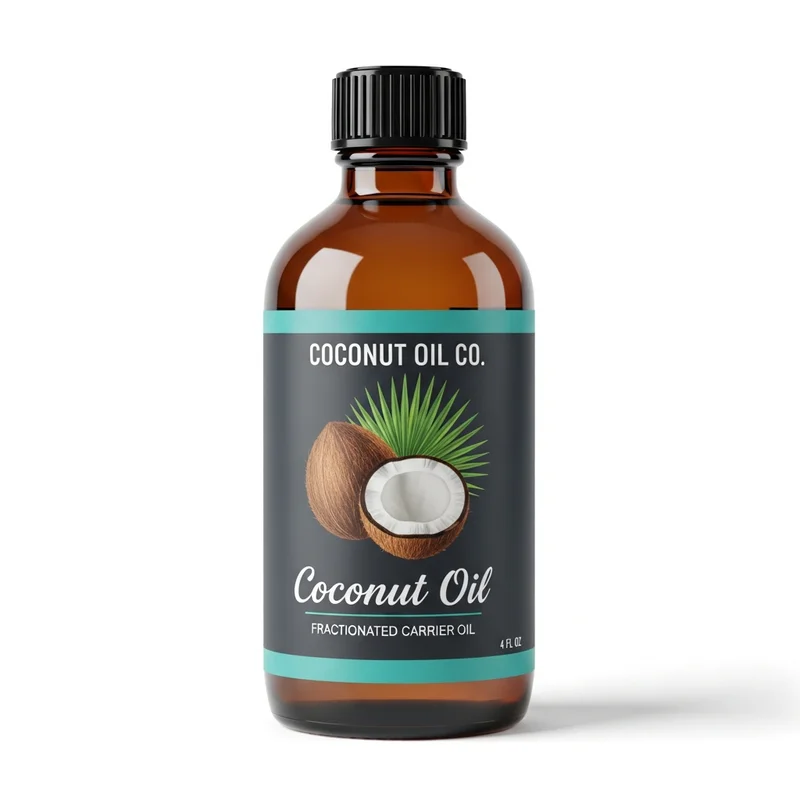
Fractionated Coconut Oil
Our own Fractionated Coconut Oil, in sizes from 0.5 oz to bulk.
From $9.99
Shop Now →Step one: coconut oil really is rich in lauric acid
This part is easy to confirm. The USDA lists 41.84 g of lauric acid per 100 g of coconut oil (FDC 171412), and a 2018 review puts it at about 49% of the fatty acids (Lin et al., 2018). Nearly all of it is bound to glycerol as a triglyceride, three fatty acids on one glycerol, rather than floating free. That detail matters in a moment. Our germ-claims article covers the lauric acid side in full.
Step three first: what monolaurin has done in the lab
Monolaurin, also called glycerol monolaurate (GML), is one lauric acid on a glycerol instead of three. It is an ordinary ingredient: a 1994 paper described it as a surfactant widely used as an emulsifier in food and cosmetics, and showed it could block staphylococcal toxin and beta-lactamase production at the level of transcription (Projan et al., 1994). The best-known virus result is older still. In 1982, researchers tested monolaurin against 14 enveloped human viruses in cell culture and saw infectivity fall by more than 99.9% at 1% for one hour at 23 C, with the viral envelope disintegrating (Hierholzer and Kabara, 1982).
Look at the setting. One percent monolaurin in a reaction mixture is a test tube concentration, and reasoning from that figure, a spoonful of coconut oil would need to deliver something similar at a target site to resemble the experiment. The abstract does not claim it does. Monolaurin has its own limits too: a 2009 PLoS One paper begins from the observation that Staphylococcus aureus lipase degrades GML, which is why its authors tested a more stable analogue (Lin et al., 2009).
Step two: does the body make it from coconut oil?
This is the interesting part. During digestion, lipases clip fatty acids off the outer positions of a triglyceride, and what can remain is a monoacylglycerol, a glycerol holding one fatty acid, which the gut absorbs and rebuilds into fat (Innis, 2011, writing about milk fat). So a monoglyceride is a normal intermediate of fat digestion, and that is the kernel of truth behind the idea. But a monoglyceride that is absorbed and reassembled into fat is not the same as monolaurin circulating at lab concentrations, and a review of medium-chain fat absorption notes that roughly 60% of lauric acid travels by the portal vein, the route for free fatty acids (Watanabe and Tsujino, 2022). We searched for a study that measured monolaurin levels after people ate coconut oil and did not find one, so the conversion is an open question and not a disproven one.
Downstream evidence is thin as well. A 2019 narrative review searched PubMed for monolaurin and its synonyms and found 28 articles with clinical relevance. Many described antimicrobial effects in vitro, only 3 peer-reviewed papers showed in vivo antimicrobial effects in humans (all topical, intravaginal or intraoral), and none supported monolaurin as a dietary supplement beyond its role as a nutrient (Barker et al., 2019). That review is about monolaurin taken directly, so it does not settle the conversion question, but it shows where the human evidence currently stands.
Where monolaurin clearly shows up: human milk
There is one place where GML is plainly present. A 2019 study measured about 3,000 micrograms per milliliter in human milk, against 150 in bovine milk and none in infant formula. Removing lipophilic molecules including GML from human milk removed its antibacterial activity in the lab, and adding GML back restored it. One Enterococcus faecalis strain was not inhibited, so even there some bacteria shrug it off (Schlievert et al., 2019). It is a fascinating result about milk, not about coconut oil, adults or supplements, and anything to do with infant feeding is a pediatrician's call.
What this means when you choose an oil
Anyone who wants monolaurin itself can find it sold as a separate ingredient and as a supplement by other companies, and we sell neither. Our fractionated coconut oil is a cosmetic carrier oil that we describe as leaving only the medium-chain triglycerides, and our virgin unrefined oil is also for external cosmetic use. The certificate of analysis we publish for one fractionated batch shows density, refractive index and optical rotation, with no fatty-acid profile, and we make no claim that either oil gives you monolaurin. Reasoning from the sources above, the conversion that a monolaurin hope would rest on has not been shown, so we would choose our oils for what they do for skin and hair and for blending.
That restraint is also how cosmetic law works. The FDA says a product's intended use decides whether it is a cosmetic or a drug, and claims in labeling, advertising and online count as evidence of intent (FDA).
If you are shopping for a monolaurin capsule
Good questions to ask the seller: what is actually in it (GML itself, lauric acid or coconut oil), how much is in a serving, and whether the study they cite used that product, at that dose, by that route. A cell-culture result at 1% and a capsule are different exposures. A pharmacist or physician can speak to dosing and interactions. For the better-documented diet question, our heart post covers coconut oil and cholesterol, and what fractionated coconut oil is explains the difference between our two oils.
Fractionated Coconut Oil
Fractionated Coconut Oil from our own shop, in sizes from 0.5 oz to bulk.
From $9.99
Shop Now →Sources & Further Reading
- USDA, 2019. FoodData Central, Oil, coconut (SR Legacy, FDC ID 171412). fdc.nal.usda.gov/171412
- Lin TK, Zhong L, Santiago JL, 2018. Anti-inflammatory and skin barrier repair effects of topical application of some plant oils. Int J Mol Sci 19(1):70. PMC5796020
- Projan SJ et al., 1994. Glycerol monolaurate inhibits the production of beta-lactamase, toxic shock toxin-1, and other staphylococcal exoproteins by interfering with signal transduction. J Bacteriol 176:4204-4209. pubmed/8021206
- Hierholzer JC, Kabara JJ, 1982. In vitro effects of monolaurin compounds on enveloped RNA and DNA viruses. J Food Safety 4:1-12. pubmed/32336838
- Lin YC et al., 2009. Glycerol monolaurate and dodecylglycerol effects on Staphylococcus aureus and toxic shock syndrome toxin-1 in vitro and in vivo. PLoS One 4:e7499. pubmed/19838303
- Innis SM, 2011. Dietary triacylglycerol structure and its role in infant nutrition. Adv Nutr. pubmed/22332059
- Watanabe S, Tsujino S, 2022. Applications of medium-chain triglycerides in foods. Front Nutr 9:802805. PMC9203050
- Barker LA, Bakkum BW, Chapman C, 2019. The clinical use of monolaurin as a dietary supplement: a review of the literature. J Chiropr Med 18:305-310. pubmed/32952476
- Schlievert PM et al., 2019. Glycerol monolaurate contributes to the antimicrobial and anti-inflammatory activity of human milk. Sci Rep 9:14550. pubmed/31601928
- US FDA. Is it a cosmetic, a drug, or both? fda.gov/cosmetics