Using Coconut Oil on Babies: What the Guides Say
New parents get a lot of advice about baby skin, and coconut oil shows up in nearly all of it, usually with total confidence in one direction or the other. We think the real picture is more reassuring and more interesting than either camp lets on. Pediatric guidance gives coconut oil a small, specific job, and the best baby skin routine turns out to be a surprisingly short one.

Fractionated Coconut Oil
Our own Fractionated Coconut Oil, in sizes from 0.5 oz to bulk.
From $9.99
Shop Now →Babies need less than the internet suggests
The American Academy of Pediatrics says three baths a week may be plenty in the first year, because more can dry the skin out. It also suggests leaving the vernix, the waxy white coating on a newborn, alone for a while, since it works as a natural moisturizer. After a bath, its suggestion is a small amount of fragrance-free moisturizing lotion, and that bathing page does not mention oils at all (AAP HealthyChildren, 2025).
We like that as a sense of proportion. Coconut oil is a handy tool for particular moments, and a gentle baby routine does not depend on it. The same thinking applies to eczema prevention. The large BEEP trial followed 1,394 newborns with a family history of allergic disease and found that a daily emollient through the first year made no difference to eczema at age 2 (23% versus 25%), so its authors advised against using daily emollients to try to prevent it (Chalmers et al., Lancet, 2020). The trial did not use coconut oil, but it answers the question many parents carry.
Cradle cap, the one place coconut oil gets a mention
Cradle cap is those yellowish, scaly patches on a baby's scalp. The AAP describes it as common, not an allergy or an infection, and not a sign of poor hygiene, and says it usually fades by itself within weeks or months. For stubborn scales, it suggests a little mineral oil, coconut oil or petroleum jelly left on overnight to soften them, with a call to the pediatrician if the area turns crusted, weepy or bumpy with pus (AAP, updated October 2023).
The UK's NHS gives a very similar picture: massage a little emollient or coconut oil into the scalp to loosen the scales, brush gently with a soft brush, then wash with baby shampoo. It also lists what to skip, including olive oil, peanut oil, soap, adult shampoo and anything fragranced, and it points parents to a pharmacist for advice on emollients and unperfumed shampoos (NHS, reviewed October 2025). Our cradle cap explainer walks through both pages, and our olive oil comparison shows why that one sits on the NHS skip list.
It helps to know that the formal evidence is modest. A Cochrane review of infant cradle cap treatments found six small trials covering 310 infants, none of which tested mineral or vegetable oils, and rated the certainty of the evidence very low (Victoire et al., 2019). So the oil is a gentle, practical step that two respected health bodies describe, and that is the whole of the claim.
What the hospital studies looked at
Most of the research on coconut oil and infants comes from neonatal units, where the question is about very premature babies. In one open-label randomized trial, 72 babies born before 30 weeks received either routine care or coconut oil at 5 mL per kg twice daily for 21 days. Skin condition scores held steady in the coconut group and slipped in the comparison group, with no adverse effects reported (Strunk et al., 2018). A review pooling seven trials of 727 preterm infants noted fewer hospital-acquired bloodstream infections in the coconut oil groups, though that rested on moderate-quality evidence from just two trials (Pupala et al., 2019). The broader Cochrane review of emollients for preterm infants, with 22 trials and 5,578 infants, rated its certainty low and asked for better trials (Cleminson and McGuire, 2021).
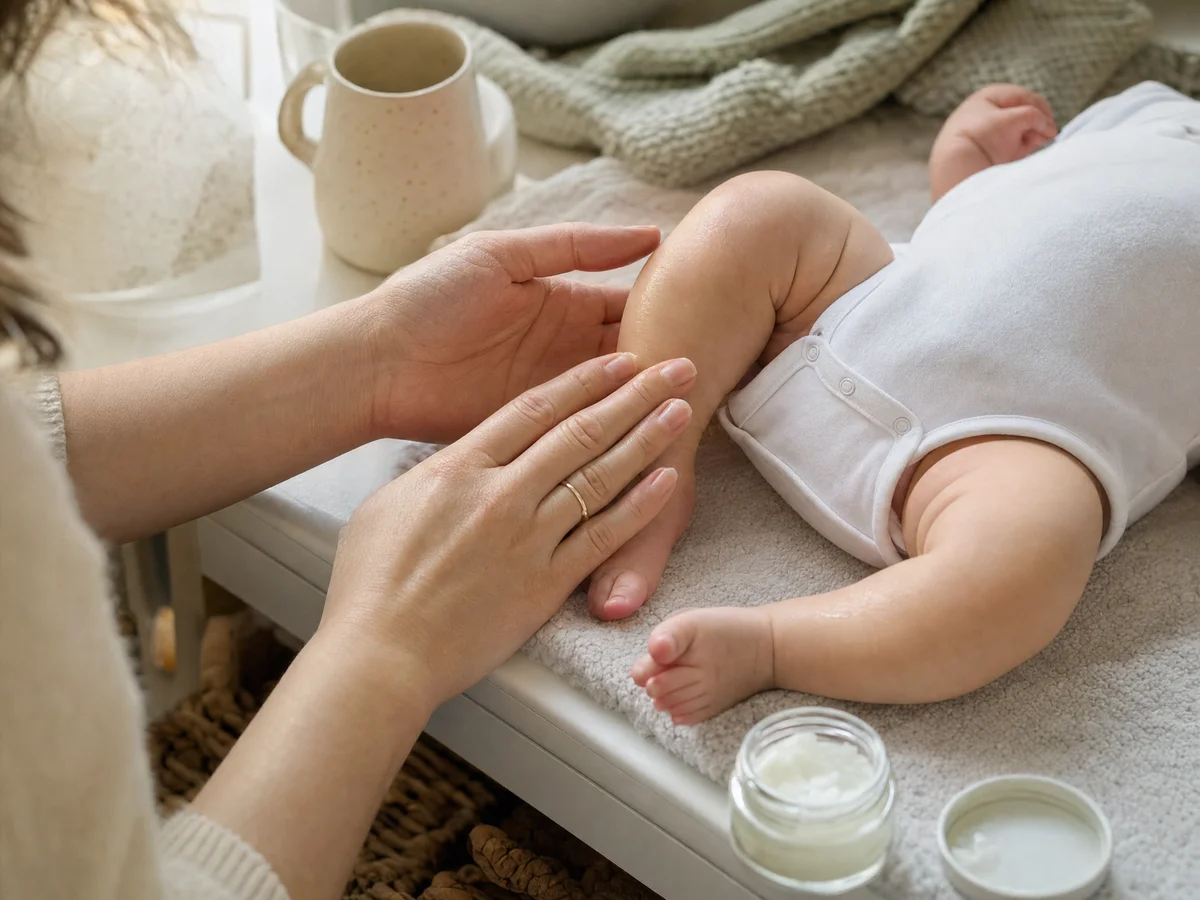
These are tiny premature babies in a hospital, with oil dosed by body weight and applied by staff. A healthy full-term baby at home is a different situation, and the studies are best read as a window into neonatal care, not a recipe for the nursery.
A note on eczema and allergy
A trial in Manila gave 117 children with mild to moderate atopic dermatitis either virgin coconut oil or mineral oil for eight weeks, and the coconut group's eczema scores fell further (68% versus 38%) (Evangelista et al., 2014). Those children already had a diagnosis and used virgin oil, so the result belongs in a conversation with a pediatrician or dermatologist. Our eczema and psoriasis article goes through that trial in more depth.
On allergy, the FDA stopped treating coconut as a major food allergen for labeling in January 2025, and coconut no longer belongs on the tree nut list for food labels (FDA allergen labeling FAQ). That is a food labeling decision, and food allergy groups were quick to say it does not mean nobody reacts to coconut (FARE, 2025). Hives, swelling, vomiting or trouble breathing after anything touches a baby's skin means stopping and getting medical help right away. More in our coconut oil allergy FAQ.
Where we fit in
We sell coconut oil for external cosmetic use, and we do not sell baby products or make baby claims. Our fractionated coconut oil stays liquid at any temperature and is virtually odorless, while our virgin unrefined coconut oil is firm in a cool room and smells of coconut. The one certificate of analysis we publish covers a single fractionated batch and reports appearance, smell, density, refractive index and optical rotation, and no microbial or contaminant data, so anyone weighing an oil for an infant should keep that in mind. The children's skin trial above used virgin oil, and whether fractionated oil behaves the same way is an open question.
For any particular baby, a pediatrician is the right person for rashes, anything weepy or crusted, premature babies and babies with known eczema or allergies, and a pharmacist can help with which emollients and shampoos suit. If cradle cap is what brought you here, start with the AAP and NHS pages above. For most babies it fades on its own, and the best part of the plan is how little there is to do.
Fractionated Coconut Oil
Fractionated Coconut Oil from our own shop, in sizes from 0.5 oz to bulk.
From $9.99
Shop Now →Sources & Further Reading
- American Academy of Pediatrics (HealthyChildren.org), 2023. Cradle cap. healthychildren.org
- American Academy of Pediatrics (HealthyChildren.org), 2025. Bathing your baby. healthychildren.org
- NHS, 2025. Cradle cap. nhs.uk/conditions/cradle-cap
- Victoire A et al., 2019. Interventions for infantile seborrhoeic dermatitis (including cradle cap). Cochrane Database Syst Rev. pmc/PMC6397947
- Strunk T et al., 2018. Topical coconut oil in very preterm infants: an open-label randomised controlled trial. Neonatology. pubmed/29197867
- Pupala SS et al., 2019. Topical application of coconut oil to the skin of preterm infants: a systematic review. Eur J Pediatr. pubmed/31267223
- Cleminson J, McGuire W, 2021. Topical emollient for preventing infection in preterm infants. Cochrane Database Syst Rev. pubmed/33961715
- Evangelista MTP et al., 2014. Topical virgin coconut oil in mild to moderate pediatric atopic dermatitis. Int J Dermatol. pubmed/24320105
- Chalmers JR et al., 2020. Daily emollient during infancy for prevention of eczema: the BEEP randomised controlled trial. Lancet. pubmed/32087126
- FDA. Food allergen labeling guidance FAQ (coconut). fda.gov
- FARE, 2025. Update: FDA guidance on food allergen labeling. foodallergy.org