Olive Oil vs Coconut Oil for Skin: What the Research Says
Olive oil is the bottle most of us already own, so it is often the first thing we reach for on dry skin. That is what makes one particular forearm study so worth knowing about. Over four weeks, olive oil lowered the integrity of the skin's outer layer and caused mild redness, while sunflower seed oil did not. It is a small study, but it neatly challenges the idea that anything natural and edible must be kind to skin. Here is what it did, how coconut oil fits in, and how we would choose.
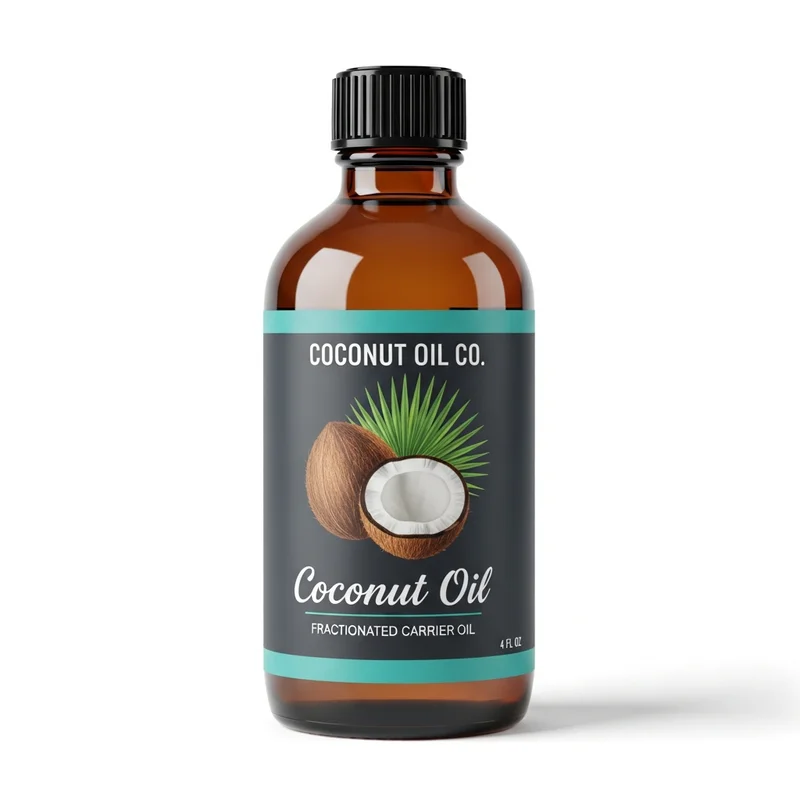
Fractionated Coconut Oil
Our own Fractionated Coconut Oil, in sizes from 0.5 oz to bulk.
From $9.99
Shop Now →What the forearm study did
Danby and colleagues ran two randomized forearm studies in 19 adult volunteers, some with a history of atopic dermatitis and some without. Everyone applied six drops of olive oil to one forearm twice a day. In the second study, the other forearm received sunflower seed oil. After four weeks, olive oil had significantly reduced the integrity of the stratum corneum, the skin's outer barrier layer, and caused mild redness in both groups. Sunflower seed oil preserved integrity, caused no redness and improved hydration. The authors concluded that olive oil should be discouraged for dry skin and infant massage (Danby et al., 2013).
No coconut oil was in the study, and forearms are not faces, so think of it as a useful flag and not a ranking of every oil.
Why oils might differ
A review of botanical skin oils connects olive oil's irritation reputation partly to its polyphenols and squalene, and notes that oils lowest in oleic acid carry a lower risk of irritant contact dermatitis (Moore, Wagner and Komarnytsky, 2020). Olive oil is mostly oleic acid. Coconut oil is about 49% lauric acid, 18% myristic, 8% palmitic, 8% caprylic and only 6% oleic (Lin, Zhong and Santiago, 2018). Reasoning from those two facts, coconut oil carries far less of the fat tied to barrier disruption, which is a point in its favor. It is not a promise for every skin type: the same Moore review links coconut oil to breakouts on skin that is not very dry, so a patch test is a good habit if your skin tends to get breakouts.
The one trial that used both
One trial compared virgin coconut oil with virgin olive oil in 52 adults with atopic dermatitis, 26 per oil, applied twice daily for four weeks. Both oils lowered a severity score, more so with coconut. Staphylococcus aureus was found in 20 coconut-group and 12 olive-group participants at the start, and afterward in 1 of the coconut group (5%) and 6 of the olive group (50%) (Verallo-Rowell et al., 2008).
That result comes from people with a skin condition, and managing eczema belongs with a dermatologist or pediatrician, so file it under interesting rather than instructional. It also used virgin coconut oil. We make fractionated coconut oil so that only the medium-chain triglycerides remain, so we cannot say a virgin-oil result carries over to it.
How we would choose
We make coconut oil, not olive oil, so here is how we would walk someone through it, reasoning from the studies above.
- Kitchen olive oil as a body or face moisturizer: the controlled barrier study argues for something else, especially for dry or eczema-prone skin.
- Eczema, yours or your child's: ask a pediatrician or dermatologist before using either oil.
- Breakout-prone skin: comedogenic scales are contested, and our post on pores explains why a chart number is a weak guide.
- A light liquid to scent with a favorite essential oil: fractionated coconut oil, which is fast-absorbing, non-greasy and liquid at any temperature.
- The coconut aroma and a creamier feel: virgin unrefined, firm in a cool room and soft in warm hands.
If you do try a coconut oil on your arms or legs, start small. A few drops warmed between your palms spread much further than you expect, and the skin should feel smooth rather than slick after a minute or two. If it still feels greasy, you used more than you needed.
Both of our oils are for external cosmetic use. Patch test a small area and wait 24 hours, keep oil away from your eyes, and check with a professional first if you have a tree nut or coconut allergy.
Feel, and the label on the bottle
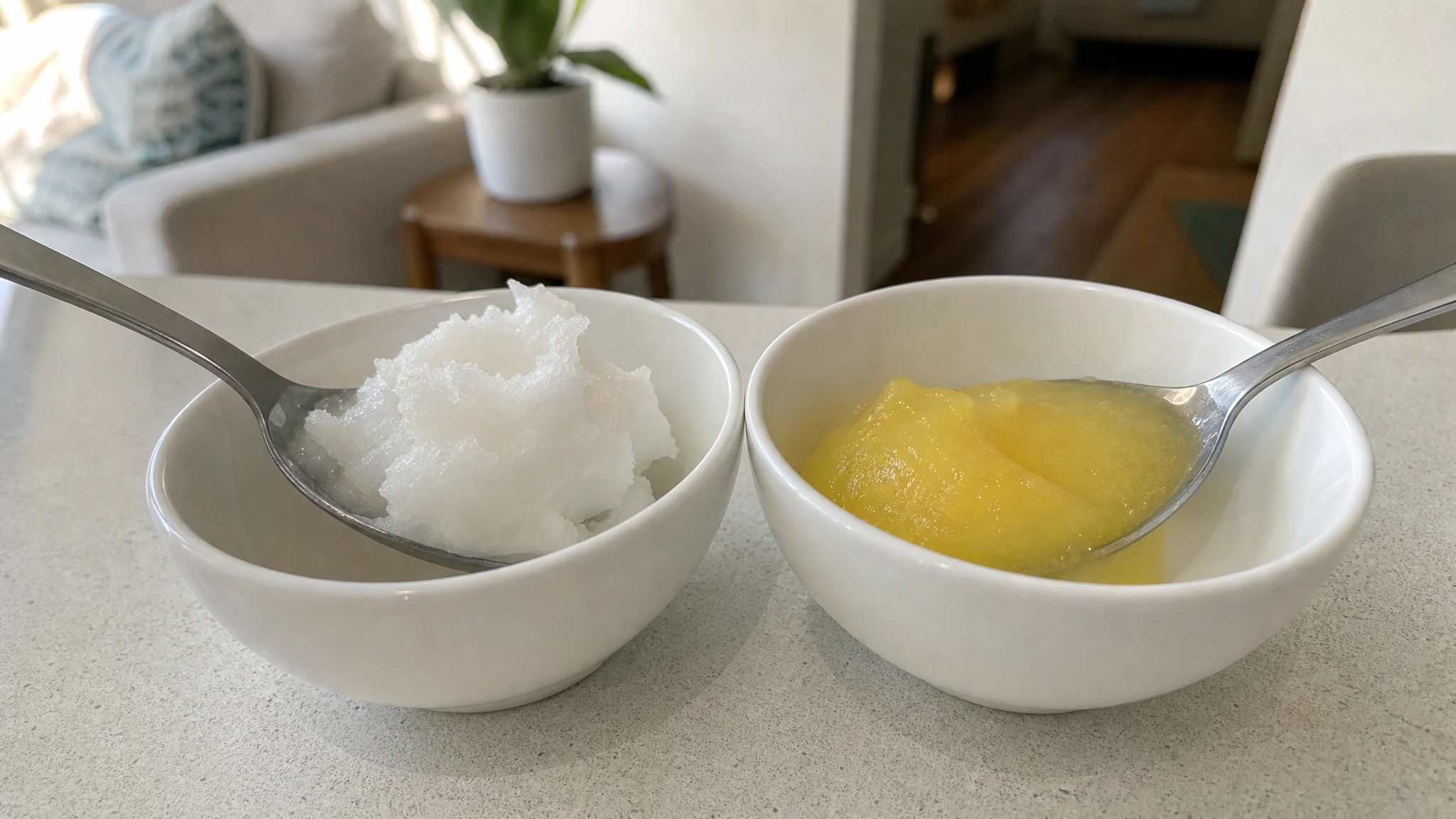
Open each bottle and the difference is plain: our virgin unrefined greets you with a coconut aroma, while we describe the fractionated as virtually odorless.
Plenty of comparisons say olive oil feels heavy and coconut oil absorbs fast. We did not find a controlled comparison of feel in our reading, so we will stick to our own products: fractionated is liquid and non-greasy, and virgin unrefined sets firm below about seventy-six degrees Fahrenheit, which changes how you apply it more than any absorption difference would.
Labels matter more than they look. A bottle that says only "olive oil" or "coconut oil" does not reveal the grade or the refining, and virgin and fractionated coconut oil are very different materials. The certificate we publish for one fractionated batch shows density, refractive index and optical rotation, and no fatty-acid profile, so if you need more detail, ask in writing before ordering, from us or anyone else.
A note about babies
The Danby authors specifically advise against olive oil for infant massage. We do not sell baby products or make claims about babies, and a pediatrician is the right person to ask about what goes on an infant's skin. Our baby skin article covers what studies and public guidance say.
Weighing coconut oil against other bases? Coconut versus jojoba and coconut versus mineral oil are good next stops, the hair comparison covers a different question, and our skin overview lines up the coconut oil studies in one place.
Fractionated Coconut Oil
Fractionated Coconut Oil from our own shop, in sizes from 0.5 oz to bulk.
From $9.99
Shop Now →Sources & Further Reading
- Danby SG et al., 2013. Effect of olive and sunflower seed oil on the adult skin barrier: implications for neonatal skin care. Pediatr Dermatol 30(1):42-50. pubmed.ncbi.nlm.nih.gov/22995032
- Verallo-Rowell VM et al., 2008. Novel antibacterial and emollient effects of coconut and virgin olive oils in adult atopic dermatitis. Dermatitis 19(6):308-15. pubmed.ncbi.nlm.nih.gov/19134433
- Moore EM, Wagner C, Komarnytsky S, 2020. The enigma of bioactivity and toxicity of botanical oils for skin care. Front Pharmacol. pmc.ncbi.nlm.nih.gov/articles/PMC7272663
- Lin TK, Zhong L, Santiago JL, 2018. Anti-inflammatory and skin barrier repair effects of topical application of some plant oils. Int J Mol Sci 19(1):70. pmc.ncbi.nlm.nih.gov/articles/PMC5796020