Is Olive Oil or Coconut Oil Better for Frying?
Ask which oil is best for frying and someone will hand you a smoke-point chart. It looks authoritative, but it is a blunt tool. Two oils with similar smoke points can behave very differently after an hour at frying temperature, and the studies that follow oils through repeated use tell a more useful story. For olive oil and coconut oil, that story is pretty friendly, as long as you pick the right version of each.

Fractionated Coconut Oil
Our own Fractionated Coconut Oil, in sizes from 0.5 oz to bulk.
From $9.99
Shop Now →What a smoke point tells you, and what it skips
A smoke point is the temperature where an oil starts giving off a steady bluish smoke under set test conditions. You can spot it in your own pan, but published numbers for the same oil scatter widely. A 2024 review explains that smoke point depends mainly on free fatty acids and calls it not a precise indicator (Abrante-Pascual et al., 2024). A hands-on example: in Milk Street's skillet test, refined olive oil first smoked at 449 F and refined coconut oil at 423 F, and they left out extra-virgin olive oil and unrefined coconut oil, which smoke lower (Milk Street, 2018).
Smoke simply tells you the pan is too hot. It says little about how the oil looks after five rounds of fries, which is what the heating studies measure.
What repeated frying showed
Two open-access studies put refined oils through repeated frying at 180 C and tracked total polar compounds (TPC), a standard marker of how far frying oil has broken down. They used different foods, schedules and comparison oils, so think of them as two snapshots rather than a race.
In the first, potato chips were fried for 80 batches in refined coconut oil, refined soybean oil, a pure olive oil (85% refined plus 15% virgin) and shortening. Refined coconut oil's TPC climbed from 2.8% to 8.1%, soybean oil reached 9.5%, and every oil stayed under the 24 to 27% rejection limit the authors cite. Coconut oil also showed the lowest conjugated dienes, which the authors tie to its high saturated fat, about 92% when fresh (Yu, Cho and Hwang, 2018).
In the second, refined olive oil and two refined sunflower oils were held at 180 C for 7 hours a day over five days while fries cooked in cycles. TPC passed the 24% limit on day four, so the authors judged the oils usable for around three days. High-oleic sunflower came out on top, regular sunflower next and refined olive oil last, a ranking that tracks each oil's makeup: the refined olive oil was 68.8% oleic and 10.8% linoleic, while the regular sunflower was 54.3% linoleic (Askin and Kaya, 2020).
Put together, oils built from saturated or oleic fats held up better than oils rich in linoleic acid, and wear builds with every hour at temperature. How long the oil stays hot and how often you reuse it matters more than which bottle you started with.
Virgin coconut and extra-virgin olive, the flavor oils
Both studies used refined oils, and we have not found one that runs virgin coconut oil and extra-virgin olive oil through the same repeated frying, so we will not hand either a ranking. Both are mostly bought for aroma, and a quick sauté is where that aroma pays off. Long batch frying is the job refined oils have data for.
Matching oil to job
This is reasoning from the studies above, laid out the way you would plan dinner.
- Deep or batch frying around 175 to 190 C: go refined. Refined coconut oil showed modest breakdown over 80 batches, and refined olive oil is workable, though it ranked below the sunflower oils in the 2020 study. Strain between uses, skip topping up with old oil, and plan on a few days of use at most.
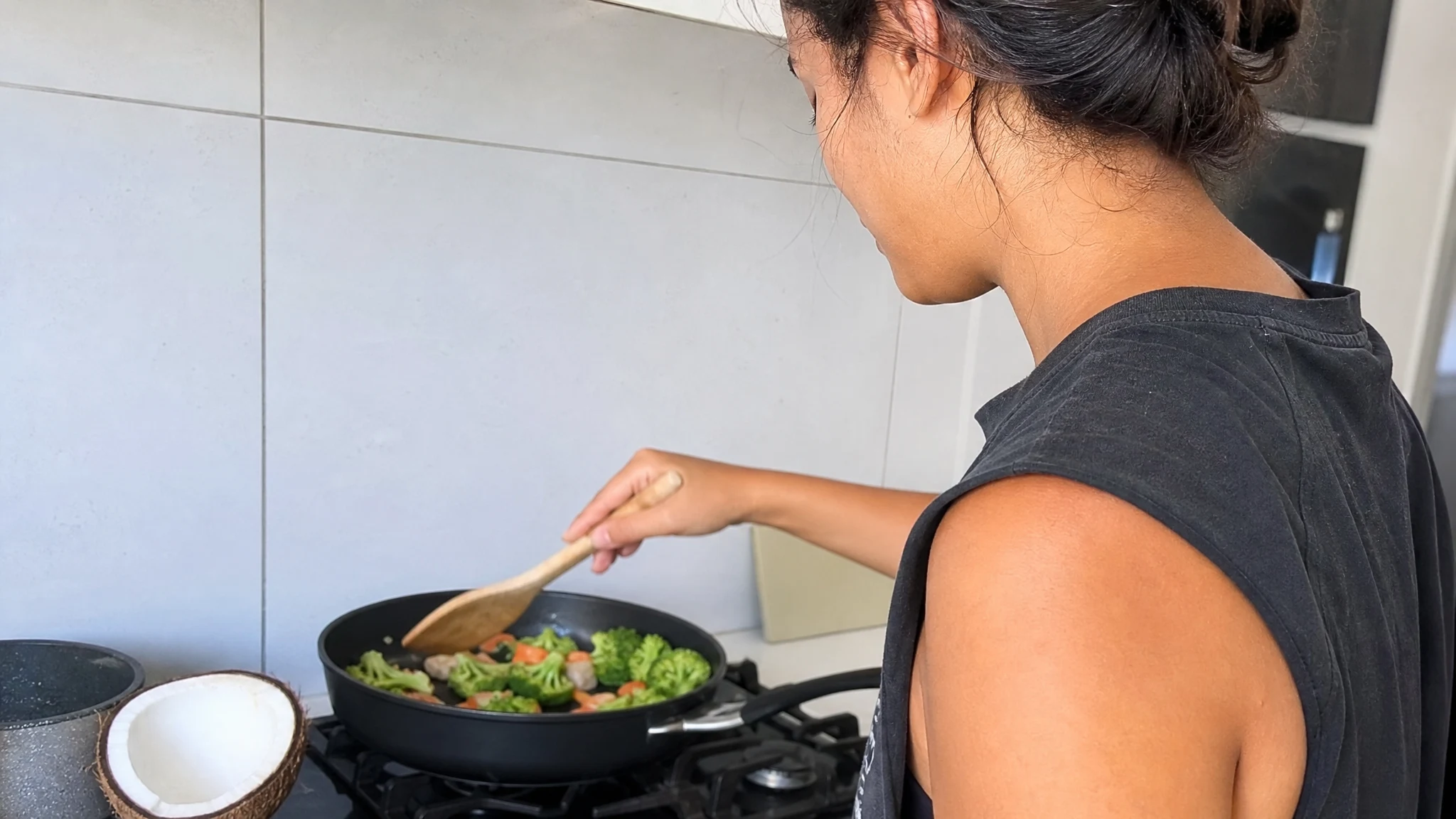
- Pan-frying and sauteing: the oil is hot for minutes and used once, so flavor decides. Virgin coconut oil gives eggs and fish a gentle coconut note, and extra-virgin olive oil adds something peppery or grassy. If you see smoke, lower the heat.
- Dressings and dips: no heat involved, so this is extra-virgin olive oil's moment. Coconut oil would firm up in a cold dressing.
Whichever oil you pick, let the pan come up to temperature before the food goes in, and pat the food dry first. A good fry has a steady, lively sizzle, and that sound is a handy signal when the heat has drifted too low or too high.
Heart health is a separate measuring stick
Stability in the pan and effects on cholesterol are different measurements. A 16-trial meta-analysis found coconut oil raised LDL cholesterol by 10.47 mg/dL (95% CI 3.01 to 17.94) compared with nontropical vegetable oils (Neelakantan et al., 2020). Olive oil is mainly monounsaturated, so that paper does not speak to it directly. If cholesterol or heart disease is part of your life, your doctor or a registered dietitian is the right person to choose your cooking fat.
One kitchen safety note
If oil starts to smoke, take the pan off the heat and ventilate. The National Park Service's deep-frying fire guidance says the same and recommends watching the oil with a thermometer (NPS, Fire Prevention 52). Our deep frying guide goes into holding a steady temperature.
A word about what we make: our fractionated coconut oil and virgin unrefined coconut oil are for external cosmetic use only, so they stay out of the fryer, and we do not sell olive oil. Pick a food-labeled bottle for the stove. For the longer smoke-point story, see our smoke point guide, for the oven see olive oil versus coconut oil in baking, and if you are shopping for a cosmetic oil, start with our oil page.
Fractionated Coconut Oil
Fractionated Coconut Oil from our own shop, in sizes from 0.5 oz to bulk.
From $9.99
Shop Now →Sources & Further Reading
- Abrante-Pascual et al., 2024. Vegetable oils and their use for frying: a review of their compositional differences and degradation. Foods 13(24):4186. PMC11675685
- Milk Street, 2018. The most durable oils for high-heat cooking. 177milkstreet.com
- Yu, Cho and Hwang, 2018. Physicochemical properties and oxidative stability of frying oils during repeated frying of potato chips. Food Sci Biotechnol 27(3):651-659. PMC6049663
- Askin and Kaya, 2020. Effect of deep frying process on the quality of the refined oleic/linoleic sunflower seed oil and olive oil. J Food Sci Technol 57(12):4716-4725. PMC7550478
- Neelakantan et al., 2020. Effect of coconut oil consumption on cardiovascular risk factors. Circulation 141(10):803-814. PMID 31928080
- National Park Service. Fire Prevention 52: Deep Fried Danger. nps.gov/articles/p52-deep-fried-turkey-fire-safety.htm