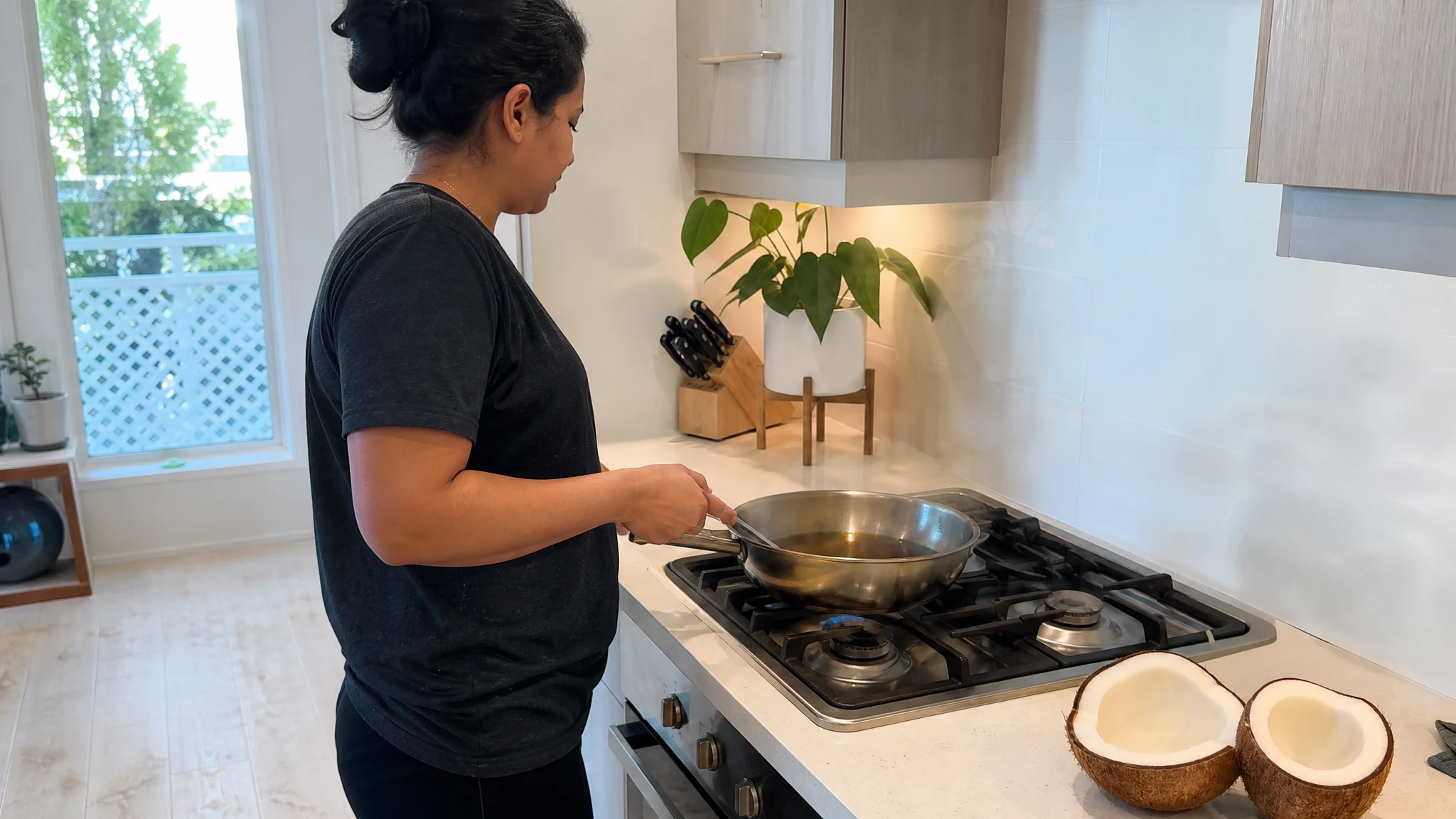
Coconut Oil Smoke Point: Why the Numbers Disagree
Ask the internet for coconut oil's smoke point and you get one confident number, usually from a chart that never says where it came from. The published sources tell a richer story. Virgin coconut oil is reported near 170 C, refined near 232 C, and a home skillet test of refined oils landed in between. Once you see why the numbers differ, picking a pan temperature gets a lot easier.

Fractionated Coconut Oil
Our own Fractionated Coconut Oil, in sizes from 0.5 oz to bulk.
From $9.99
Shop Now →The numbers, and where they come from
| Source | What it reports |
|---|---|
| Ng et al., Bioprocess and Biosystems Engineering, 2021 (coconut oil extraction review) | Unrefined coconut oil 170 C (338 F); refined 232 C (about 450 F) |
| Milk Street, 2018 (skillet test, infrared thermometers, three runs, refined oils only) | Refined coconut 423 F (about 217 C), in a field that ran from avocado at 412 F to grapeseed at 494 F |
| Abrante-Pascual et al., Foods, 2024 (frying review) | No coconut figure. Notes that oils rich in medium-chain fatty acids have a lower smoke point than long-chain ones, and that smoke point depends mainly on free fatty acids |
| Scianò et al., Food Chemistry X, 2025 (aldehydes review) | No coconut value. Citing Lozano-Castellon et al. (2022): extra virgin olive oil about 205 C, peanut about 225 C, sunflower about 255 C, soybean about 242 C, palm about 227 C |
That raises a fun puzzle. If refined coconut oil smokes at 232 C and extra virgin olive oil at 205 C, coconut should be the champion of high heat. Yet the 2024 frying review says coconut's fatty acid makeup is a poor match for frying, and the skillet test put refined coconut slightly below the other refined oils it tried. All of this can be true at once, and the reason is worth knowing.
Why one oil gets several numbers
A smoke point is a reading taken on one sample under one set of conditions. The 2024 review says it depends mainly on the free fatty acids in the oil and on the length of the fatty acid chains. Free fatty acids are not fixed for an oil type: they differ between a fresh virgin oil and a refined one, and they climb as an oil gets used. Ng and colleagues compared four ways of making virgin coconut oil and reported that the expeller-pressed oil had the lowest free fatty acid and peroxide values of the four. So a published figure is a typical value for a typical sample, and your own bottle may sit a little above or below it.
The frying review goes a step further and says the smoke point is no longer seen as a precise indicator of how well an oil resists breakdown, and the aldehyde review makes a similar point more briefly. In practice, the number is a good hint about when an oil will start to smoke and a lighter guide to how it holds up through a long fry.
Turning the figures into pan advice
Hold the numbers loosely and let them set a starting point. This is our reading of the table and not the result of cooking trials.
- Virgin or unrefined coconut oil: think of about 170 C (338 F) as a comfortable ceiling for sauteing. It is plenty for curries, gentle saute work and baking, which is where virgin oil's coconut flavor is a bonus.
- Refined coconut oil: the reported ceiling runs from about 217 C in the skillet test to 232 C in the review, which leaves good room for shallow frying and stir-frying. For long, hot, repeated frying, the frying review's note on medium-chain fats is a nudge toward other oils.
- Anything that is smoking: lift the pan off the heat, open a window and start over with fresh oil, whatever the chart says.
A probe or clip-on thermometer beats guessing from the first wisp of smoke. Our deep frying guide covers temperature handling in detail, and our olive oil comparison sets the two oils side by side. Home test results are a good fit for refined coconut only, since Milk Street left unrefined oils out.
What reuse does to the number
The aldehyde review calls reheating oil after deep frying common but hazardous, and the 2024 review explains why smoke point is affected: as triglycerides break down during frying they release more free fatty acids, and the smoke point falls. Oil that was perfect for the first batch of fries therefore smokes sooner for the second and sooner again for the third. Fresh oil for each fry is the simple rule.
Using your senses at the stove
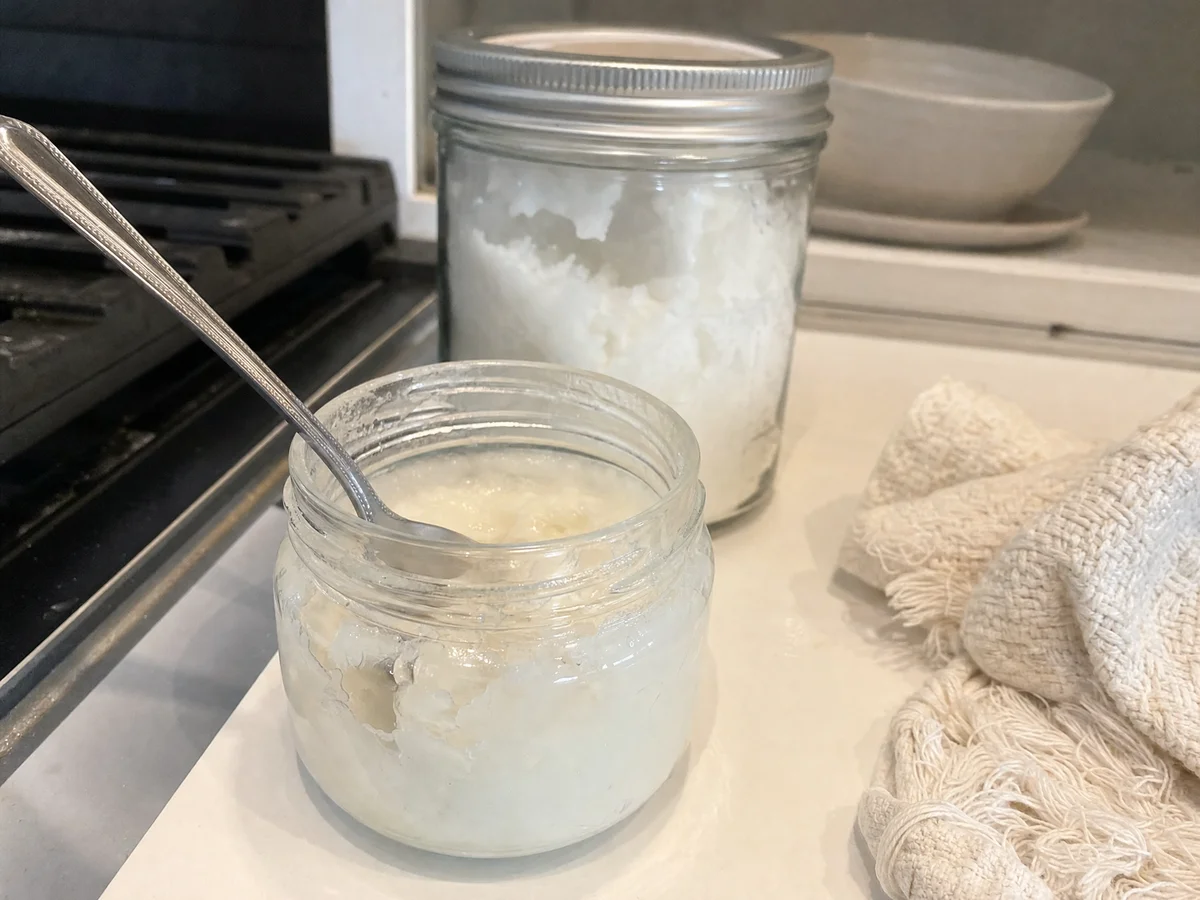
A thermometer is the most reliable guide, but your eyes and nose help too. Fresh oil in a warm pan looks clear and still, and a shimmer is a sign it is getting hot. Virgin coconut oil smells sweetly of coconut as it warms. A sharp, acrid smell or a thin wisp of smoke rising from the surface is the sign to take the pan off the burner, let it cool and wipe it out before you start again.
Where our oils fit
Our main product is fractionated coconut oil, which we describe as keeping only the medium-chain triglycerides. By the 2024 review's own logic about medium-chain fats, that is the style of oil least suited to a frying pan, and it is sold for external cosmetic use in any case. Neither it nor our virgin unrefined listing is a food, so both stay out of the skillet and on the skin-care shelf. The guide to coconut oil types and uses sorts them by job, and virgin versus refined explains the kitchen split.
The short version at the stove
Choose refined for neutral flavor and virgin for coconut flavor, keep the heat moderate and treat smoke as a stop sign. Fresh oil for every fry keeps things simple. In our judgment, saturated fat matters more to health than smoke point does, and our heart health post explores it. Anyone with high LDL or on lipid-lowering medication should ask a physician or registered dietitian. Use the number to pick a starting temperature, then trust the pan more than the page.
Fractionated Coconut Oil
Fractionated Coconut Oil from our own shop, in sizes from 0.5 oz to bulk.
From $9.99
Shop Now →Sources & Further Reading
- Ng YJ et al., 2021. A comprehensive review on the techniques for coconut oil extraction and its application. Bioprocess Biosyst Eng 44(9):1807-1818. PMC8132276
- Milk Street, 6 Aug 2018. Durable oils: smoke point test of highly refined cooking oils. 177milkstreet.com/stories/durable-oils
- Abrante-Pascual S, Nieva-Echevarria B, Goicoechea-Oses E, 2024. Vegetable Oils and Their Use for Frying: A Review of Their Compositional Differences and Degradation. Foods 13(24):4186. PMC11675685
- Scianò F et al., 2025. Toxic aldehydes in cooking vegetable oils: Generation, toxicity and disposal methods. Food Chem X 29:102744. PMC12281009