Coconut Oil Before Shampoo: How to Do a Pre-Wash
Oiling your hair before shampoo is one of those habits that feels like a small luxury and, according to the lab work, may be a smart one too. The same bottle can go on for an hour, for a warm-oil treat, or overnight, and the version with the most research behind it is the simplest: oil first, shampoo after. Here is how we would set it up, and how to make it your own.

Fractionated Coconut Oil
Our own Fractionated Coconut Oil, in sizes from 0.5 oz to bulk.
From $9.99
Shop Now →What the hair studies looked at
Two papers from the same research group are behind most of the "coconut oil for hair" talk. In 2003, Rele and Mohile compared coconut, sunflower and mineral oil on hair fibers. Coconut oil was the only one that clearly reduced protein loss, in both undamaged and damaged hair, whether it went on before washing or after. The authors credit lauric acid, coconut oil's main fatty acid, which is attracted to hair protein and small and straight enough to slip into the strand.
A 2005 study by Keis and colleagues added warmth to the picture. Coconut, olive and sunflower oils all lowered the cling between fibers over time, mineral oil did not, and warming lowered it further for coconut and sunflower. Both were bench studies on hair fibers and tresses, and both came from groups connected to a coconut hair oil maker, so we read them as a good reason to try pre-wash oiling and not as a promise for any one head of hair.
Why we start with pre-wash
Pre-wash oiling fits into a wash day you already have. The shampoo clears the surface oil afterward, so there is no greasy finish to manage, and it is the form the 2003 result speaks to. Because oil moves into a hair fiber gradually, an hour or two is a lovely place to begin, and you can stretch it from there if you enjoy it. That timing is our reasoning from how diffusion works, not a measured result.
- Start with dry or slightly damp hair and work the oil through the lengths and ends. Keep it off the scalp unless you have a reason to put it there.
- Go light. Half a teaspoon is about 2.5 ml, roughly 2.3 g at the 0.948 density on the Certificate of Analysis we publish for one fractionated batch (our arithmetic, one batch). Shoulder-length hair can take that once or twice over, and a few extra drops will cover thirsty ends.
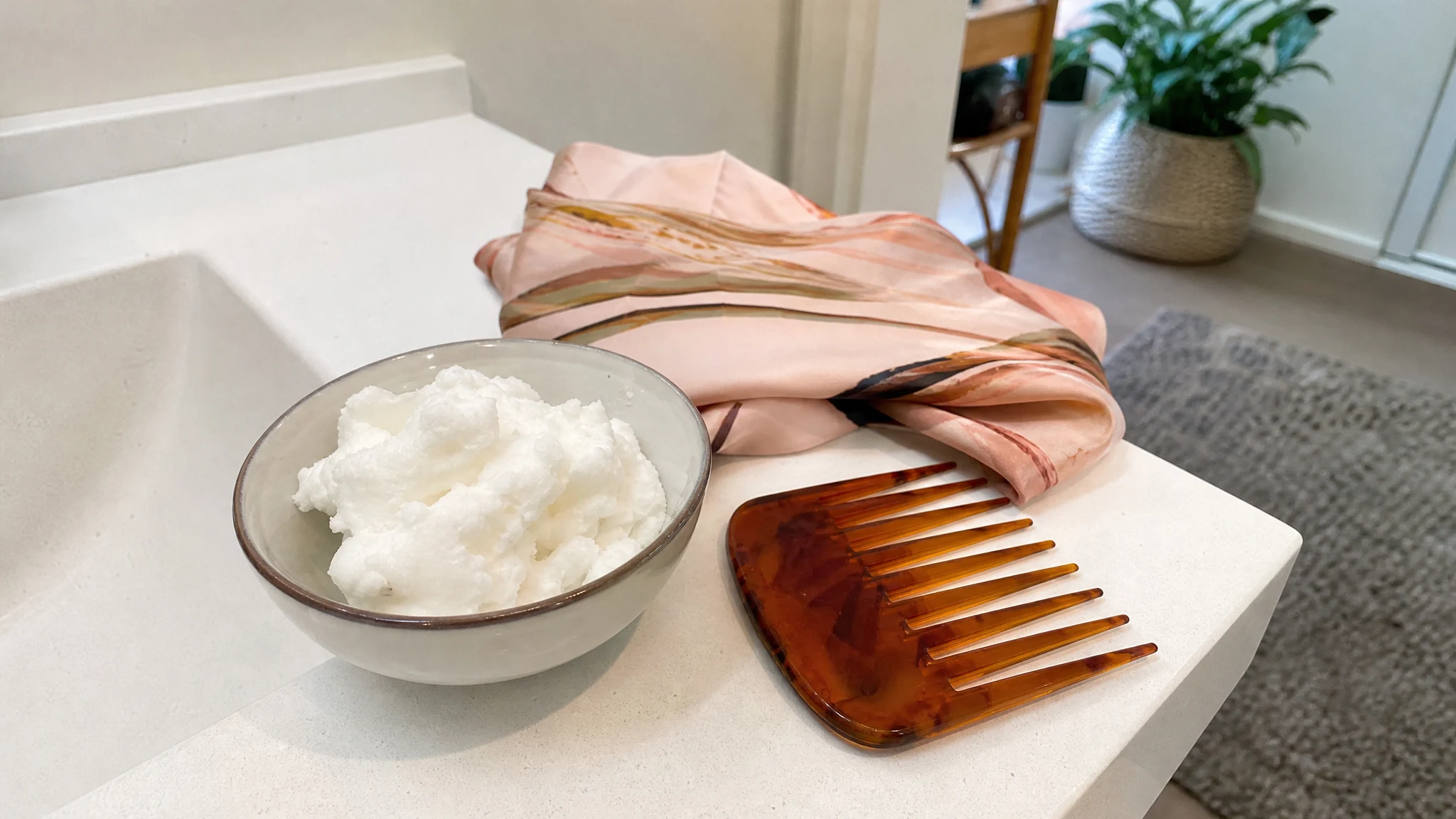
- Leave it on for as long as suits your day. A loose wrap or an old towel looks after pillows and collars.
- Shampoo, a second round if hair still feels coated, then condition. The American Academy of Dermatology suggests conditioner after every shampoo and wrapping wet hair gently instead of rubbing (AAD, how to stop damaging your hair).
Warm oil, the cozy version
Warm oil feels wonderful, and the 2005 paper gives it some scientific backing, though it does not say how warm. Comfort on the scalp is the best guide. Oil holds heat and clings, so a pour that feels fine in a bowl can feel much hotter on skin. Stand a closed bottle in a mug of warm tap water for a few minutes, test a drop on the inside of your wrist, and skip the microwave. Those are practical habits drawn from how oil behaves, not study findings.
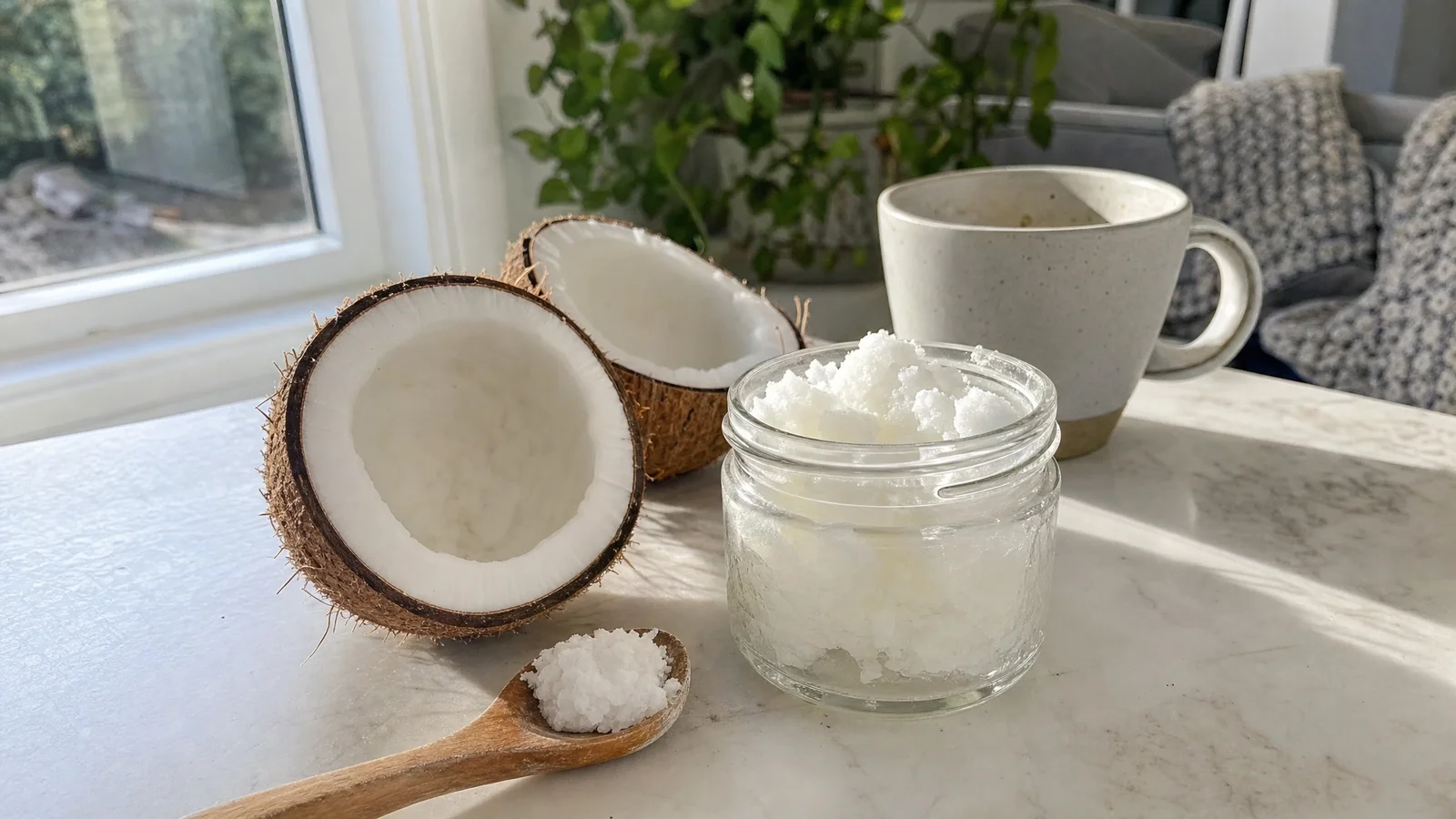
We describe our fractionated coconut oil as staying liquid at any temperature, so warming it is purely for comfort. Our virgin unrefined listing is firm below roughly 76 degrees Fahrenheit, according to our oil page, so a minute between your palms or a few minutes in that mug of warm water makes it pourable.
Overnight, if you love the ritual
An overnight session is a question of taste. The sources do not measure it, so we treat the extra hours as an indulgence and not an upgrade. A bonnet or a spare pillowcase handles the practical side. A review in the International Journal of Trichology notes that leave-on products can make straight, unprocessed hair look oily and dull (Gavazzoni Dias, 2015), which makes the shorter session a happy fit for fine or straight hair.
Which of our oils for which method
The studies used ordinary coconut oil, which one published breakdown puts at about 49% lauric acid (Lin and colleagues, 2018). General sources describe fractionated coconut oil as mostly caprylic and capric acid, with most of the lauric acid removed (Healthline). Whether the pre-wash result carries over to fractionated oil is an open question, and our published COA gives density, refractive index and optical rotation for one batch, so we do not state a composition for ours.
Reasoning from that, the virgin unrefined oil is the closest match to the oil in the studies, and its coconut aroma mostly rinses away with shampoo. The fractionated oil is the easy companion for quick sessions and finishing touches: it pours at room temperature and we describe it as virtually odorless. Both are sold for external cosmetic use only.
Tuning it to your hair
Fine or thin hair does best with a little oil on the ends for a shorter time. Thick or coarse hair can take more, and working in small sections matters more than quantity. Curly and coily hair often likes oil spread with fingers or a wide-tooth comb on damp hair, and our type 4 hair guide covers protective styles. Bleached and color-treated hair is more porous according to the same review. The sources are silent on color fade, so we make no promise there.
This is a hair routine and not a scalp treatment. If your scalp itches, burns, flakes or develops a rash, wash the oil out and see a dermatologist. Patch test a small area first and wait 24 hours, as we advise on our product page, and if you have a coconut or tree nut allergy, check with a professional before use. For more, our coconut oil for hair overview and hair mask guide are good next stops, and our olive oil comparison shows how another pantry oil fared in similar studies.
If you want one plan, make it an hour or two before wash day, a measured amount, and a proper shampoo and conditioner to finish. Warm oil and overnight sessions are treats for the days you feel like them.
Fractionated Coconut Oil
Fractionated Coconut Oil from our own shop, in sizes from 0.5 oz to bulk.
From $9.99
Shop Now →Sources & Further Reading
- Rele AS, Mohile RB, 2003. Effect of mineral oil, sunflower oil, and coconut oil on prevention of hair damage. pubmed.ncbi.nlm.nih.gov/12715094
- Keis K et al., 2005. Investigation of penetration abilities of various oils into human hair fibers. library.scconline.org/v056n05/1
- Gavazzoni Dias MFR, 2015. Hair cosmetics: an overview. Int J Trichology. pmc.ncbi.nlm.nih.gov/PMC4387693
- Lin TK, Zhong L, Santiago JL, 2018. Anti-inflammatory and skin barrier repair effects of topical application of some plant oils. Int J Mol Sci 19(1):70. pmc.ncbi.nlm.nih.gov/PMC5796020
- Healthline. Fractionated coconut oil explainer. healthline.com
- American Academy of Dermatology. How to stop damaging your hair. aad.org