Coconut Oil Instead of Butter: How to Swap by Weight
"Just swap the butter for coconut oil, one to one" is advice you will find on a thousand recipe pages, and it is a little off in a way a kitchen scale can fix. Butter is not pure fat, and coconut oil is. Once you account for that small difference, a swap goes from a hopeful guess to a plan, and your cookies, cakes and pastry come out much closer to what the recipe's author intended.

Fractionated Coconut Oil
Our own Fractionated Coconut Oil, in sizes from 0.5 oz to bulk.
From $9.99
Shop Now →What butter really is
Under United States law, butter must contain "not less than 80 per centum by weight of milk fat" (21 U.S.C. 321a). That is a floor, so in a recipe that calls for a cup of butter, up to a fifth of the weight is something other than fat. Coconut oil is all fat. Replace butter gram for gram and the batter gets more fat and less liquid than the author planned, which is where the drier, firmer results come from.
For the arithmetic below we treat the non-fat part of butter as water. That is an approximation, since the law fixes only the fat floor, and a butter labeled with a higher fat percentage narrows the gap. Check the package on the butter your recipe was written for.
The conversion, by weight
A pound is 453.6 g, so a US stick (a quarter pound) is 113.4 g, and a cup is two sticks. At the 80% floor:
| Recipe calls for | Butter weight | Fat in it (80%) | Non-fat part (20%) |
|---|---|---|---|
| 1 stick (1/2 cup) | 113.4 g | 90.7 g | 22.7 g |
| 1 cup (2 sticks) | 226.8 g | 181.4 g | 45.4 g |
| 1 pound (4 sticks) | 453.6 g | 362.9 g | 90.7 g |
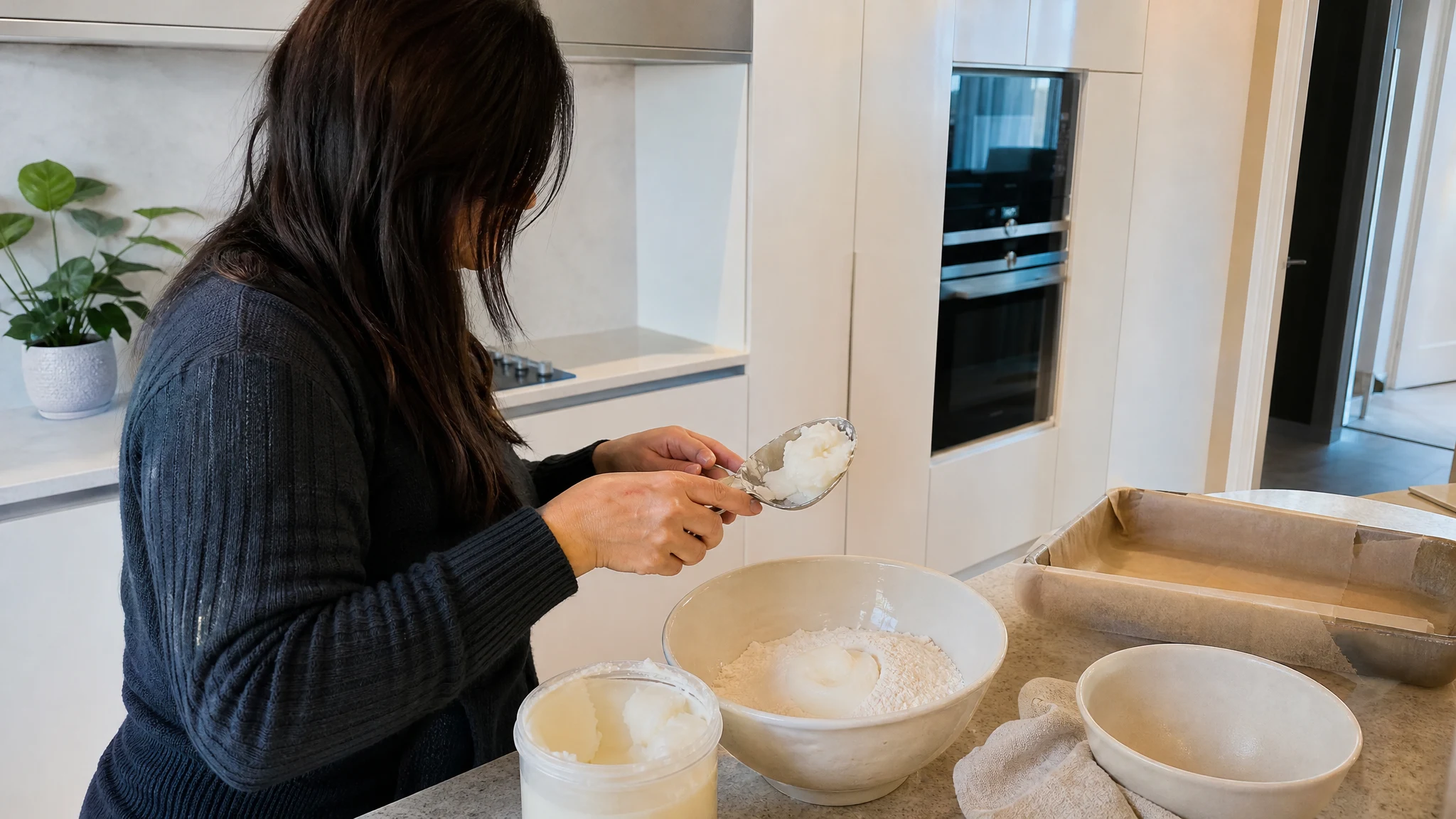
The swap follows from the table: weigh out the fat figure in coconut oil, then add back the non-fat figure as a liquid the recipe already uses, such as milk, plant milk or water. For a cup of butter that is about 181 g of coconut oil plus about 45 g of liquid. If your dough is already on the wet side, start with half of the liquid and go by feel. In cookie dough the extra liquid affects spread, so a small first batch is a friendly way in.
Grams solve a quiet puzzle, too. Coconut oil is solid when you scoop it and liquid when you pour it, and a scooped cup can hide air gaps while a poured cup is exact. Convert a favorite recipe to grams once and write the numbers on the page.
Solid or melted is a temperature question
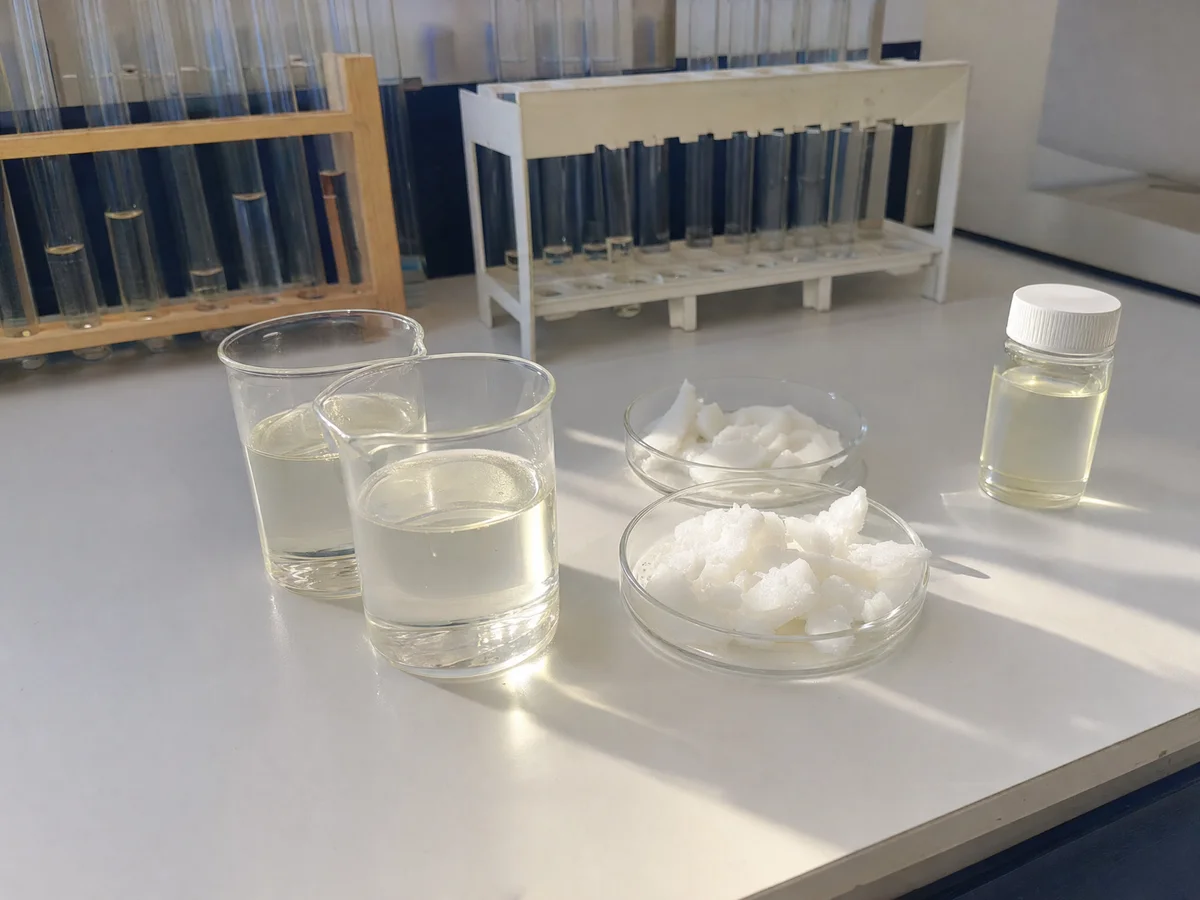
Ng and colleagues describe coconut oil as a colourless liquid at 30 C and above that solidifies at 25 C (Ng et al., 2021). A kitchen sits right across that line, so the same jar can be rock hard in January and pourable in July. Reasoning from that range, a few habits help.
- Warm your cold ingredients. Melted oil poured into fridge-cold eggs or milk can set again in little flecks. Bring everything to room temperature, or stream the oil in slowly.
- Cream with a light hand. Solid coconut oil can be beaten with sugar, though the lift will differ from butter's, so try a small batch before baking for a crowd.
- Keep pastry fat cold. Chilled-hard coconut oil cuts into flour like a solid fat, and warm hands melt it quickly, so work in short bursts.
If a recipe calls for a liquid oil such as canola, the logic runs the other way: melt the coconut oil, let it cool until just fluid, and measure it as a liquid. One US cup is 8 fluid ounces, about 237 ml. Our look at olive oil versus coconut oil in baking covers flavor and texture, and melting coconut oil quickly helps when the jar is firm.
Refined for quiet, virgin for coconut
The Ng review notes that refined coconut oil lacks the coconut smell. For a vanilla cake or a buttery-tasting cookie, refined is the quieter choice, and for a coconut macaroon, virgin gives the flavor you are after. Our virgin versus refined comparison explains how the two are made. If you are comparing kitchen fats, coconut oil versus ghee is a fun next read, and granola bars show what coconut oil does in a no-flour bake.
A friendly word about our own bottles, since people ask. Our fractionated coconut oil stays liquid at any temperature, the opposite of what a baker wants from a solid fat, and both it and our virgin unrefined listing are sold for external cosmetic use only. For the oven, buy a coconut oil labeled for food, and keep ours for skin and hair. The fractionated oil explainer shows why the two behave so differently.
A word on nutrition
A swap does not turn a dessert into health food. Both fats are high in saturated fat, and one review puts coconut oil at around 90% saturated fatty acids (Abrante-Pascual et al., 2024). In a four-week trial, 94 adults ate 50 g a day of extra virgin coconut oil, extra virgin olive oil or unsalted butter, and LDL cholesterol rose more on butter than on coconut oil (Khaw et al., 2018). That was a short trial in healthy adults, and the authors did not suggest it changes the general advice to cut back on saturated fat. If you have high cholesterol or take a lipid-lowering medicine, please check with your physician or a registered dietitian before changing the fat you bake with.
Your first batch
Convert the recipe to grams using the table and write the numbers down. Choose refined for a neutral taste or virgin for coconut notes. Warm the eggs and liquids before adding melted oil, and bake a half batch first, noting spread and crumb. Adjust the liquid in round two rather than round one. Do the weight math first and coconut oil will stand in for butter very happily.
Fractionated Coconut Oil
Fractionated Coconut Oil from our own shop, in sizes from 0.5 oz to bulk.
From $9.99
Shop Now →Sources & Further Reading
- U.S. Code, Title 21, Section 321a. Butter: definition. law.cornell.edu/uscode/text/21/321a
- Ng YJ et al., 2021. A comprehensive review on the techniques for coconut oil extraction and its application. Bioprocess Biosyst Eng 44(9):1807-1818. PMC8132276
- Abrante-Pascual S, Nieva-Echevarria B, Goicoechea-Oses E, 2024. Vegetable Oils and Their Use for Frying. Foods 13(24):4186. PMC11675685
- Khaw KT et al., 2018. Randomised trial of coconut oil, olive oil or butter on blood lipids and other cardiovascular risk factors in healthy men and women. BMJ Open 8(3):e020167. pubmed.ncbi.nlm.nih.gov/29511019