Coconut Oil Granola Bars: How to Keep Them from Melting
Coconut oil has a personality trait that decides how a granola bar turns out: it is firm in a cool kitchen and soft in a warm one. Design around that and you get some of the best bars that ever rode in a lunchbox. Ignore it and you get a lovely puddle in a backpack. Here is how to make the trait work for you.

Fractionated Coconut Oil
Our own Fractionated Coconut Oil, in sizes from 0.5 oz to bulk.
From $9.99
Shop Now →One note first. We sell fractionated and virgin unrefined coconut oil for external cosmetic use only, so the jar for this project is a coconut oil labeled for food.
What the fat is there to do
A bar that crumbles wants more binder, and a bar that sweats wants less loose fat. Coconut oil brings its melting point to the party. A review from India's Central Food Technological Research Institute lists virgin and refined coconut oil as melting at about 24 C, or 75 F (Gopala Krishna et al., 2010), and our own virgin listing puts the change at about 76 F. Because of that, a bar built on coconut oil will be firm from the refrigerator, sliceable in a cool room and soft in a warm lunchbox, a hot car or a summer picnic.
So our recommendation is simple: coconut oil suits bars that live in the fridge or a cool pantry. For a bar that has to survive a hot backpack, lean on a stickier syrup and less free fat, or bake it, and tune the balance to your own oven and climate.
Virgin or refined
Virgin tastes of coconut, and refined is the neutral choice. In a bar loaded with dried fruit and warm spice, that coconut note is a happy bonus. In a plain oat and almond bar it can crowd the other flavors. Our virgin versus refined article sets them side by side.
No-bake or baked
| Choice | What the fat does | Keeps best | What to expect |
|---|---|---|---|
| No-bake, set in the refrigerator | Sets as it cools below its melting point and acts like glue | Cold | Softens quickly at room temperature, since the fat is the structure |
| Baked | Melts into the mix, then partly re-sets on cooling | Cool pantry or refrigerator | Crisper edges and more browning; fat may weep if overloaded |
If any ingredient is flour, the oven is the answer. The CDC says most flour is raw and that germs are killed only when flour is baked or cooked, so skip tasting the raw batter and do not set a flour mixture in the fridge unbaked (CDC, raw flour and dough, 24 November 2025).
Picking the sweetener
Honey, maple syrup and dates are the usual choices, and all three are lovely stickies for holding oats together. They also count as added sugars. The CDC's guidance on foods to avoid or limit says infants and young children should not have added sugars, and that honey given to children younger than 12 months may cause a severe food poisoning called botulism (CDC, 14 April 2026). For a baby or toddler, leave the honey out and ask a pediatrician what suits them. These bars are designed for older children and adults.
Who gets which bar
The CDC's choking hazards page lists cookies and granola bars among grain products to avoid for babies and young children, alongside whole or chopped nuts and seeds, chewy fruit snacks and raisins (CDC, 11 March 2026). A homemade bar packed with nut chunks and dried fruit combines several of those, so keep it for older eaters unless a pediatrician says otherwise.
On allergens, the FDA says it no longer considers coconut a major food allergen and dropped it from the Tree Nut List in its January 2025 guidance (FDA allergen FAQ). That is a labeling matter and does not tell you whether a particular child reacts. The nuts and seeds in the bar are a separate question, and a school or workplace with a nut ban should hear about them before you pack lunches.
Where coconut oil sits in your week
Coconut oil is mostly saturated fat, and pooled trials found it raised LDL cholesterol more than nontropical vegetable oils did (Neelakantan et al., 2020). The American Heart Association's 2017 advisory adds that swapping saturated fat for unsaturated fat lowers cardiovascular disease, while swapping it for refined carbohydrates and sugars did not (Sacks et al., 2017). Since a granola bar is often fat plus sugar, that second half is worth keeping in mind. A bar now and then is an easy fit for most people, and if you manage cholesterol, a physician or registered dietitian can say how coconut oil belongs in your week. Our saturated fat article covers the debate.
A little ritual for the pan
Line the pan with parchment with a little overhang on two sides, so you can lift the whole slab out in one go. When you press the mixture down, use the flat bottom of a measuring cup or a glass and lean into it, working from the middle out to the corners. You will notice the surface turn from shaggy to smooth as it compacts, and that is your cue that the bar will hold together when you bite into it.
Cutting and keeping
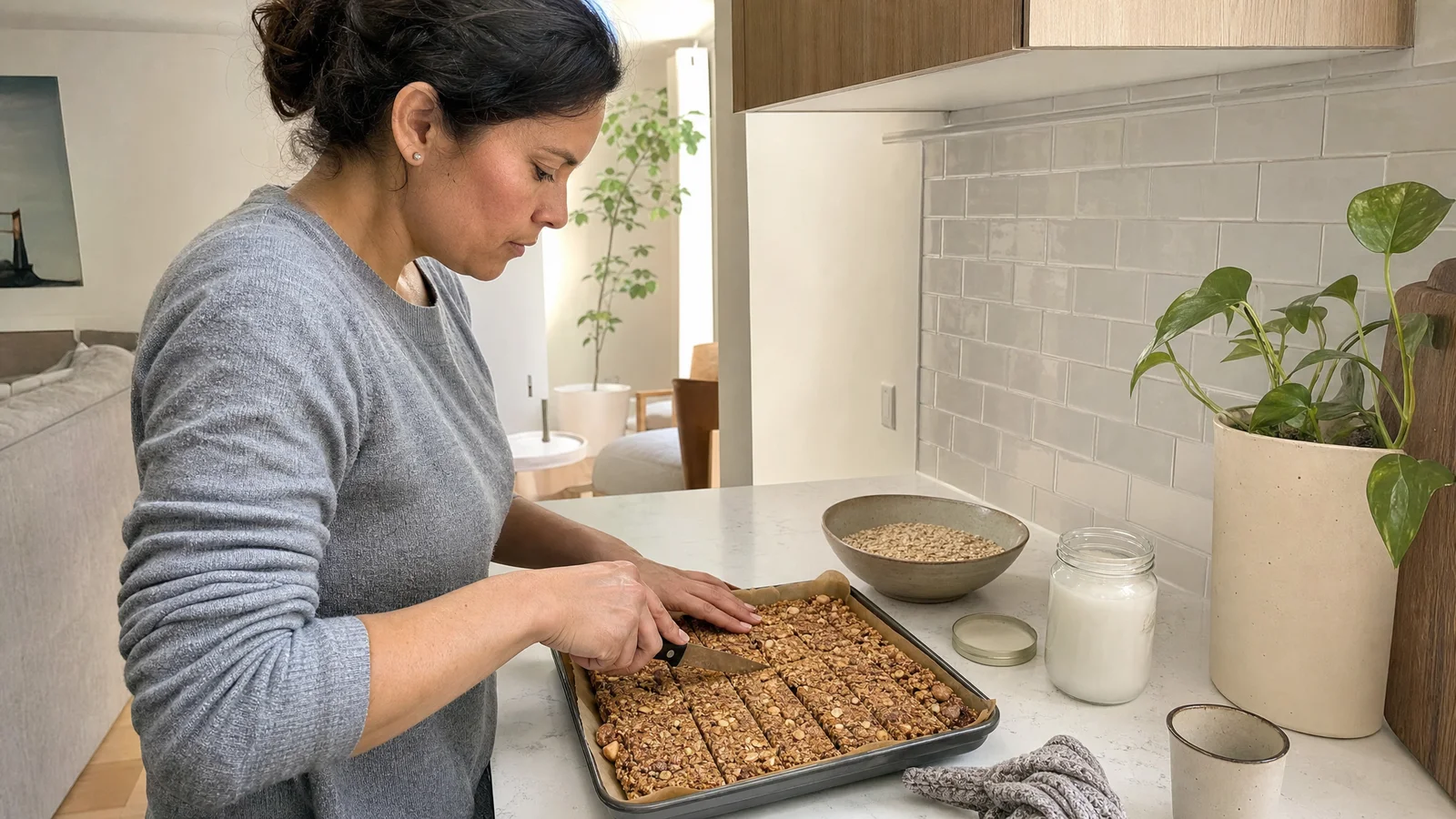
Because the fat sets as it cools, chill the slab completely before you cut it. A warm slab drags soft fat through the crumbs. Press the mixture firmly into the pan, since the fat only binds what it touches, and wrap pieces one by one so they do not fuse as they warm. All of that follows from how the fat behaves.
To find your own best balance, change one thing per batch (fat, sweetener or oats), write it down and judge the bar at the temperature it will actually live in. Cut one piece after a full chill and leave another on the counter for an hour. A bar that is only good cold is simply a refrigerator bar, and that is a fine thing to be. Keep them cold and discard anything that smells off.
The smoke point article is a good companion for more kitchen heat questions, and the energy ball article is the no-bake cousin of these bars.
Fractionated Coconut Oil
Fractionated Coconut Oil from our own shop, in sizes from 0.5 oz to bulk.
From $9.99
Shop Now →Sources & Further Reading
- Gopala Krishna AG et al., 2010. Review of coconut oil (CFTRI Mysore). Indian Coconut Journal, July 2010. coconutboard.in
- CDC, 24 November 2025. Raw flour and dough. cdc.gov/food-safety/foods/no-raw-dough
- CDC, 14 April 2026. Foods and drinks to avoid or limit. cdc.gov/infant-toddler-nutrition
- CDC, 11 March 2026. Choking hazards. cdc.gov/infant-toddler-nutrition/choking-hazards
- FDA, page current as of 29 October 2026. Frequently asked questions: food allergen labeling guidance (5th edition, January 2025). fda.gov
- Neelakantan N, Seah JYH, van Dam RM, 2020. The effect of coconut oil consumption on cardiovascular risk factors. Circulation 141(10):803-814. PMID 31928080
- Sacks FM et al., 2017. Dietary fats and cardiovascular disease: a presidential advisory from the American Heart Association. Circulation. PMID 28620111