Popping Popcorn in Coconut Oil: Virgin or Refined?
Popcorn in coconut oil is a movie-night classic with a built-in puzzle. Kernels need about 180 C to pop, and virgin coconut oil starts to smoke not far below that. That near-miss explains the occasional wisp over the pot, and it is why choosing virgin or refined is about more than flavor. Here is what the numbers mean at the stove.

Fractionated Coconut Oil
Our own Fractionated Coconut Oil, in sizes from 0.5 oz to bulk.
From $9.99
Shop Now →The oil for the pot should be a food-aisle coconut oil, because we sell fractionated and virgin unrefined coconut oil for external cosmetic use only.
What a kernel needs
Virot and Ponomarenko measured it in the Journal of the Royal Society Interface in 2015. In their oven tests, 17 of 50 kernels (34%) popped at 170 C and 48 of 50 (96%) at 180 C. Hull rupture came at about 10 bar of pressure, and each kernel holds around 20 mg of water, most of it liquid until the hull gives way (Virot and Ponomarenko, 2015). They used an oven and a hot plate and not oil, so the paper describes the kernel and not the pot.
Because the hull holds and then fails all at once, kernels pop in a rush once the pot is hot enough and hardly at all below it. Early scattered pops are the sign the pot is in the range where most of the batch is about to go, which is the moment to be at the stove. When the pops slow, take the pot off the heat, because extra seconds at 180 C or more add smoke and no popcorn.
What coconut oil brings to the pot
A 2021 study of coconut oil extraction methods reports a smoke point of about 170 C for unrefined coconut oil and about 232 C for refined (Ng et al., 2021). Other published tables give somewhat different figures, and smoke point shifts with free fatty acid content and with reuse, so treat any single number as a guide.
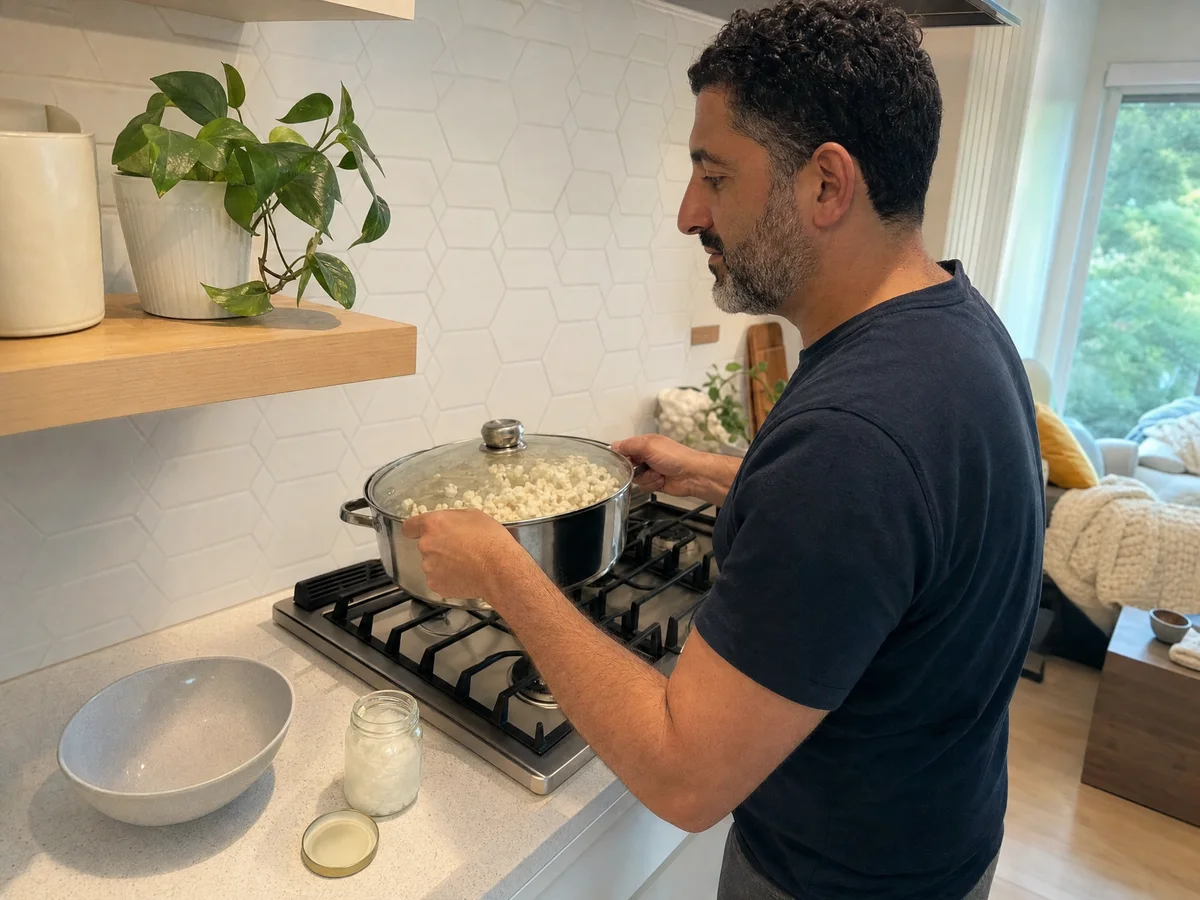
Set the numbers side by side and the picture is clear. Heat reaches a kernel through the oil and the pot, so the oil around the kernels is at least as hot as the pop point when most of them go. For unrefined oil that is above its smoke point, so a wisp of smoke is what you would expect. For refined oil there is a margin of 50 C or more. That is reasoning from the figures, and your pot, burner and quantity will shift it.
Virgin for aroma, refined for room to breathe
If you want popcorn that smells of coconut, go virgin, keep the heat at medium, shake the pot and enjoy the aroma, knowing you are working near the edge. If you want a quieter kitchen, refined oil gives you far more room. Either way, stay with the pot. The U.S. Fire Administration notes that cooking fires start when the heat is too high, that unattended equipment accounted for 37% of ignitions in nonconfined home cooking fires, and that the rule is to stand by your pan with a lid or baking sheet nearby to cover it if it catches fire (USFA cooking fire safety). If the oil smokes before the first pop, turn the burner down, not up. A slightly vented lid keeps kernels in the pot, which suits a snack that jumps.
The sound is your timer
You do not need to watch the clock for popcorn. Listen to the pot instead: first a few scattered pops, then a rapid-fire rattle, then the gaps between pops stretching out. A good habit is to give the pot a gentle shake over the heat as the rattle builds. When the gaps between pops are a couple of seconds, lift the pot off the burner and let the last few kernels finish in the residual heat. Toss the bowl with a pinch of fine salt while the popcorn is still warm, so it sticks.
Coconut oil or butter
Whether coconut oil beats butter is a matter of taste. The facts are modest. U.S. law requires butter to contain at least 80% milk fat by weight (21 U.S.C. 321a), so a fifth is water and milk solids, which melted butter brings to the bowl. Coconut oil is all fat. Choose by whether you want a coconut note or a dairy one.
If flavored popcorn oils tempt you, read the label. A 2007 review by NIOSH scientist Kathleen Kreiss reports that butter-flavoring vapors were linked in 2000 to bronchiolitis obliterans in workers at microwave popcorn plants, where workers mixed butter flavorings with heated oil (Kreiss, 2007). That concerns occupational exposure and says nothing directly about a home bowl, but it is a good reason to ventilate whenever you heat a flavoring with oil.
What the oil adds to the bowl
Popcorn is mostly air and starch, so the fat is the part to think about. A 2020 pooled analysis of 16 trials found that coconut oil raised LDL cholesterol by 10.47 mg/dL compared with nontropical vegetable oils (Neelakantan et al., 2020). Those were trials of eaten oil, so applying them to a bowl of popcorn is an inference. The American Heart Association's 2017 advisory favors unsaturated over saturated fat (Sacks et al., 2017). A weekly bowl is a different story from a daily one, and anyone managing cholesterol can ask a physician or registered dietitian. Our saturated fat article goes deeper.
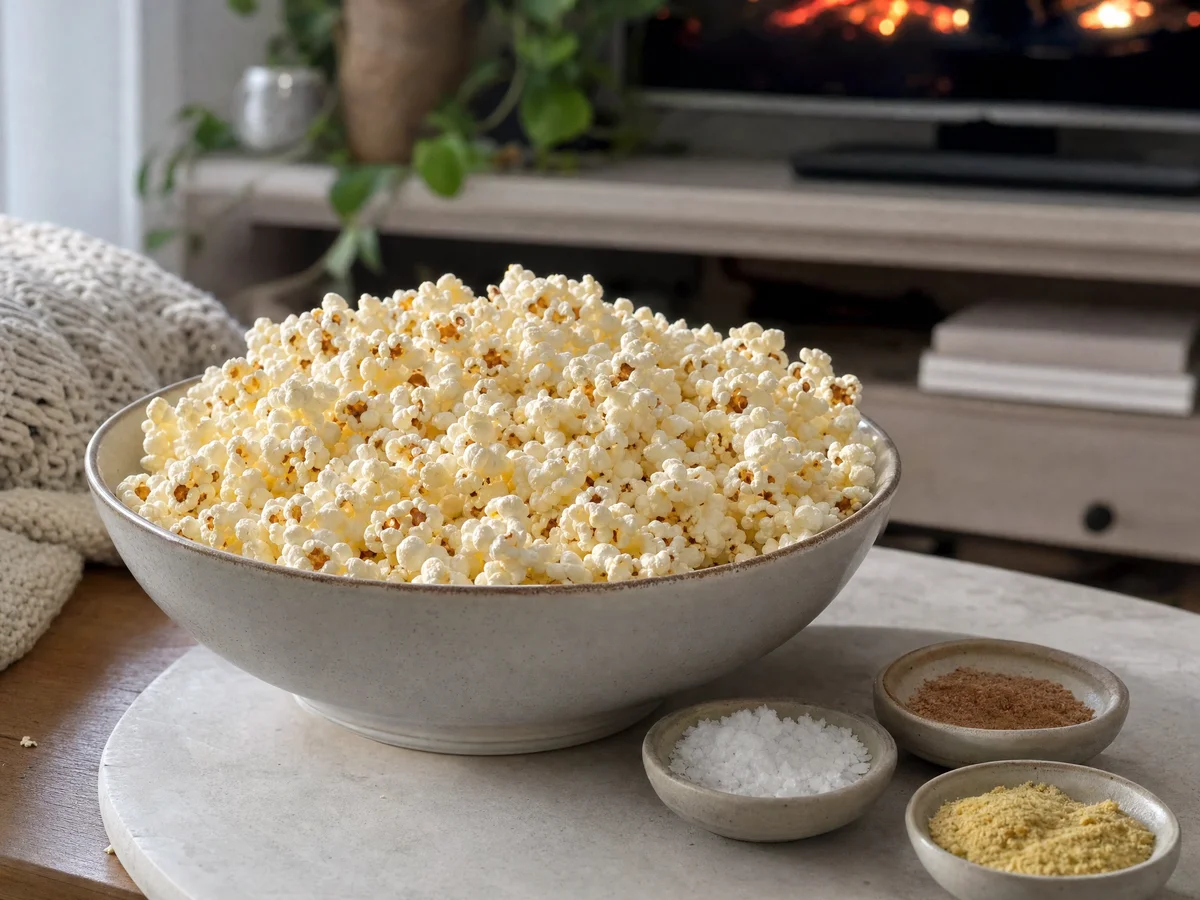
Sharing the bowl
The CDC's choking hazards page lists popcorn among grain products to avoid for babies and young children (CDC, 11 March 2026), so keep it off a toddler's lap on movie night, whichever oil you use. On allergens, the FDA says it no longer considers coconut a major food allergen and removed it from its Tree Nut List, though coconut still has to be named in an ingredient list. A guest with a known coconut reaction should ask an allergist before sharing (FDA allergen FAQ).
The short version is refined coconut oil for margin, virgin for aroma with an eye on the pan, and medium heat either way. For more on temperatures, the smoke point article and the frying comparison go further, and the grilling article applies the same thinking outdoors.
Fractionated Coconut Oil
Fractionated Coconut Oil from our own shop, in sizes from 0.5 oz to bulk.
From $9.99
Shop Now →Sources & Further Reading
- Virot E, Ponomarenko A, 2015. Popcorn: critical temperature, jump and sound. J R Soc Interface 12(104):20141247. PMC4345489
- Ng et al., 2021. A comprehensive review on the techniques for coconut oil extraction and its application. Bioprocess Biosyst Eng 44(9):1807-1818. PMC8132276
- U.S. Fire Administration, page last reviewed 28 September 2026. Cooking fire safety. usfa.fema.gov
- 21 U.S.C. 321a, definition and standard for butter. law.cornell.edu/uscode/text/21/321a
- Kreiss K, 2007. Flavoring-related bronchiolitis obliterans. Curr Opin Allergy Clin Immunol 7(2):162-167. stacks.cdc.gov/view/cdc/185993
- Neelakantan N, Seah JYH, van Dam RM, 2020. The effect of coconut oil consumption on cardiovascular risk factors. Circulation 141(10):803-814. PMID 31928080
- Sacks FM et al., 2017. Dietary fats and cardiovascular disease: a presidential advisory from the American Heart Association. Circulation. PMID 28620111
- CDC, 11 March 2026. Choking hazards. cdc.gov/infant-toddler-nutrition/choking-hazards
- FDA, page current as of 29 October 2026. Frequently asked questions: food allergen labeling guidance (5th edition, January 2025). fda.gov