Grilling With Coconut Oil: When to Brush It On
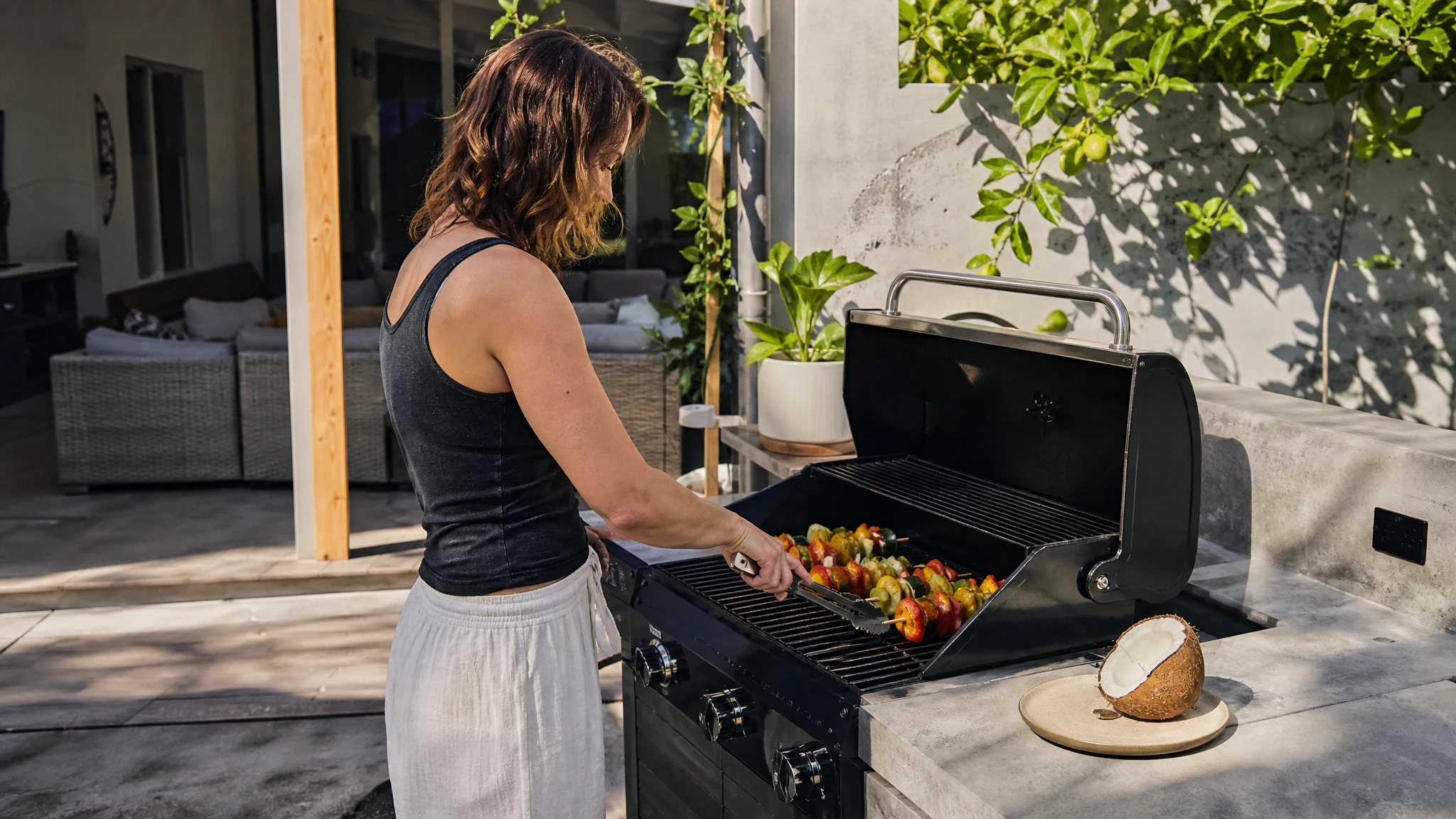
Shrimp skewers glossed with coconut oil, pineapple rings charred at the edges, chicken thighs with lime and chili: coconut oil and a hot grill are an old pairing for good reason. The trick is knowing when the oil goes on. Brush it on at the right moment and you get a fragrant, glossy finish; add it too early or too generously and you get flare-ups and a smoky cookout.

Fractionated Coconut Oil
Our own Fractionated Coconut Oil, in sizes from 0.5 oz to bulk.
From $9.99
Shop Now →Let the flavor choose the jar
Virgin coconut oil tastes and smells like coconut, and refined is the version sold as neutral. That makes virgin the natural partner for shrimp, pineapple, sweet potato, or chicken with lime and chili, where a tropical note is the whole point. Fruit is a particularly happy match: pineapple, mango and peaches brown at the edges because of their natural sugars, and a light coat of fragrant oil right as they come off the heat makes them look and smell like dessert. On a ribeye, where nobody asked for coconut, a neutral oil does the quieter job. Our virgin versus refined article sets the two side by side if you want the longer comparison.
One honest boundary before we go further: we sell our coconut oils for external cosmetic use only, so for the grill you will want a jar sold as food. Everything below is about cooking technique, and it applies to whichever food-grade oil you pick up.
Brush the food, not the grate
Coconut oil is rich in lauric acid, and a 2024 review of frying oils explains why that puts it toward the lower end for smoke point: smoke point depends mainly on free fatty acids and chain length, and oils built on shorter chains such as lauric acid begin to smoke sooner than oils built on longer ones. It also drops as an oil gets used again and again (Abrante-Pascual et al., 2024). Published smoke point figures for any oil vary quite a bit from source to source, and grill surfaces get hotter than most people guess, so we would not lean on a number at all.
The practical conclusion is easy to remember. A thin coat brushed onto the food is the right use. A film spread over a roaring hot grate is not. Save the high heat for the sear, and let the oil be the finishing touch.
For the temperature story behind all this, our smoke point article explains why the published figures disagree, and the frying comparison puts coconut next to olive oil.
Marinades and the fridge
Our virgin unrefined listing solidifies below about 76 degrees Fahrenheit, and a refrigerator is far colder than that. It follows that a coconut oil marinade chilling alongside the meat will thicken and cling in clumps instead of coating evenly. A liquid oil suits the marinade that sits in the fridge. Keep the coconut oil for a brushed finish at room temperature, when it has melted back into a pour.
Raw poultry deserves its own habits. The CDC advises keeping raw chicken and its juices away from ready-to-eat food and storing it on the bottom shelf in a sealed container so nothing drips (CDC, chicken, 2024). Following that logic, a marinade raw meat has sat in is a bowl of raw juices. Set aside the portion you plan to brush on at the end before the meat goes in, use separate brushes for raw and cooked food, and discard what the raw meat touched.
Flare-ups, smoke and basting
The National Cancer Institute explains that when fat and juices drip from meat onto a hot surface or open flame, the resulting smoke and flames deposit compounds on the food, and that high temperatures and long cooking times form more of another group called heterocyclic amines. Its tips are refreshingly practical: keep meat from direct exposure to open flame or hot metal, turn it often, shorten time on high heat, and trim away charred bits (NCI fact sheet, reviewed 2017). The same sheet notes that population studies have not established a definitive link to cancer in people.
What that means for oil is straightforward reasoning: oil is fat, and oil that pools and drips feeds exactly the flare-up the sheet describes. Drain or pat off wet marinade before the food goes on, then brush the coconut oil on thinly late in the cook, or off the heat while the food rests. That is the moment a glossy, fragrant layer adds the most flavor and the least smoke. If you cook on a side burner, keep a lid or baking sheet close, in line with the U.S. Fire Administration's reminder to stay by anything cooking (USFA).
The gloss at the end
There is a lovely moment when food comes off the grill and a spoonful of melted oil meets it. Pineapple rings go glossy and the edges look almost lacquered; shrimp pick up a soft sheen. A small brush, or the back of a spoon, is all you need, and the oil should be warm enough to flow but not smoking. Keep a little in a small bowl near the grill so it is ready when the food is.
Trust the thermometer, not the shine
A glossy coat can look finished well before the middle is. The CDC advises a food thermometer and an internal temperature of 165 F for chicken, and oil does not change that number. Probe the thickest part, and let the thermometer settle the question.
Who may want a different fat
Coconut oil is mostly saturated fat. A 2020 analysis pooling 16 trials found LDL cholesterol was higher with coconut oil than with nontropical vegetable oils (Neelakantan et al., 2020). Those trials used eaten oil in larger amounts than a brushed coat on a skewer, but anyone watching their cholesterol can ask a physician or registered dietitian how often it belongs on the menu.
Popcorn is another place where heat decides everything, and our popcorn article works through it. If you came looking for an oil for skin, hair or a massage blend, that is where our fractionated coconut oil shines, and the grill is better left to its food-grade cousins.
Whatever you grill, let the heat and the thermometer make the big decisions, and let the oil be the fragrant finish.
Fractionated Coconut Oil
Fractionated Coconut Oil from our own shop, in sizes from 0.5 oz to bulk.
From $9.99
Shop Now →Sources & Further Reading
- Abrante-Pascual S, Nieva-Echevarria B, Goicoechea-Oses E, 2024. Vegetable oils and their use for frying: a review of their compositional differences and degradation. Foods 13. PMC11675685
- CDC, 2024. Chicken and food poisoning. cdc.gov/food-safety/foods/chicken
- National Cancer Institute, reviewed 2017. Chemicals in meat cooked at high temperatures and cancer risk. cancer.gov
- U.S. Fire Administration. Cooking fire safety. usfa.fema.gov
- Neelakantan N, Seah JYH, van Dam RM, 2020. The effect of coconut oil consumption on cardiovascular risk factors. Circulation 141(10):803-814. PMID 31928080