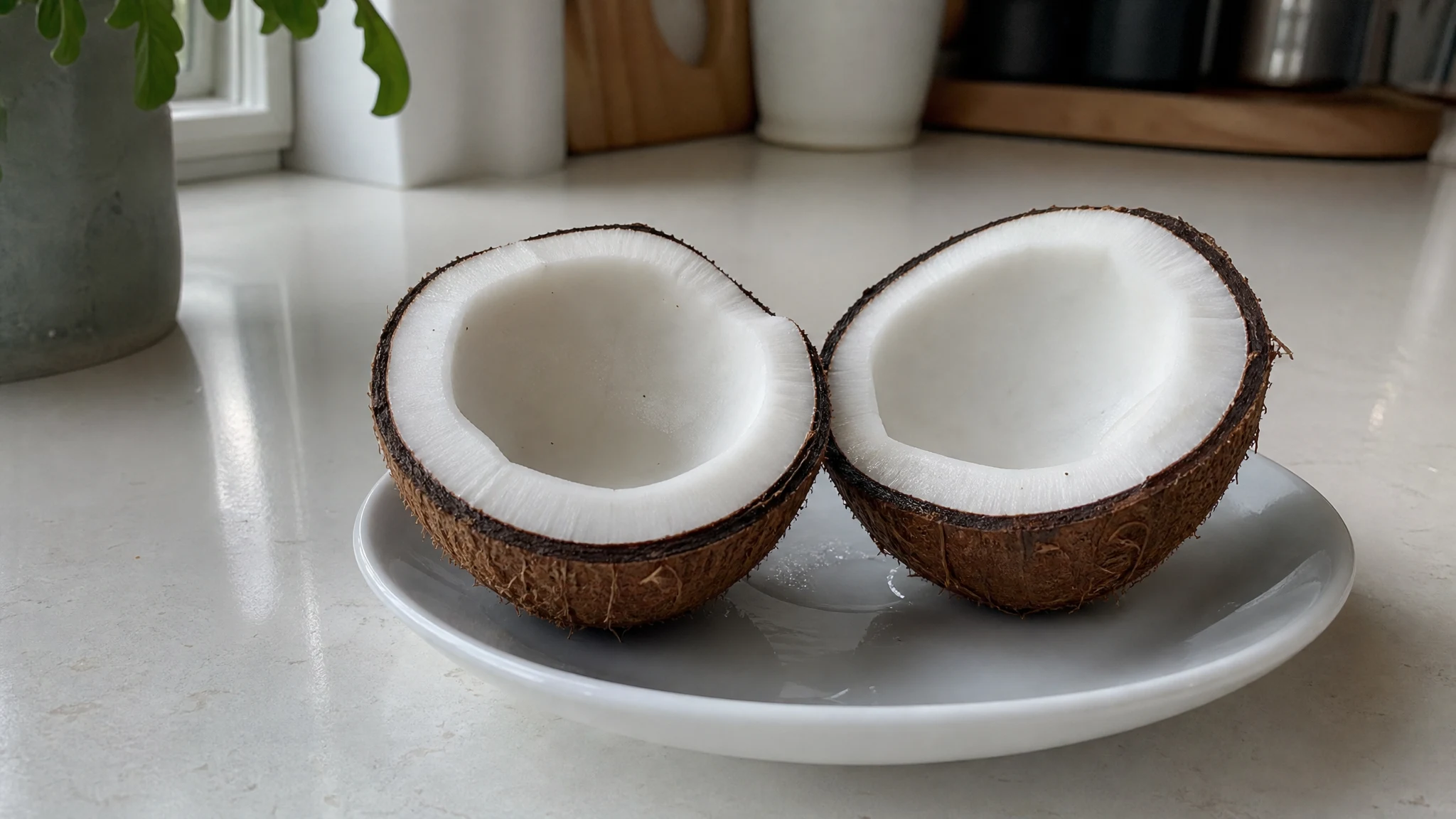
Coconut Oil Allergy: What to Know Before Using It on Skin
It is a fair question, and the answer has a few layers. Yes, a person can be allergic to coconut. Yes, ordinary skin irritation can look a lot like an allergy. And the biggest official change about coconut in recent years is easy to misread. We sell coconut oils, so we care that you know how to sort the real considerations from the noise before you put any oil on your skin or someone else's.

Fractionated Coconut Oil
Our own Fractionated Coconut Oil, in sizes from 0.5 oz to bulk.
From $9.99
Shop Now →How common is a coconut allergy?
Uncommon, but real. A national US survey of 78,851 people, reported by Warren and colleagues (Annals of Allergy, Asthma & Immunology, 2023), found that 0.39% of respondents had what the authors call convincing coconut allergy: 0.43% of adults and 0.22% of children. That is about 1 in 260 people. The detail we find most telling is that fewer than half of them had ever had it confirmed by a physician. Because this was a self-report survey, it is best read as an estimate of how many people describe coconut-type reactions, not a count of confirmed cases. The Academy of Nutrition and Dietetics repeats the 1-in-260 figure in a 2026 article and adds that the study hints at milder symptoms than for some other major allergens, with more research needed.
What the FDA changed
You may have read that coconut is "no longer a tree nut." In a narrow sense that is true. The FDA's food allergen labeling FAQ says the agency no longer considers coconut a major food allergen, and coconut has come off the Tree Nut List in the revised fifth edition of its guidance, published 6 January 2025 (FDA). The major allergens it lists now are milk, egg, fish, crustacean shellfish, tree nuts, wheat, peanuts, soybeans and sesame.
The word to hold on to is labeling. Food Allergy Research & Education (FARE) noted in February 2025 that the FDA did not say coconut stopped being an allergen for the people who react to it. It just will not appear in the bolded allergen statement on a food package. Reasoning from those two pages, someone with a coconut allergy now reads the ingredient list itself, and a food-labeling rule says nothing about how a cosmetic is labeled or how your skin will behave.
Skin has its own rules
For a cosmetic oil, the useful question is what a reaction on the skin means. The NHS describes two kinds of contact dermatitis. In the irritant kind, a substance directly roughs up the outer layer of skin. In the allergic kind, the immune system reacts to something it has learned to see as a threat. Either can show up within hours or days, and the advice is the same: avoid the trigger, ask a pharmacist about symptoms, and see a GP if it is persistent, recurrent or severe.
The American Academy of Allergy, Asthma & Immunology has an Ask the Expert answer on coconut with a nicely balanced tone. It calls reactions to coconut oil itself very rare, acknowledges that coconut can cause contact dermatitis through immune or irritant routes, and points to coconut diethanolamide, an ingredient in some cleaning and hand-care products, as a documented occupational culprit. Both things hold at once: rare across the population, still possible for you.
A calm way to try a new oil
Our product pages ask for a patch test before wider use, and on the fractionated oil page we say to wait 24 hours. There is a reason for the full day. The NHS describes reactions that can arrive hours or days after exposure, so a quick dab and a glance five minutes later can miss a delayed response. Here is the routine we suggest:
- Put a small amount on a small patch of skin, such as the inside of the forearm, and leave it for a full day.
- If you see redness, itch, bumps or swelling, wash it off and stop. Anything spreading, painful or on the face is a reason to see a clinician. Hives, swelling of the lips or face, wheezing or trouble breathing call for emergency care.
- If you blend essential oils into your carrier, remember they are their own set of potential allergens. Our dilution guide covers how much to use.
A rash after using an oil could be an allergy, irritation, a different product used at the same time, or an existing skin condition. Telling them apart is a job for a dermatologist or allergist, and the AAAAI notes that testing for coconut is available.
If you have a tree nut allergy
Our product pages ask anyone with a tree nut or coconut allergy to check with a professional before use, and the evidence on overlap shows why. It is small and mixed. The AAAAI page says cross-reacting allergens between coconut and tree nuts have been documented, while its author judges the added risk for a tree nut-allergic child as probably slight. A small retrospective review by Stutius and colleagues (2010) tested 191 children for sesame but only 40 for coconut, and found that peanut and tree nut sensitization tracked with sesame sensitization but not with coconut. Forty children cannot settle much, so the answer for any individual is an allergist's evaluation rather than a general rule.
Does refining or fractionating change the picture?
It is a reasonable-sounding idea, and you will see it stated as fact. The AAAAI page says protein content varies with processing and that deodorized coconut oil contains much less protein than crude oil, though the clinical significance of those levels is unclear. We have no protein or allergen data to offer for our oils: the certificate of analysis we publish for one fractionated batch reports density, refractive index and optical rotation, and there is nothing for the virgin unrefined listing. So we will not tell an allergic person that fractionated is safer than virgin. If documentation matters to you, ask us in writing before ordering, and ask your doctor for the opinion that counts.
Where our oils fit
We sell fractionated coconut oil and a virgin unrefined listing, both for external cosmetic use only, and we make no claim that either suits every skin. If your skin handles coconut well, our guide to choosing by job and virgin versus refined will help you pick between them. For babies and children, talk with a pediatrician first; our baby skin article reports what the studies did and did not test. And if a rash or eczema is what brought you here, the eczema and psoriasis article is a better starting point than any oil bottle.
Fractionated Coconut Oil
Fractionated Coconut Oil from our own shop, in sizes from 0.5 oz to bulk.
From $9.99
Shop Now →Sources & Further Reading
- Warren CM, Sehgal S, Nimmagadda SR, Gupta RS, 2023. Prevalence and burden of coconut allergy in the United States. pubmed.ncbi.nlm.nih.gov/37625503
- Academy of Nutrition and Dietetics, 2026. Coconut is no longer a tree nut allergen. eatright.org
- US FDA. Frequently asked questions: food allergen labeling guidance. fda.gov
- Food Allergy Research & Education, 2025. Update on FDA guidance for food allergen labeling. foodallergy.org
- NHS. Contact dermatitis. nhs.uk/conditions/contact-dermatitis
- American Academy of Allergy, Asthma & Immunology. Ask the Expert: reaction to coconut. aaaai.org
- Stutius LM et al., 2010. Characterizing the relationship between sesame, coconut, and nut allergy in children. pubmed.ncbi.nlm.nih.gov/21073539