Coconut Oil for Skin: What the Studies Really Show
Coconut oil's reputation on skin is much bigger than its paper trail, and that gap is actually a fun place to explore. Behind the confident claims sits a short stack of small studies, nearly all done with virgin coconut oil. Once you know what each one measured, you can read the next headline like an insider, and you can pick an oil for the job you actually have.

Fractionated Coconut Oil
Our own Fractionated Coconut Oil, in sizes from 0.5 oz to bulk.
From $9.99
Shop Now →Dry skin, the best-supported use
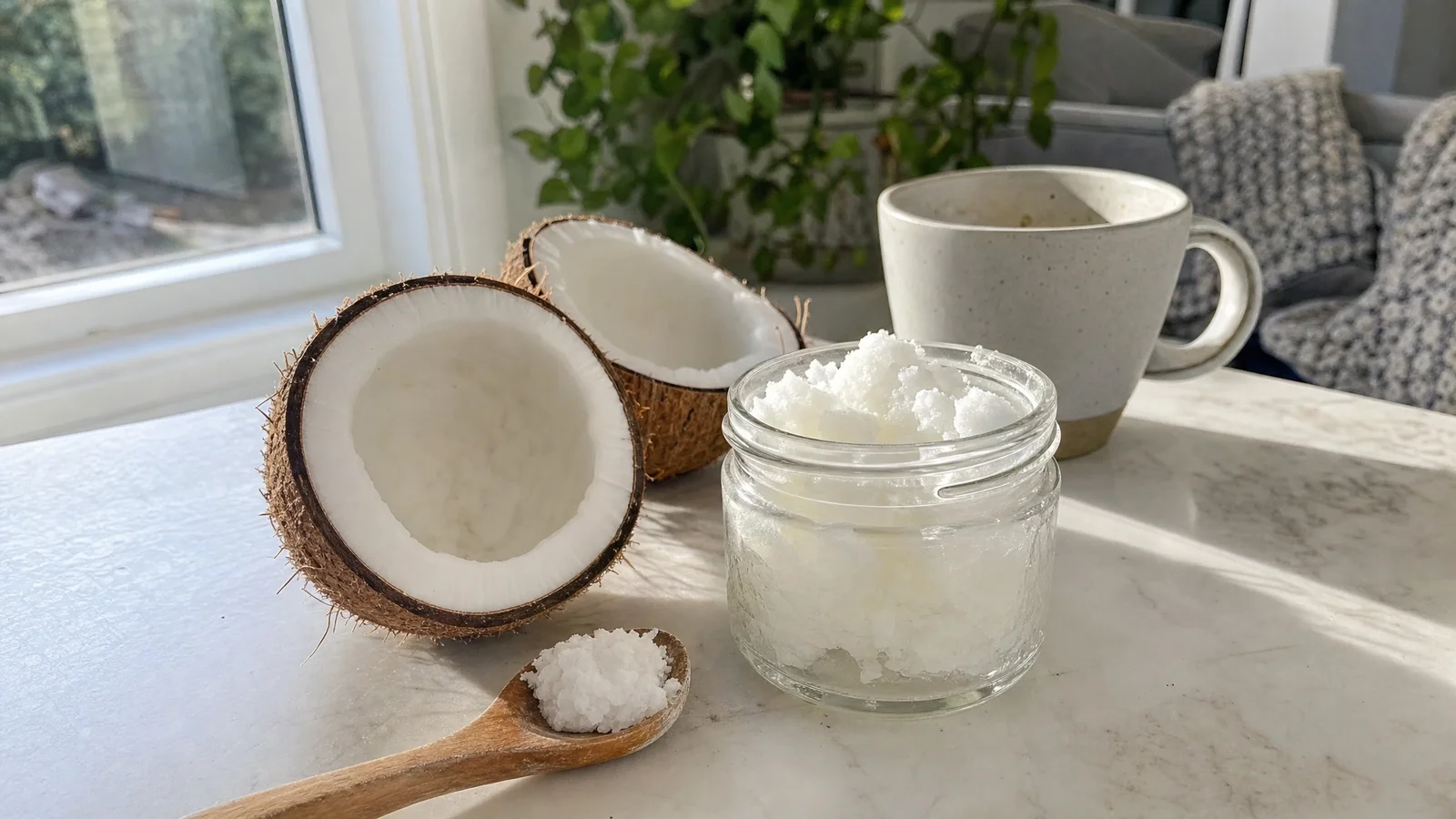
The most solid result is also the most down-to-earth. In a double-blind trial, 34 people with mild to moderate dry skin were randomized to virgin coconut oil or mineral oil on their legs, twice a day for two weeks. Both raised skin hydration and surface lipids, and neither caused adverse reactions (Agero and Verallo-Rowell, 2004). It is a modest study, and it matches what most of us notice at home: a plain oil smoothed over skin after a bath leaves it feeling softer. Our elbows and knees guide turns that into a routine.
The American Academy of Dermatology adds the practical frame: keep baths and showers to five to ten minutes in warm water, moisturize while the skin is still damp, and remember that creams and ointments hold more moisture than lotions (AAD, updated January 2026). Its list of helpful ingredients names jojoba oil, mineral oil, petrolatum and shea butter, among others. Coconut oil is not on it, and we take that as a nice reminder that there are many good moisturizers, which is also why we like comparing them in coconut versus shea butter.
Eczema studies, and what they are for
The other two trials people quote are about atopic dermatitis, a medical skin condition. In 117 children with mild to moderate eczema, virgin coconut oil scored better than mineral oil on a severity scale over eight weeks (Evangelista et al., 2014). In 52 adults with eczema, Staphylococcus aureus was still detected afterward in 1 of 20 who used virgin coconut oil versus 6 of 12 who used virgin olive oil over four weeks (Verallo-Rowell et al., 2008). Both are interesting findings about a specific oil, a specific group and a specific comparison. We sell an external cosmetic oil and make no medical claims, so a dermatologist or GP is the right first stop for eczema or any rash, and our eczema and psoriasis article goes through what each trial did.
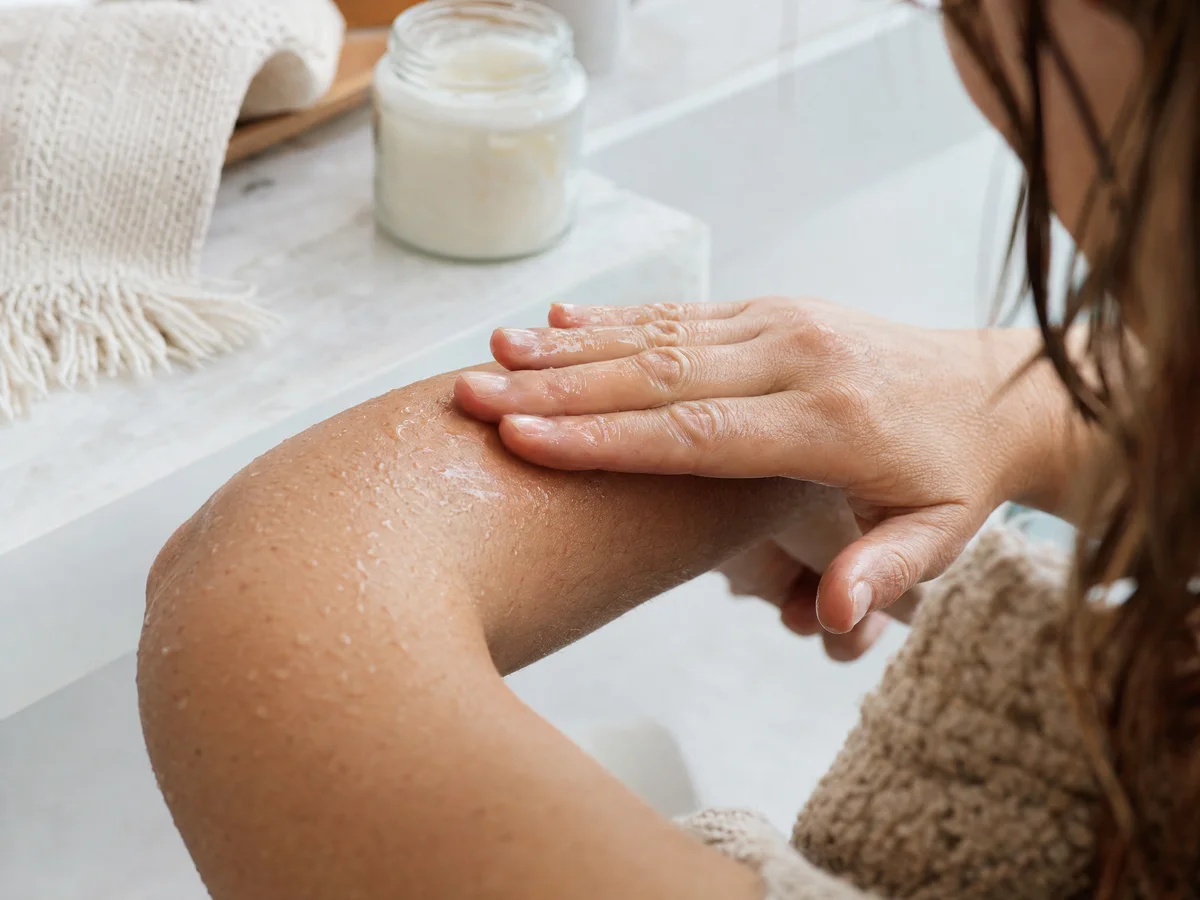
The bigger picture is encouraging in its own way. A Cochrane review of 77 trials covering 6,603 people found that moisturisers in general reduced eczema flares, with no reliable evidence that any single moisturiser beats the others (van Zuuren et al.). The habit of moisturizing matters more than the brand of oil.
Stretch marks and sun
Two more popular questions deserve a quick answer. A Cochrane review of six trials in 800 women, testing creams that included olive oil and cocoa butter, found no clear prevention of stretch marks (Brennan, Young and Devane), and our cocoa butter comparison picks up from there. On sun, coconut oil is not a sunscreen, and the AAD points people to broad-spectrum, water-resistant SPF 30 or higher. We cover that in the sunscreen post, and the face article covers where a drop of oil does fit.
Which coconut oil was used?
Every trial above used virgin coconut oil. That oil is roughly half lauric acid, with smaller shares of myristic, palmitic, caprylic and capric acids (Lin, Zhong and Santiago, 2018). We describe our fractionated oil as keeping only the medium-chain triglycerides, so its fatty-acid mix is different by design. The certificate of analysis we publish for one fractionated batch lists physical constants only: relative density 0.948, refractive index 1.450 and optical rotation +0.00 degrees at 20 C. It carries no fatty-acid profile, so we do not quote percentages.
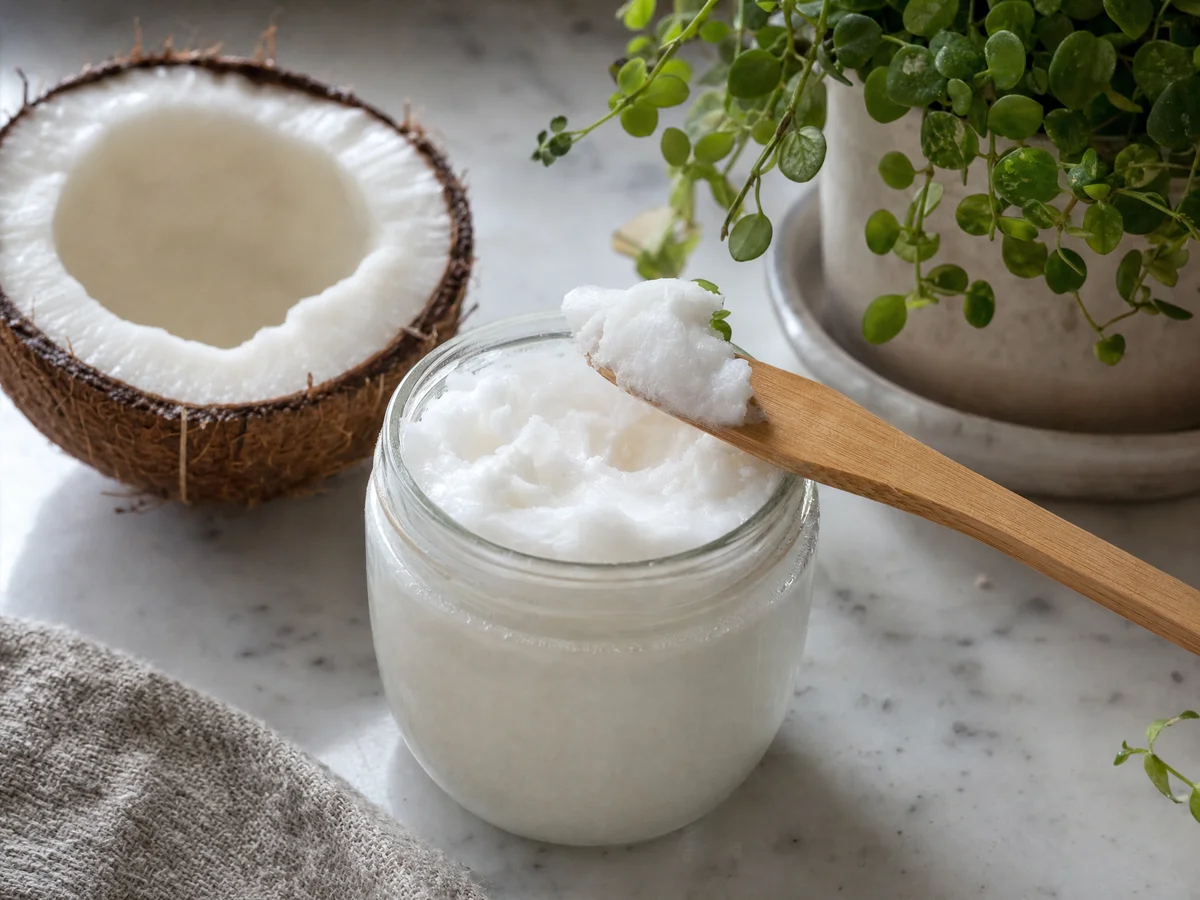
What follows is reasoning and not a trial result: findings from virgin oil should not be assumed to carry over to fractionated oil, and the reverse holds too. What we can say is that our fractionated coconut oil is fast-absorbing and non-greasy, stays liquid at any temperature and is virtually odorless, which makes it a light, easy oil for massage blending, roll-ons and DIY skincare. That is a lovely job to have.
Choosing between our two oils
For a light, liquid oil that blends cleanly with essential oils, start with fractionated coconut oil. For the full coconut aroma, the creamy feel and the form the studies used, virgin unrefined is the match. It is firm in a cool room and melts in warm hands. Both are for external cosmetic use. We do not publish a certificate for the virgin listing, so if you need documentation, ask us in writing. Our guide to choosing by skin type helps with the rest.
A few safety notes in plain terms. Patch test a small area first and wait 24 hours, keep oil away from your eyes, and check with a professional if you have a coconut or tree nut allergy. In January 2025 the FDA stopped listing coconut as a tree nut for food allergen labeling, but it did not say coconut allergy is not real, and that rule applies to food labels (FDA, food allergen labeling FAQ).
A handy filter for the next claim
When you read a coconut oil claim, ask which oil was used, where it went (skin, scalp, mouth or dinner plate), how many people took part for how long, and what it was compared with. The FDA draws a related line from the legal side: whether something is a cosmetic or a drug depends on its intended use, shown by labeling and advertising claims (FDA). That is why our pages stay with soft, smooth-feeling skin. If you are weighing oils against each other next, coconut versus mineral oil and coconut versus olive oil are the natural reads.
Fractionated Coconut Oil
Fractionated Coconut Oil from our own shop, in sizes from 0.5 oz to bulk.
From $9.99
Shop Now →Sources & Further Reading
- Agero AL, Verallo-Rowell VM, 2004. Coconut oil versus mineral oil as a moisturizer for xerosis. Dermatitis 15(3):109-16. pubmed/15724344
- American Academy of Dermatology, 2026. Dermatologists' top tips for relieving dry skin. aad.org
- American Academy of Dermatology. How to apply sunscreen. aad.org
- Evangelista MT et al., 2014. Topical virgin coconut oil in mild to moderate pediatric atopic dermatitis. Int J Dermatol 53(1):100-8. pubmed/24320105
- Verallo-Rowell VM et al., 2008. Coconut and virgin olive oils in adult atopic dermatitis. Dermatitis 19(6):308-15. pubmed/19134433
- van Zuuren EJ et al., 2017. Emollients and moisturisers for eczema. Cochrane Database Syst Rev CD012119. cochrane.org
- Brennan, Young, Devane. Topical preparations for preventing stretch marks in pregnancy. Cochrane Database Syst Rev CD000066. cochrane.org
- Lin TK, Zhong L, Santiago JL, 2018. Anti-inflammatory and skin barrier repair effects of topical application of some plant oils. Int J Mol Sci 19(1):70. pmc/PMC5796020
- US FDA. Food allergen labeling guidance FAQ. fda.gov
- US FDA. Is it a cosmetic, a drug, or both? fda.gov