Coconut Oil vs Mineral Oil: A Near Tie on Dry Skin
"Natural versus petroleum" makes a tidy headline, and it turns out to be a less useful question than it sounds. When researchers put virgin coconut oil and mineral oil head to head on dry skin, the two came out nearly even. That is good news for anyone who simply wants a plain oil on rough legs, and it is a nice reminder that what an oil is made from tells you less than what it does on your skin.

Fractionated Coconut Oil
Our own Fractionated Coconut Oil, in sizes from 0.5 oz to bulk.
From $9.99
Shop Now →Two weeks on dry legs
In a double-blind trial, 34 people with mild to moderate dry skin were randomly assigned to virgin coconut oil or mineral oil on their legs, twice a day for two weeks. Both oils raised skin hydration and surface lipids. Water loss through the skin and skin pH, measured as safety checks, did not differ meaningfully between the groups, and nobody had a reaction. Coconut oil showed a trend toward better symptom scores that never reached statistical significance, and the authors called it as effective and safe as mineral oil for this use (Agero and Verallo-Rowell, 2004).
What does that mean in practice? A simple oil, rubbed in regularly, leaves dry skin feeling more hydrated, and the plant oil kept pace with the lab-made one. It is a modest, friendly result. It is not evidence that coconut oil rebuilds the skin barrier, since barrier-related water loss was no different between the groups. Hydration is what improved, and hydration is most of what dry skin feels like day to day.
The study with children, and where we stop
A second trial followed 117 children with mild to moderate atopic dermatitis for eight weeks, 59 using virgin coconut oil and 58 using mineral oil, and reported larger improvements on a clinical severity score in the coconut group (Evangelista et al., 2014). It is an interesting paper, but it concerns a medical condition in children and was scored with a clinical tool, so it belongs in a pediatrician's or dermatologist's office. We sell an external cosmetic oil, and we make no claims about eczema.
Both trials used virgin coconut oil, which keeps its long-chain fats. Our fractionated oil is a different material, so carrying either result over to it is an inference, not a finding.
Where mineral oil fits in the picture
Mineral oil comes from petroleum, and a review of botanical skin oils describes it as an effective conditioning agent that adds hydration (Moore, Wagner and Komarnytsky, 2020). In the United States it also appears in the FDA's skin protectant monograph as an active ingredient at 50 to 100 percent, next to petrolatum, cocoa butter, dimethicone and zinc oxide (21 CFR 347.10). That matters because a product sold as a skin protectant is a regulated over-the-counter drug with a stated strength. Ours is a cosmetic carrier oil, so if you want a labeled protectant for chapped or cracked skin, a pharmacist can point you to one.
Three practical differences
Aging in the bottle. Coconut oil is mostly saturated, with about 49% lauric acid and only around 6% oleic and 2% linoleic (Lin, Zhong and Santiago, 2018). Fats with fewer double bonds generally resist oxidation better, so it follows that coconut oil should keep well. That is reasoning from composition, not a measurement of our bottles. We say about two years unopened for our fractionated oil, stored cool and dark.
Skin type. The same Moore review links coconut oil with breakouts on skin that is not very dry, and comedogenic scales are debated. If your skin tends to break out, a small patch test (we ask for a 24-hour wait with our fractionated oil) is a sensible first step, and our post on pores explains why a chart number is a loose guide.
Allergies. Coconut oil is a plant product and mineral oil is not, so a coconut allergy is a clear reason to prefer one over the other. If you have a tree nut or coconut allergy, check with an allergist or another professional before using ours.
Where our oils come in
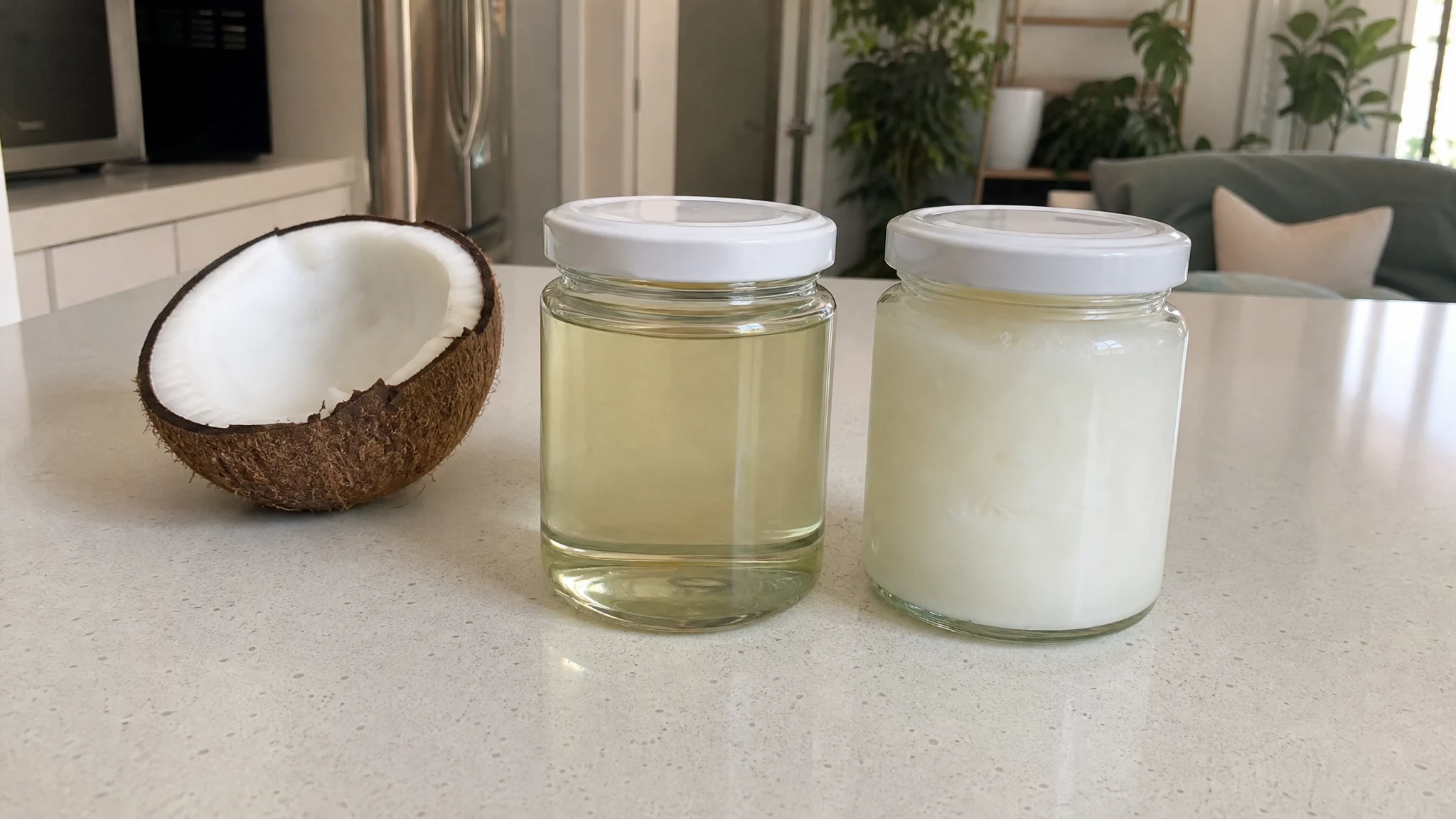
If you want a light, liquid base, fractionated coconut oil is what we make: fast-absorbing, non-greasy and liquid at any temperature, which is why it suits massage blends, roll-ons and DIY mixing. If you love the aroma and the richer feel, virgin unrefined is the one that matches what the trials used. Our virgin versus refined guide explains the difference.
One label tip while you shop: virgin, refined and fractionated coconut oil can all carry the same ingredient name, so the INCI line will not tell you which one you are holding. The certificate we publish for one fractionated batch lists Cocos nucifera (Coconut) Fruit Oil with extraction method "Fractionated", plus density, refractive index and optical rotation. It does not include a fatty-acid profile or peroxide value, so if you need either, ask in writing before ordering, from us or anyone else.
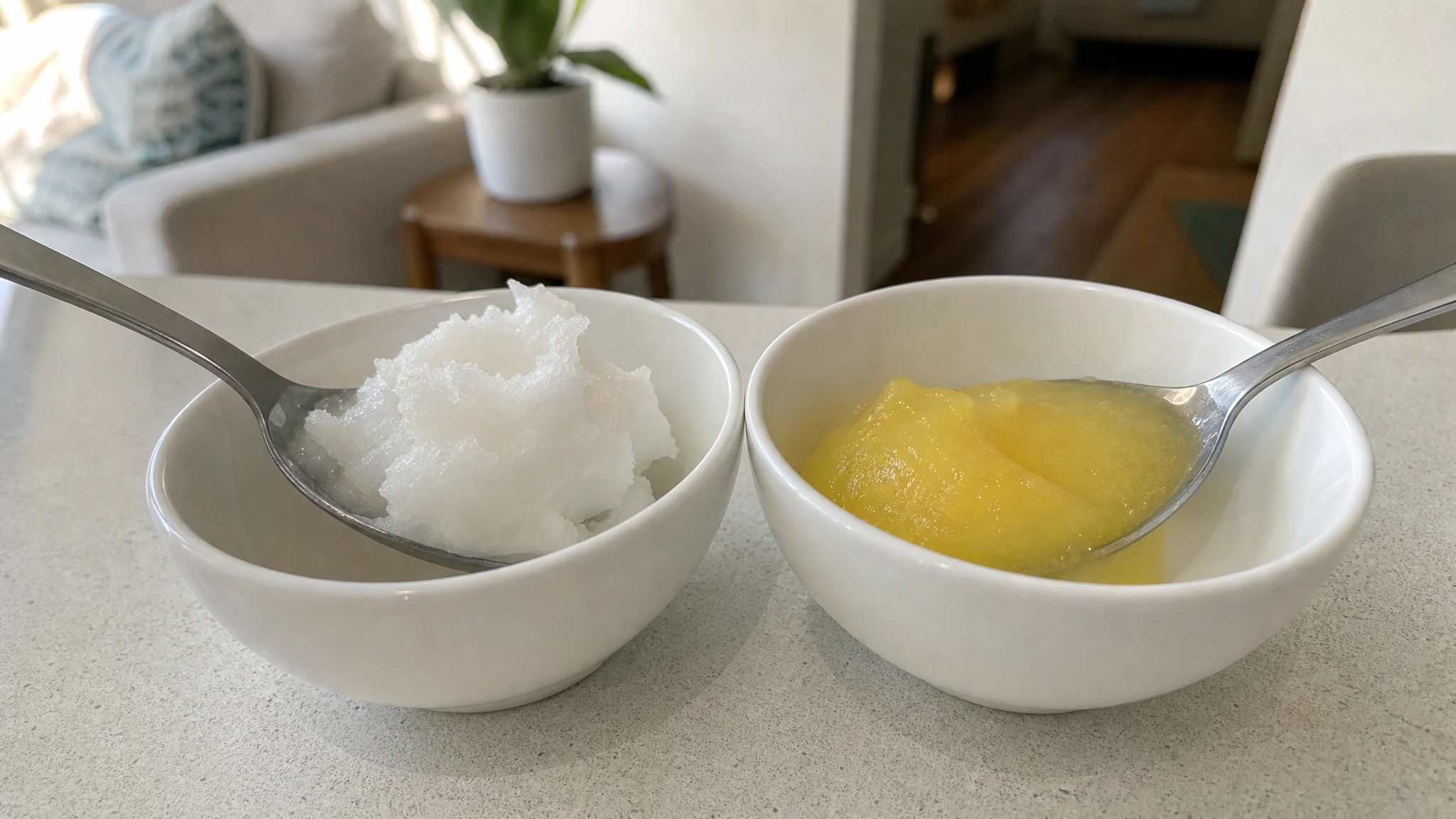
You can learn a lot from a simple hand test. Put a single drop of each oil on the back of your hand and watch how it spreads, how glossy it looks, and how long the shine lingers. Notice the smell, or the lack of one, and how your hand feels a few minutes later. Preferences here are personal, and since the trial found the two close on hydration, your own hand is a fair judge.
A quick way to decide
- Everyday dry skin: both oils did about the same on hydration in the trial, so choose on feel, scent and allergies.
- Eczema, especially in a child: ask a pediatrician or dermatologist before choosing any oil.
- Cracked, bleeding or infected skin: a pharmacist or physician comes first.
- A light base for blending or massage: that is the job fractionated coconut oil does best.
Still comparing oils? Coconut versus jojoba, coconut versus olive oil on skin and the skin type guide cover the neighboring questions, and our overview of the skin studies sets these two trials in context.
Fractionated Coconut Oil
Fractionated Coconut Oil from our own shop, in sizes from 0.5 oz to bulk.
From $9.99
Shop Now →Sources & Further Reading
- Agero AL, Verallo-Rowell VM, 2004. A randomized double-blind controlled trial comparing extra virgin coconut oil with mineral oil as a moisturizer for mild to moderate xerosis. Dermatitis 15(3):109-16. pubmed.ncbi.nlm.nih.gov/15724344
- Evangelista MT et al., 2014. Topical virgin coconut oil vs mineral oil in pediatric atopic dermatitis. Int J Dermatol 53(1):100-8. pubmed.ncbi.nlm.nih.gov/24320105
- Moore EM, Wagner C, Komarnytsky S, 2020. The enigma of bioactivity and toxicity of botanical oils for skin care. Front Pharmacol. pmc.ncbi.nlm.nih.gov/articles/PMC7272663
- Lin TK, Zhong L, Santiago JL, 2018. Anti-inflammatory and skin barrier repair effects of topical application of some plant oils. Int J Mol Sci 19(1):70. pmc.ncbi.nlm.nih.gov/articles/PMC5796020
- US FDA, 21 CFR 347.10, Skin protectant active ingredients. law.cornell.edu/cfr/text/21/347.10