Coconut Oil vs Avocado Oil: Solid or Pourable?
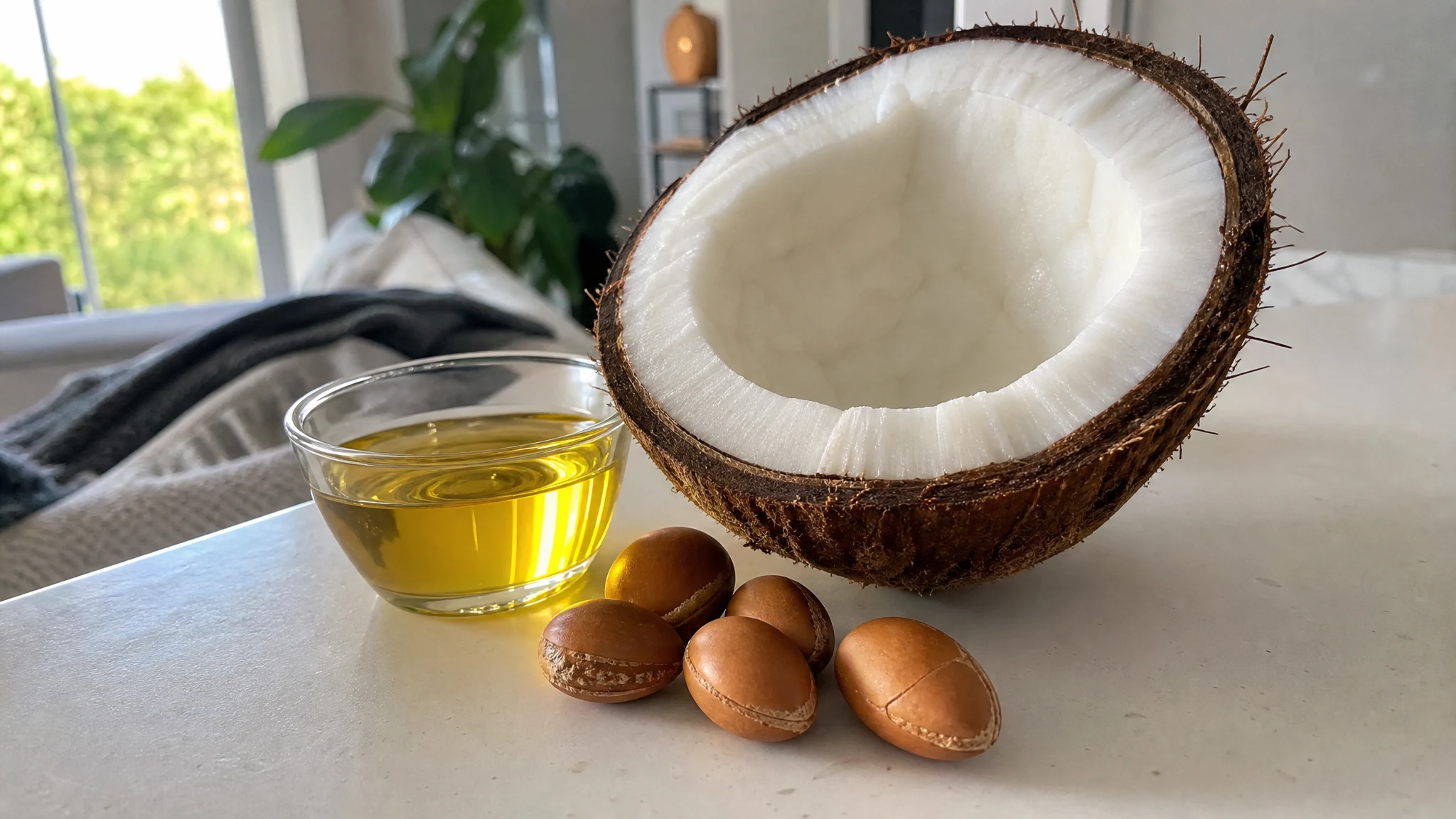
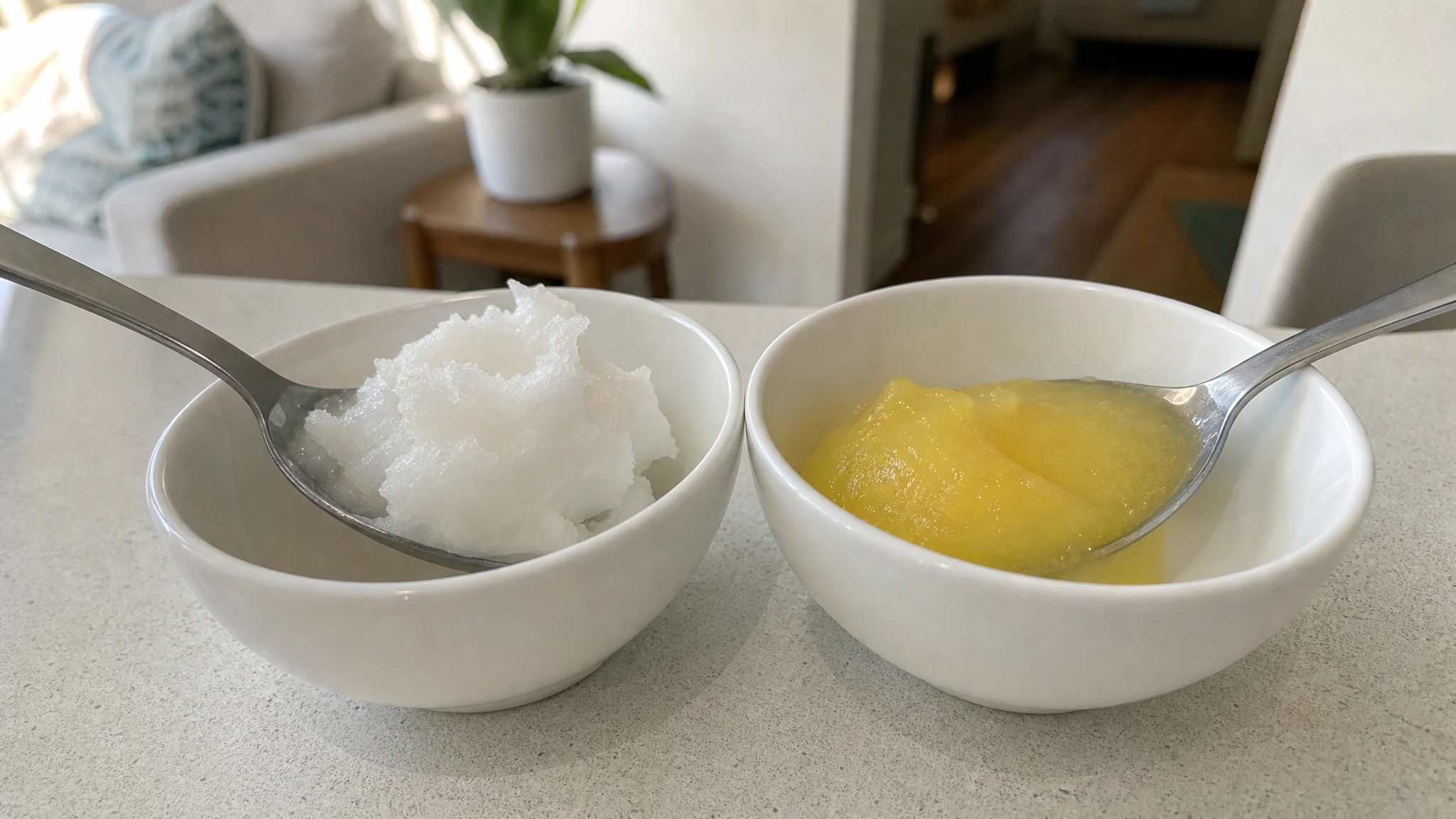
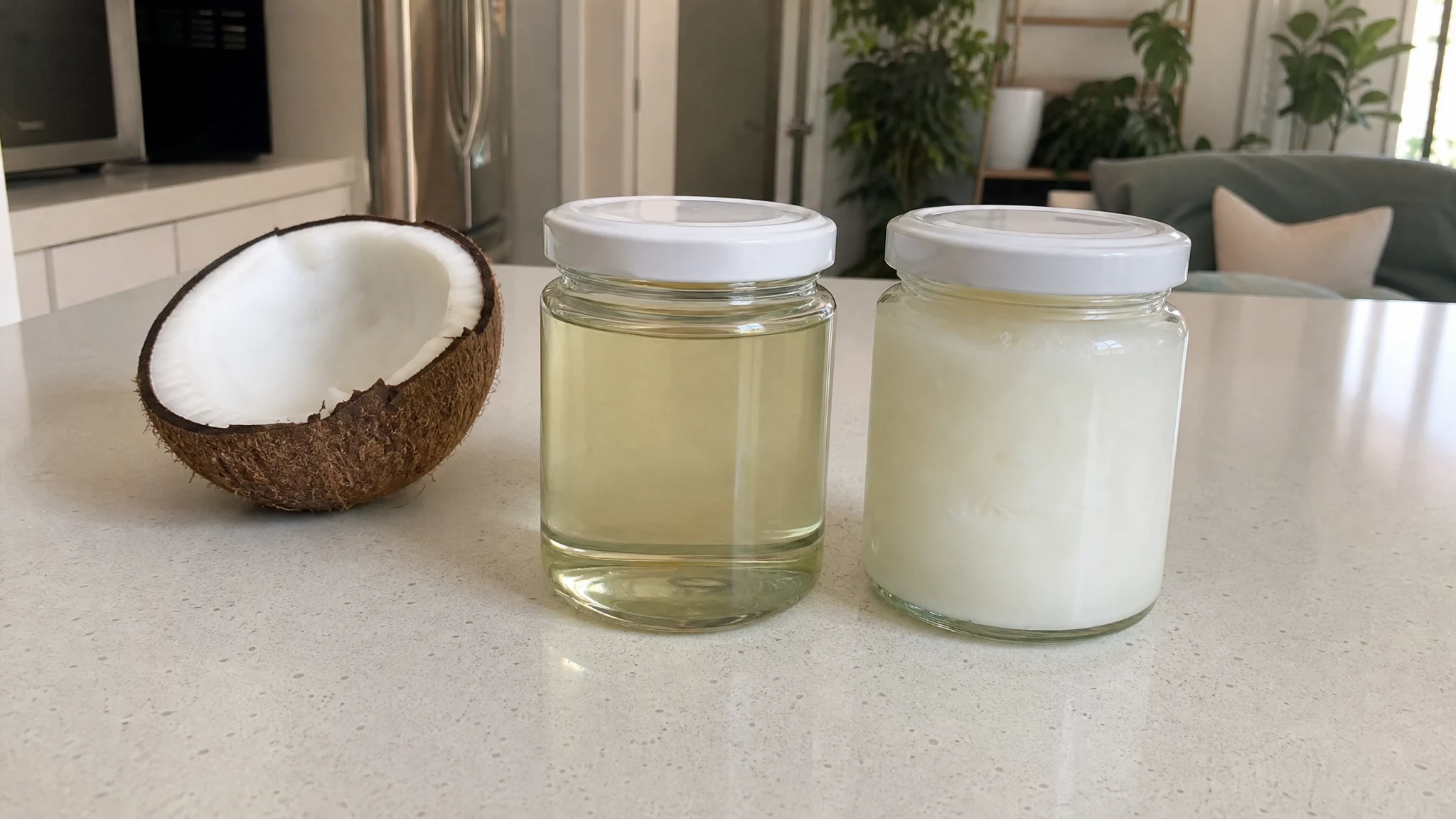
Open a jar of coconut oil and you find a creamy white block that melts into a clear pool in your palm. Pour avocado oil and you get a green-gold liquid with a soft, buttery smell. They live side by side in pantries and on bathroom shelves, and the quickest way to choose between them is to ask a very simple question: does this job want a fat that sets, or one that pours?
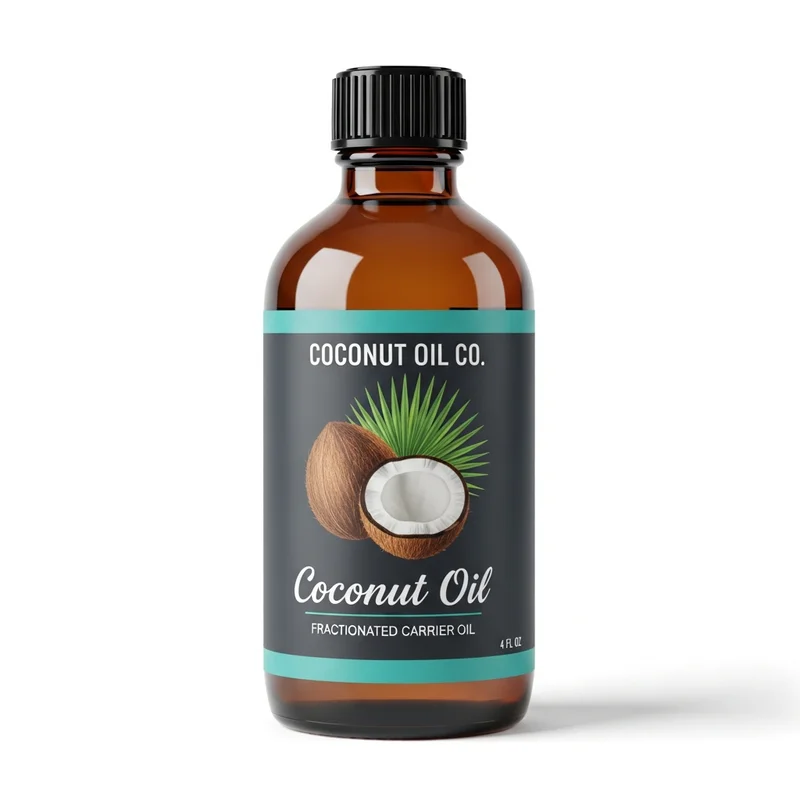
Fractionated Coconut Oil
Our own Fractionated Coconut Oil, in sizes from 0.5 oz to bulk.
From $9.99
Shop Now →Two fats, built differently
The big difference is how saturated they are. In a 2015 gas-chromatography survey of vegetable oils, coconut oil came out at 92.1% saturated fatty acids, with lauric acid alone at 47.7% (Orsavova et al., 2015). The USDA lists the same oil at 99.1 g of fat per 100 g, 82.5 g of it saturated (FoodData Central). The two sets of numbers agree; one is grams per 100 g of oil, the other a share of the fatty acids.
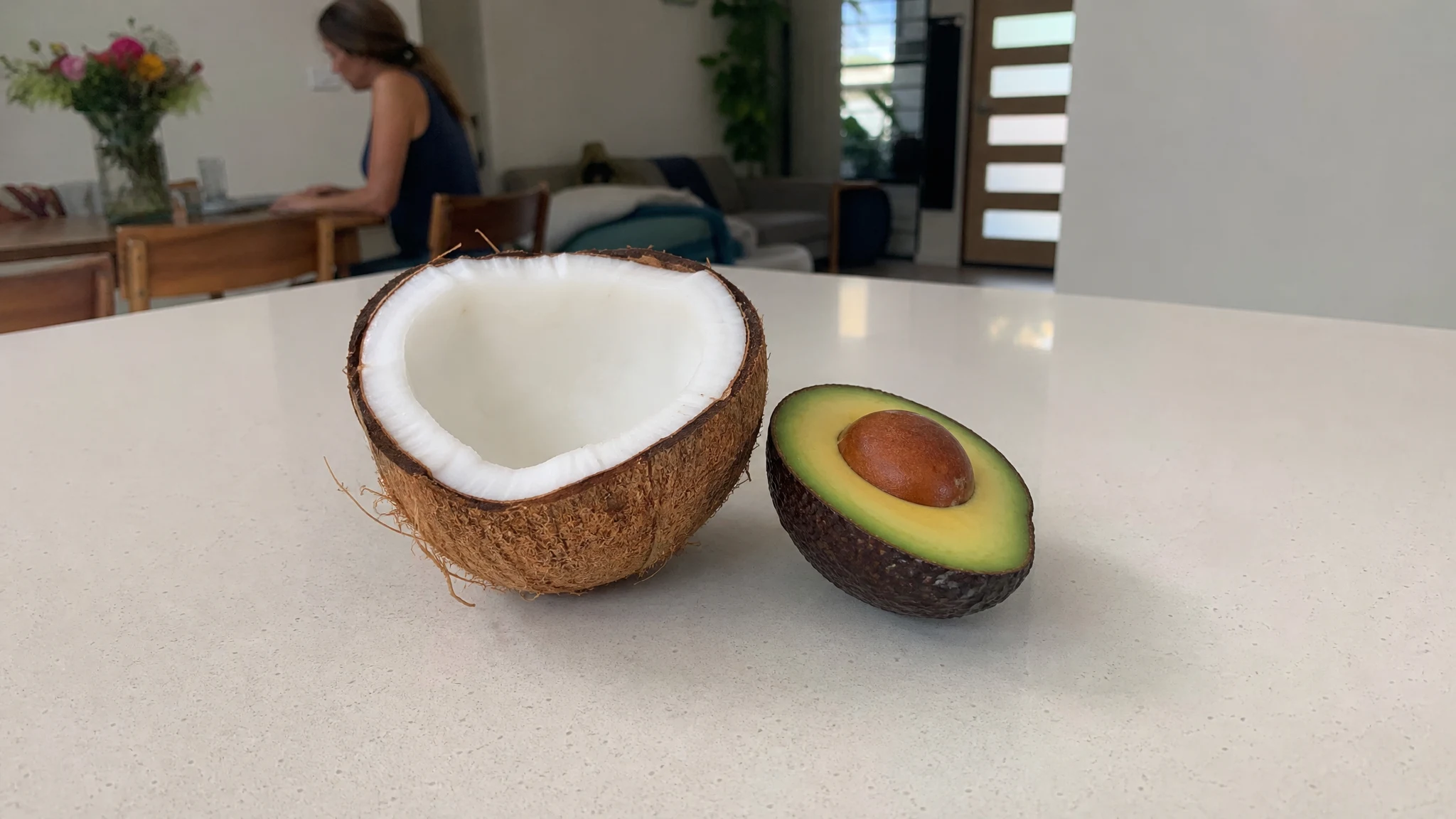
Avocado oil is mostly oleic acid, the fat that dominates olive oil, and it varies more from bottle to bottle. A review of avocado oil quotes one study at 69.4% monounsaturated, 16.6% polyunsaturated and 14% saturated, and shows oleic acid ranging from roughly 41% to 67% depending on cultivar and origin (Flores et al., 2019). That spread is why avocado oil can feel a little different from brand to brand, while coconut oil is steadier on paper.
In everyday terms, coconut oil is solid in a cool room and liquid in a warm one (our virgin listing firms up below about 76 F), and avocado oil stays pourable. Most of the practical choices below follow from that single fact.
In the hot pan, closer than you might expect
Search for the best high-heat oil and avocado oil is usually crowned. The measurements are less one-sided. In a 2018 skillet test, Milk Street heated highly refined oils and read the temperature with infrared thermometers when each began to smoke, three runs per oil. Refined coconut oil averaged 423 F and avocado oil 412 F, with canola at 453 F and olive oil at 449 F (Milk Street, 2018). They left out unrefined coconut oil and extra-virgin olive oil because both smoke lower, and they point out that published smoke points often differ from their own readings.
Another angle is how an oil holds up while it stays hot. One research team heated avocado oil and olive oil at 180 C for up to nine hours and tracked oxidation markers, phytosterols and vitamin E, concluding that avocado oil's stability was similar to olive oil's (Berasategi et al., 2012). Put the two findings together and a sensible reading is that refined avocado oil and refined coconut oil are both capable pan oils, and the refining level of the bottle matters more than the name on it. For the longer story of why smoke-point charts disagree, see our smoke point guide, and for the olive oil matchup there is coconut against olive oil for frying.
Baking and cold dishes
Here the physical state matters more than the chemistry. Cookies creamed with sugar, flaky pastry and no-bake bars want a fat that firms up, and coconut oil is the one of the pair that does. Salad dressings, marinades and liquid batters want a fat that stays pourable, which makes avocado oil the natural fit; coconut oil turns cloudy and sets in a cold fridge. If you are swapping coconut oil in for butter, our baking swap guide has the arithmetic.
On flavor, avocado oil is mild and a little grassy, while virgin coconut oil announces itself. We describe our virgin listing as having a rich, creamy, unmistakably coconut aroma, which is a joy in a curry or a tropical cake and a lot in a plain sauté.
A word on the heart-health conversation
This one belongs to a clinician or registered dietitian, so here is simply what the big reviews say. A 16-trial meta-analysis found coconut oil raised LDL cholesterol by 10.47 mg/dL (95% CI 3.01 to 17.94) compared with nontropical vegetable oils (Neelakantan et al., 2020). The 2017 American Heart Association advisory found that in randomized trials, replacing saturated fat with polyunsaturated vegetable oil lowered cardiovascular disease by about 30% (Sacks et al., 2017). Avocado oil is mainly monounsaturated, and neither paper rates it directly, so treat both as a map of the landscape rather than a verdict on any bottle.
On skin and hair
This is where our shelves come in. We sell fractionated coconut oil and a virgin unrefined coconut oil, both for external cosmetic use only. Our fractionated oil stays liquid at any temperature, and we describe it as fast-absorbing, non-greasy and virtually odorless, which is why it turns up in massage blends, roll-ons and DIY skincare. Fractionation changes an oil's makeup, so the composition numbers earlier in this article describe ordinary coconut oil rather than our bottle; the one certificate of analysis we publish covers density, refractive index and optical rotation for a single batch.
Avocado oil has devoted fans in skin care as well. A review of plant oils for the skin describes it as a rich source of enrichment for dry, damaged or chapped skin, based largely on rat wound studies, and the same paper notes that oleic acid applied continuously can disrupt the skin barrier (Lin, Zhong and Santiago, 2018). What follows is reasoning rather than a trial result: avocado oil can be around half oleic acid and coconut oil is closer to 6%, so someone with easily irritated skin may like to try avocado oil on a small patch first and use it occasionally. For skin-focused matchups, see coconut against olive oil on skin or coconut against jojoba.
Choosing in one breath
Searing and roasting: refined versions of either do the job, so pick on flavor and keep the pan under the smoke. Pastry, cookies and anything that has to set: coconut oil. Dressings and pourable batters: avocado oil. Skin and hair: an oil bought for that purpose. Our fractionated coconut oil is made for it, while avocado oil is not something we sell and neither of our coconut oils is a food oil, so a food-labelled bottle is the right choice for the stove.
Whichever you reach for on skin, patch test a small area and wait 24 hours, keep it away from your eyes, and check with a professional first if you have a coconut or tree nut allergy. Ongoing dryness, rashes or eczema deserve a dermatologist's attention rather than a carrier oil. If you are curious how the coconut oil types differ before you shop, virgin against refined is a good next stop.
Fractionated Coconut Oil
Fractionated Coconut Oil from our own shop, in sizes from 0.5 oz to bulk.
From $9.99
Shop Now →Sources & Further Reading
- Orsavova et al., 2015. Fatty acids composition of vegetable oils. Int J Mol Sci 16(6):12871-90. PMC4490476
- USDA, FoodData Central. Oil, coconut (fdcId 330458). fdc.nal.usda.gov/330458
- Flores et al., 2019. Avocado oil: characteristics, properties, and applications. Molecules 24(11):2172. PMC6600360
- Milk Street, 2018. The most durable oils for high-heat cooking. 177milkstreet.com
- Berasategi et al., 2012. Stability of avocado oil during heating: comparative study to olive oil. Food Chem 132(1):439-446. PMID 26434313
- Sacks et al., 2017. Dietary fats and cardiovascular disease: AHA presidential advisory. Circulation 136(3):e1-e23. PMID 28620111
- Neelakantan et al., 2020. Effect of coconut oil consumption on cardiovascular risk factors. Circulation 141(10):803-814. PMID 31928080
- Lin, Zhong and Santiago, 2018. Anti-inflammatory and skin barrier repair effects of topical application of some plant oils. Int J Mol Sci 19(1):70. PMC5796020