Coconut Oil vs Argan Oil for Hair: Which Fits?
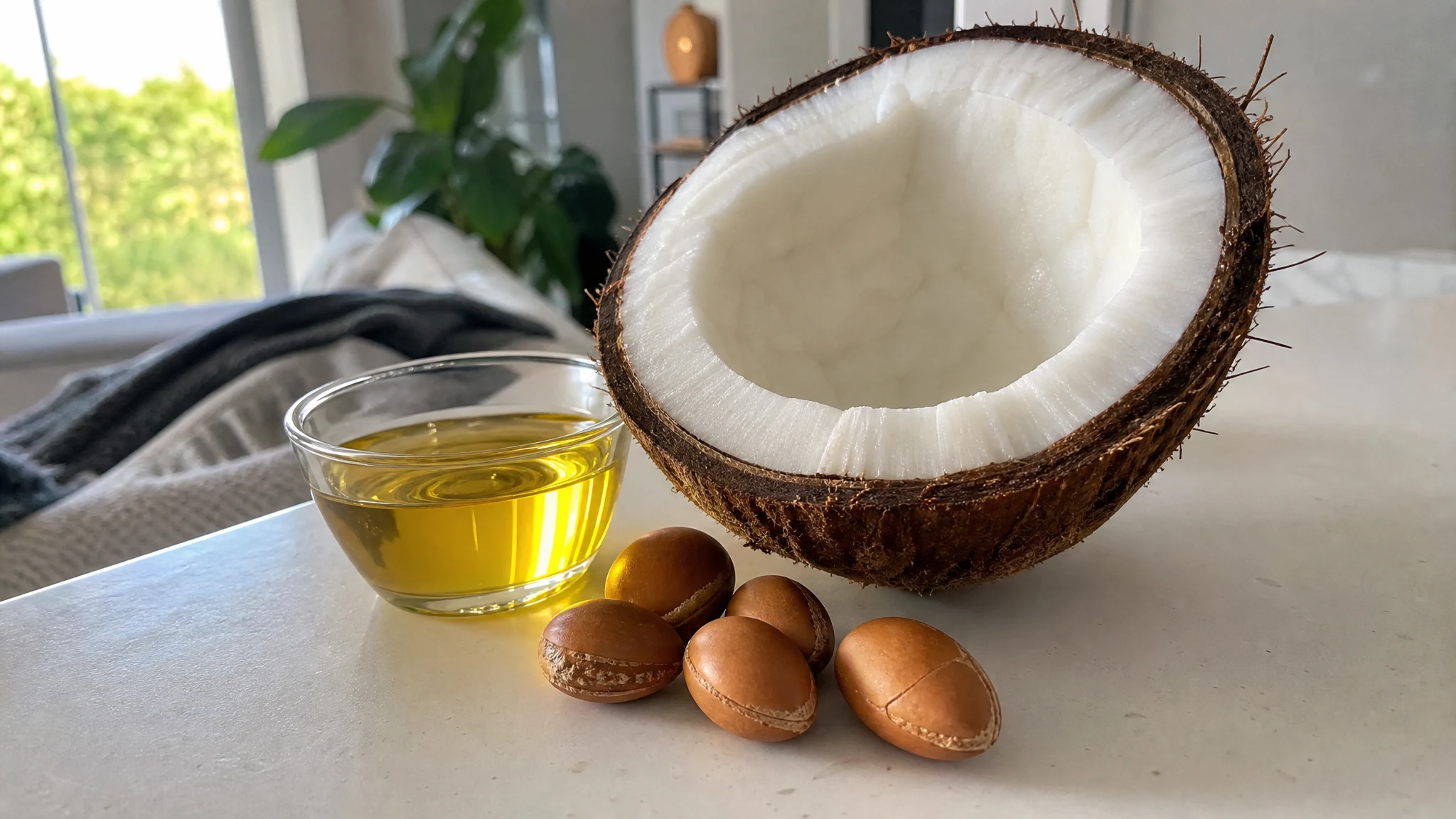
Argan oil is golden, nutty and a little glamorous, a Moroccan oil that lives in salon cabinets. Coconut oil is pale, tropical and a pantry staple. They are often set against each other as rivals, but they are really two different tools, and on hair only one of them has a measured job behind it.

Fractionated Coconut Oil
Our own Fractionated Coconut Oil, in sizes from 0.5 oz to bulk.
From $9.99
Shop Now →What the research has actually looked at
A 2022 systematic review of 22 articles on coconut, castor and argan oil for hair, written with patients who have skin of color in mind, found clinical evidence for coconut oil on brittle hair and limited evidence for growth. For argan it found nothing significant for hair quality or growth (Phong et al., 2022). The same authors note that dermatologists often tell patients to keep their traditional hair oils because they carry little foreseeable downside, not because trials show a benefit. That is a kind and sensible way to think about both bottles.
The coconut story comes from work on hair fibers. Rele and Mohile (2003) found that coconut oil, unlike sunflower or mineral oil, reduced protein loss in both undamaged and damaged hair, and Keis and colleagues (2005) found it reduced the cling between fibers over time. Both papers come from a group connected to a coconut hair oil maker. For argan, a hair-cosmetics review says the oil is rich in tocopherols and polyphenols and that data on its hair benefits are lacking (Gavazzoni Dias, 2015). "Not yet measured" is the fair phrase for argan, and it is a different thing from "does nothing."
Two very different fat profiles
Ordinary coconut oil is about 49% lauric acid in one published breakdown (Lin and colleagues, 2018). Argan oil from two sets of Algerian trees came out near 46% oleic and 31% linoleic acid, with lauric acid not a major component; a Moroccan standard quoted in the same paper runs 43.0 to 49.1% oleic and 29.3 to 36.0% linoleic, so bottles vary a little (Ould Safi and colleagues, 2026).
Here is how we read that. Rele and Mohile credit coconut oil's effect to lauric acid, a compact, straight-chain fat that seems to have an affinity for hair protein. Argan is mostly long-chain unsaturated fat, which is a silky profile and a natural fit for adding slip and a glossy finish to dry ends. No hair study tests that, so it is reasoning from the chemistry. Fractionated coconut oil is a third thing again: general sources describe it as mostly caprylic and capric acid with the lauric acid largely removed (Healthline), and the certificate of analysis we publish gives density, refractive index and optical rotation for one batch rather than a fatty acid profile. So the lauric acid story belongs to ordinary coconut oil, not automatically to ours.
Choosing by the job
If you want to oil your hair before shampooing, coconut oil is the one with a measured result. Because the studies used ordinary coconut oil, our virgin unrefined coconut oil is the closer match. The method matches the one in our pre-wash comparison: a light hand, lengths and ends, shampoo afterward.
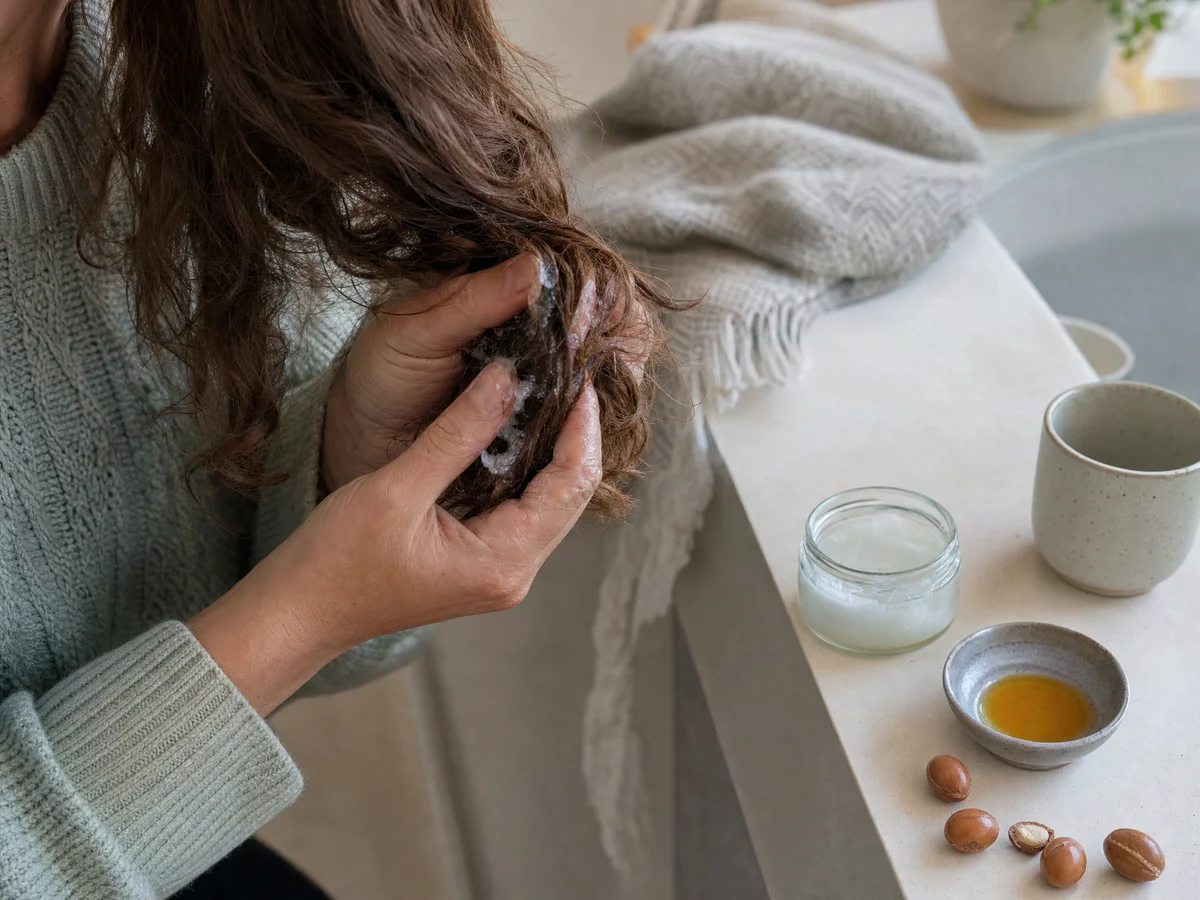
If you want a few drops of finish on dry ends, that is a question of feel, and no study answers it. Argan is a lovely oil for the purpose if you already own a bottle. We do not sell argan, so what we can offer is the coconut side of that job: we describe our fractionated coconut oil as fast-absorbing and non-greasy, and because it stays liquid at any temperature, a few drops warm easily between your fingers and smooth over the ends.
Scent may decide it for you. We describe the fractionated oil as virtually odorless, while the virgin listing has an unmistakable coconut aroma. Argan carries its own nutty note, which depends on how it was processed.
Fitting the oil to your hair
These are reasoned suggestions rather than trial results. Fine or straight hair shows oil quickly, and the Gavazzoni review notes that leave-on products can leave straight, unprocessed hair looking oily and dull, so keep the amount small and the placement to the ends. Thick or coarse hair has more room for oil. In curly and coily hair, sebum travels down the strand slowly and oils help reduce friction while detangling; our type 4 hair guide covers that, and why protective-style tension matters more than any oil. Bleached or chemically treated hair is more porous, and the sources do not compare these two oils on it.
For quantity, half a teaspoon is about 2.5 ml, roughly 2.3 g of fractionated coconut oil at the 0.948 density on our published certificate (one batch). Start there and add more only if the ends still look dry.
Oil is the finishing touch
Whichever oil you choose, the habits that matter most for healthy-looking hair sit elsewhere. The American Academy of Dermatology suggests conditioner after every shampoo, blotting wet hair rather than rubbing it, and using heat tools no more than about once a week (AAD, how to stop damaging your hair). Its advice does not mention oils at all, which tells you where oil belongs: on top of good habits. A shinier look after oiling is mostly a surface coating, and that is a perfectly nice thing to want.
If we had to pick one, we would reach for coconut oil before washing because it has a measured result behind it, and keep argan on the shelf for finishing if you love it. Hair that is breaking, thinning or itchy is a question for a dermatologist rather than an oil. If you have a coconut or tree nut allergy, ask an allergist before using coconut oil. Our oils are cosmetic carrier oils for external use only, so patch test first and keep them out of your eyes. For more head-to-heads, see how coconut stacks up against olive oil, castor oil and jojoba.
Fractionated Coconut Oil
Fractionated Coconut Oil from our own shop, in sizes from 0.5 oz to bulk.
From $9.99
Shop Now →Sources & Further Reading
- Phong C et al., 2022. Coconut, Castor, and Argan Oil for Hair in Skin of Color Patients: A Systematic Review. J Drugs Dermatol 21(7):751-757. europepmc.org/MED/35816075
- Rele AS, Mohile RB, 2003. J Cosmet Sci 54(2):175-92. pubmed.ncbi.nlm.nih.gov/12715094
- Keis K et al., 2005. J Cosmet Sci 56(5):283-295. library.scconline.org/v056n05/1
- Gavazzoni Dias MFR, 2015. Hair cosmetics: an overview. Int J Trichology. pmc.ncbi.nlm.nih.gov/PMC4387693
- Lin TK, Zhong L, Santiago JL, 2018. Anti-inflammatory and skin barrier repair effects of topical application of some plant oils. Int J Mol Sci 19(1):70. pmc.ncbi.nlm.nih.gov/PMC5796020
- Ould Safi M et al., 2026. Argan oil from endemic and planted trees in south-west Algeria. Foods. pmc.ncbi.nlm.nih.gov/PMC13408776
- American Academy of Dermatology. How to stop damaging your hair. aad.org
- Healthline. Fractionated coconut oil explainer. healthline.com