Fractionated vs Virgin Coconut Oil: Which Do You Need?
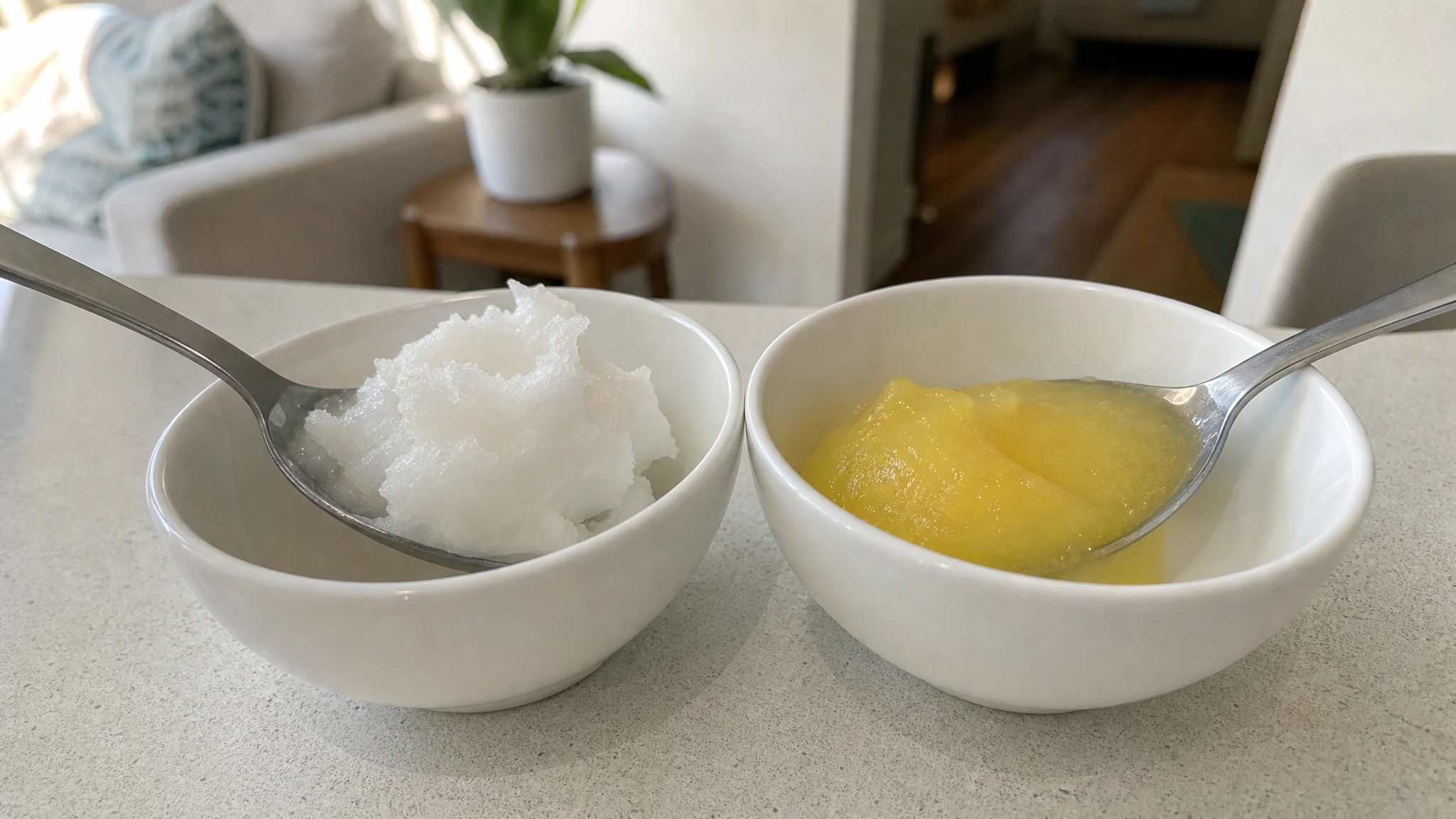
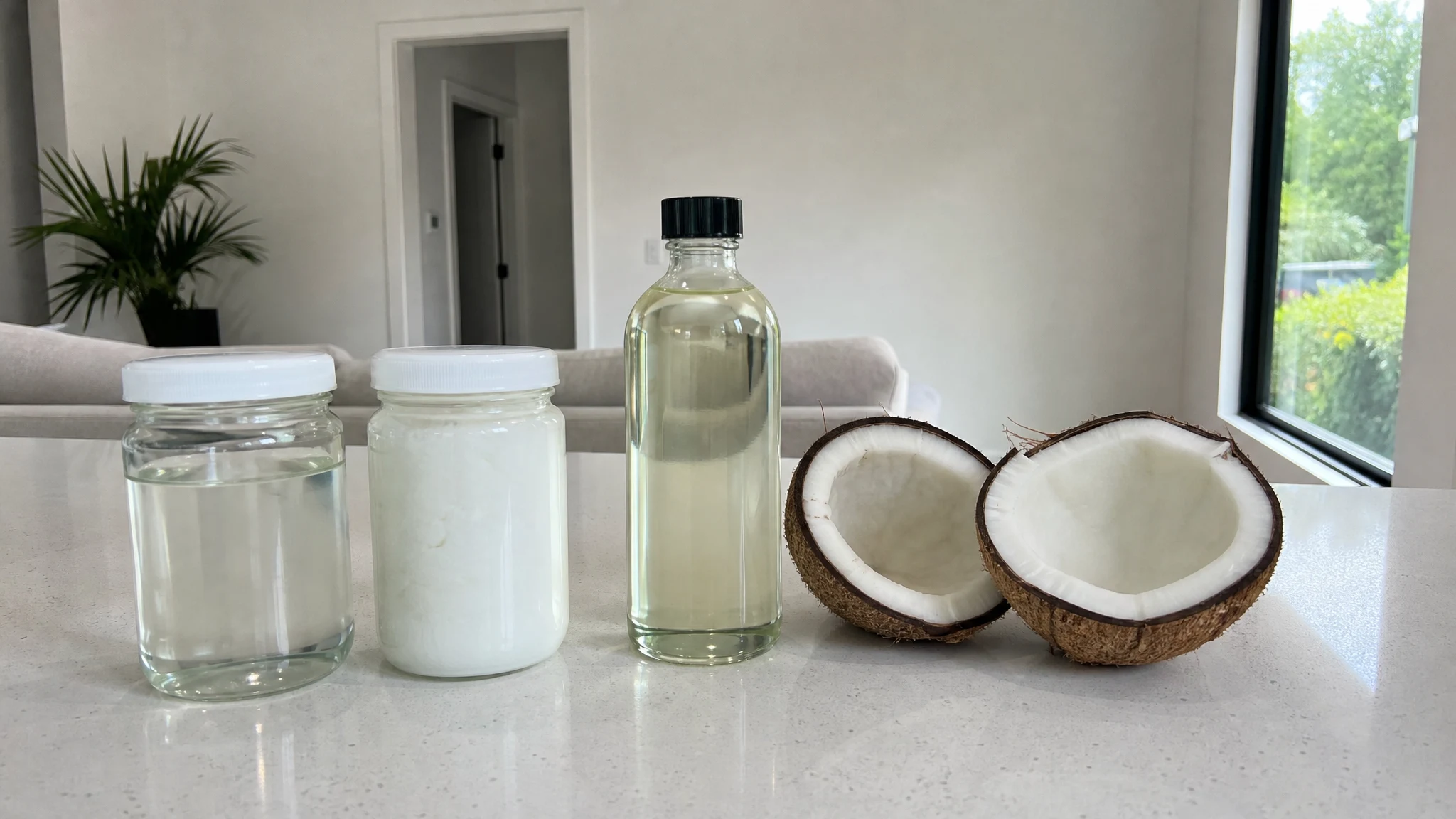
We sell two coconut oils, and they could hardly be more different in the hand. One pours like a light oil on a cold morning and stays quietly out of the way. The other is a soft solid in a cool room, melts the moment it touches your palm, and smells like a beach holiday. Neither is better, and the quickest way we know to choose is to start with what you are making.

Fractionated Coconut Oil
Our own Fractionated Coconut Oil, in sizes from 0.5 oz to bulk.
From $9.99
Shop Now →If you are filling roller bottles or blending with essential oils
Reach for fractionated. We make it to stay liquid at any temperature, so it pours into a roller bottle on a chilly windowsill and does not set in the bottle. It is fast-absorbing and non-greasy, and we describe it as virtually odorless, which leaves lavender, lemon, tea tree, peppermint, frankincense or rose to be the star of the blend. Our dilution guide turns percentages into drops.
A small word on that "odorless". The certificate we publish for one fractionated batch lists its smell standard as "Mild, Earthy", so treat our description as a friendly summary rather than a measurement.
If you are making a balm, a body butter or a soap
Here the virgin unrefined listing does what a liquid cannot. Coconut oil is a solid below roughly room temperature and a clear liquid above it. A review from India's Central Food Technological Research Institute gives a melting point of about 24 C for virgin and refined coconut oil (Gopala Krishna et al., 2010), and our own origin page says the virgin oil sets below about 76 F. That firmness is a feature when you want a balm to hold its shape, and the gentle coconut note is part of the charm. Our melting guide helps when the jar has set.
If the coconut aroma is the point
Choose virgin without hesitation. Our virgin listing has a rich, creamy, unmistakably coconut aroma, and fractionated will not give you one. Our origin page puts it plainly: if what you want is the smell of coconut, buy virgin. For hair and body care where the scent is part of the pleasure, it is the one we would point you to, and our virgin versus refined article explains how the virgin and refined styles differ.

What is inside each jar
Whole coconut oil is roughly 49% lauric acid, with myristic, palmitic, caprylic, capric, oleic and linoleic acids making up the rest (Lin, Zhong and Santiago, 2018). Fractionating separates those fractions, and general descriptions say the liquid that results mainly keeps the medium-chain caprylic (C8) and capric (C10) acids, with most of the lauric acid gone (Healthline, 2019). Our fractionated oil is made so that only the medium-chain triglycerides remain.
Those are general figures. The only certificate we publish covers one fractionated batch and reports a relative density of 0.948, a refractive index of 1.450 and an optical rotation of +0.00 degrees at 20 C. It carries no fatty acid profile, so we give no percentages for our oil. If you want the longer story, what fractionated coconut oil is walks through the method.
Shelf life and paperwork, side by side
| Check | Fractionated | Virgin unrefined |
|---|---|---|
| Form | Liquid at any temperature | Firm in a cool room, melts in warm hands |
| Scent | Virtually odorless | Rich coconut aroma |
| Shelf life | About 2 years unopened | Typically 18 to 24 months, kept closed, cool and dark |
| Paperwork we publish | One batch certificate of physical constants | None; contact us for documentation |
| Uses | Massage blending, roll-ons, hair and beard oil, skincare base | Hair and body care, soap and balm making, blends, candle and fragrance crafts |
That one batch certificate belongs to one batch. If a project needs documentation on the exact lot you will receive, please ask us in writing before you order.
A word about pores, and about "cold-pressed"
If a comedogenic rating is on your mind, hold it lightly. A 2006 study of finished products on six volunteers prone to comedones concluded that products made with comedogenic ingredients are not necessarily comedogenic themselves (Draelos and DiNardo, 2006), so we do not publish a rating for either oil. Our comedogenic ratings article sorts through the evidence. As for "cold-pressed", it describes how some virgin oils are made rather than a separate category, and our article on what it tells you explains why. We do not use that term for either of ours.
A thought for the shelf at home
Picture two jars on your counter. One is for the things you want to disappear into your skin or your blend, and it lives next to the roller bottles. The other is for the days you want a warm, creamy scent in your hands, and it sits near the balm tins. Plenty of people end up wanting both, and that is perfectly sensible. Different jobs call for different jars, and nobody needs to settle the argument once and for all.
Both are for the outside
Both oils are cosmetic carriers sold for external use only. For cooking buy a food-labeled oil, and for anything medical, oral or involving a baby or a pet, a doctor, dentist, pediatrician or veterinarian is the right person to ask. With any new oil, patch test a small area and wait 24 hours, and if you have a coconut or tree nut allergy, check with a professional first.
If you can only pick one jar, the liquid is the more flexible starting point for blending, and the virgin is the one for balms and for anyone who loves the scent. Both come in ten sizes from 0.5 oz upward, and our bulk buying guide is there when you scale up. For everyday ideas, see our fractionated oil uses.
Fractionated Coconut Oil
Fractionated Coconut Oil from our own shop, in sizes from 0.5 oz to bulk.
From $9.99
Shop Now →Sources & Further Reading
- Gopala Krishna AG et al., 2010. Coconut oil processing review (CFTRI Mysore). Indian Coconut Journal, July 2010. coconutboard.in
- Lin TK, Zhong L, Santiago JL, 2018. Anti-inflammatory and skin barrier repair effects of topical application of some plant oils. Int J Mol Sci 19(1):70. PMC5796020
- Healthline, 2019. Fractionated coconut oil. healthline.com/nutrition/fractionated-coconut-oil
- Draelos ZD, DiNardo JC, 2006. A re-evaluation of the comedogenicity concept. J Am Acad Dermatol 54(3):507-512. PMID 16488305