Cold-Pressed Coconut Oil: What the Label Means
"Cold-pressed" has a lovely ring to it. It sounds gentle and fresh, as if nothing was lost on the way from coconut to bottle. It is also a term that works best as a starting point for good questions, and once you know how virgin coconut oil is actually made, you will know exactly which ones to ask.

Fractionated Coconut Oil
Our own Fractionated Coconut Oil, in sizes from 0.5 oz to bulk.
From $9.99
Shop Now →Four ways to a virgin oil
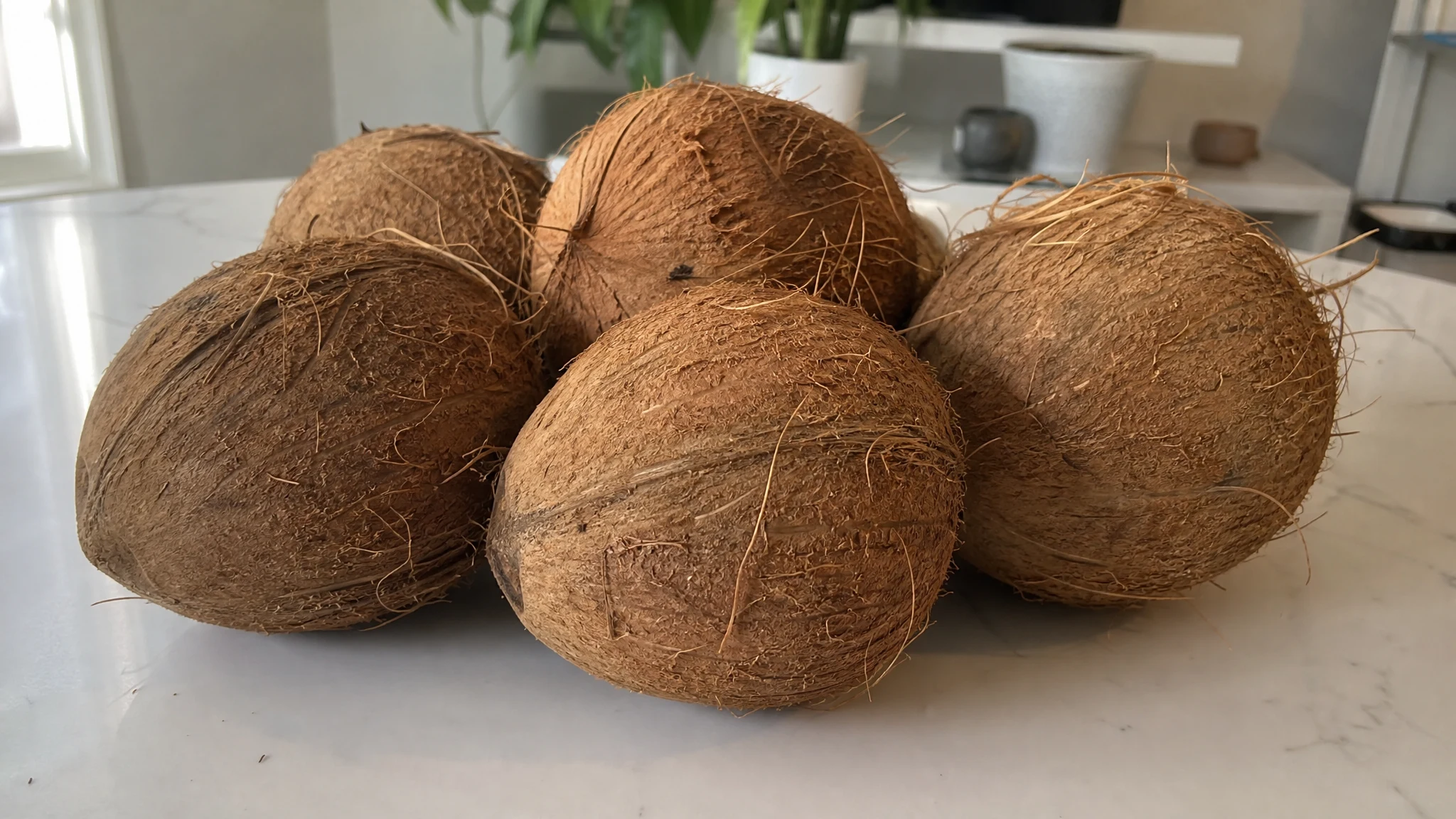
Coconut oil comes from the kernel, the white flesh. A 2018 study compared four ways of making virgin coconut oil. Two were "wet": chill the coconut milk and centrifuge the oil out, or let the milk ferment for 72 hours and skim the oil off the top. Two were "dry": grate the kernel, dry it (in a 40 C oven for 4 hours, or in the sun for 3 to 4 hours), then press it with a micro expeller (Ghani and colleagues, Food Science & Nutrition, 2018). The authors define virgin coconut oil as an edible oil obtained from the milk of fresh, mature kernel.
Notice that two of the four routes involve no pressing at all, and the two that do press dry the kernel with warmth or sun first. That is why "cold-pressed" is a slippery label: it describes one slice of a bigger picture. For the whole story, including refined oil, our article on how coconut oil gets from palm to bottle goes through it, and there is a home-scale version in our make-it-at-home piece.
How the method shows up in freshness
The same paper measured peroxide value, an early sign of oxidation, against an industry virgin coconut oil limit of 3 milliequivalents of oxygen per kilogram. The wet methods came in at 2.2 (chilling and centrifuging) and 2.8 (fermenting), and the dry-then-press methods at 3.4 (oven-dried) and 4.2 (sun-dried). Free fatty acids ran from 0.17 to 0.53 percent, and moisture stayed under the 0.3 percent ceiling.
This is one study of one coconut variety bought in Brunei, so it does not crown wet methods everywhere. What it shows nicely is that oils sold under the same "virgin" name can differ on a freshness measure, and that the way the oil was made accounted for the gap.
Does heat cost an oil its antioxidants?
Many people assume so, and a 2009 laboratory comparison found the opposite: coconut oil extracted under hot conditions had more phenolic compounds and scored higher in antioxidant assays than cold-extracted oil, and the authors suggested heat favors heat-stable phenolics (Seneviratne, Hapuarachchi and Ekanayake, Food Chemistry, 2009). A second 2009 paper compared chilled and fermented virgin oils with refined, bleached, deodorized oil and found the virgin ones had greater antioxidant capacity, with ferulic and p-coumaric acids the main phenolic acids (Marina and colleagues, 2009).
Together they suggest the sharper dividing line is virgin versus refined, with cold versus hot a smaller matter. These are bench measurements of the oil itself and not of skin or hair, so neither tells us a cold-pressed oil does more for you. Our article on phenolics in coconut oil follows the same thread.
What it is made of, whichever way it was made
The Cosmetic Ingredient Review expert panel describes coconut oil as about 90 percent saturated triglycerides. Its 2011 final report concluded that coconut oil and related ingredients are safe as cosmetic ingredients under the use practices and concentrations assessed, and noted it was reported in 626 products at concentrations from 0.0001 to 70 percent (Burnett and colleagues, 2011). A review of plant oils for skin gives approximate fatty acids of lauric 49 percent, myristic 18, palmitic 8, caprylic 8, capric 7, oleic 6, linoleic 2 and stearic 2 (Lin, Zhong and Santiago, 2018). Neither source addresses extraction method, and these are general figures and not measurements of our oils.
Good questions to ask any seller
- Virgin or refined? Start here, since it seems to matter more than temperature.
- How was it extracted? Wet, dry, expeller, centrifuge: the answer tells you more than "cold."
- Can I see peroxide value and free fatty acids? They are the freshness numbers, and the 2018 paper shows they vary by method. Our buying checklist lists more paperwork worth requesting.
- What does it smell like? A virgin oil should smell of coconut, so a sharp, soapy or stale smell is a good reason to ask for batch information.
- What do I want it for? A firm virgin oil suits balms and a coconut scent, while a liquid base is a different product, compared in our fractionated versus virgin guide.
We sell oils for external cosmetic use only. For cooking or diet, choose an oil labeled as food and talk to a doctor or dietitian.
It helps to practice reading a jar the way you would read a menu. Let the big front-of-label words wash over you, then find the smaller line that names the type, the ingredient and any batch information. A jar that is generous with those details is usually easier to trust than one that leans on a single appealing word. Once you have done it a couple of times, the habit takes about ten seconds.
Where our oils fit
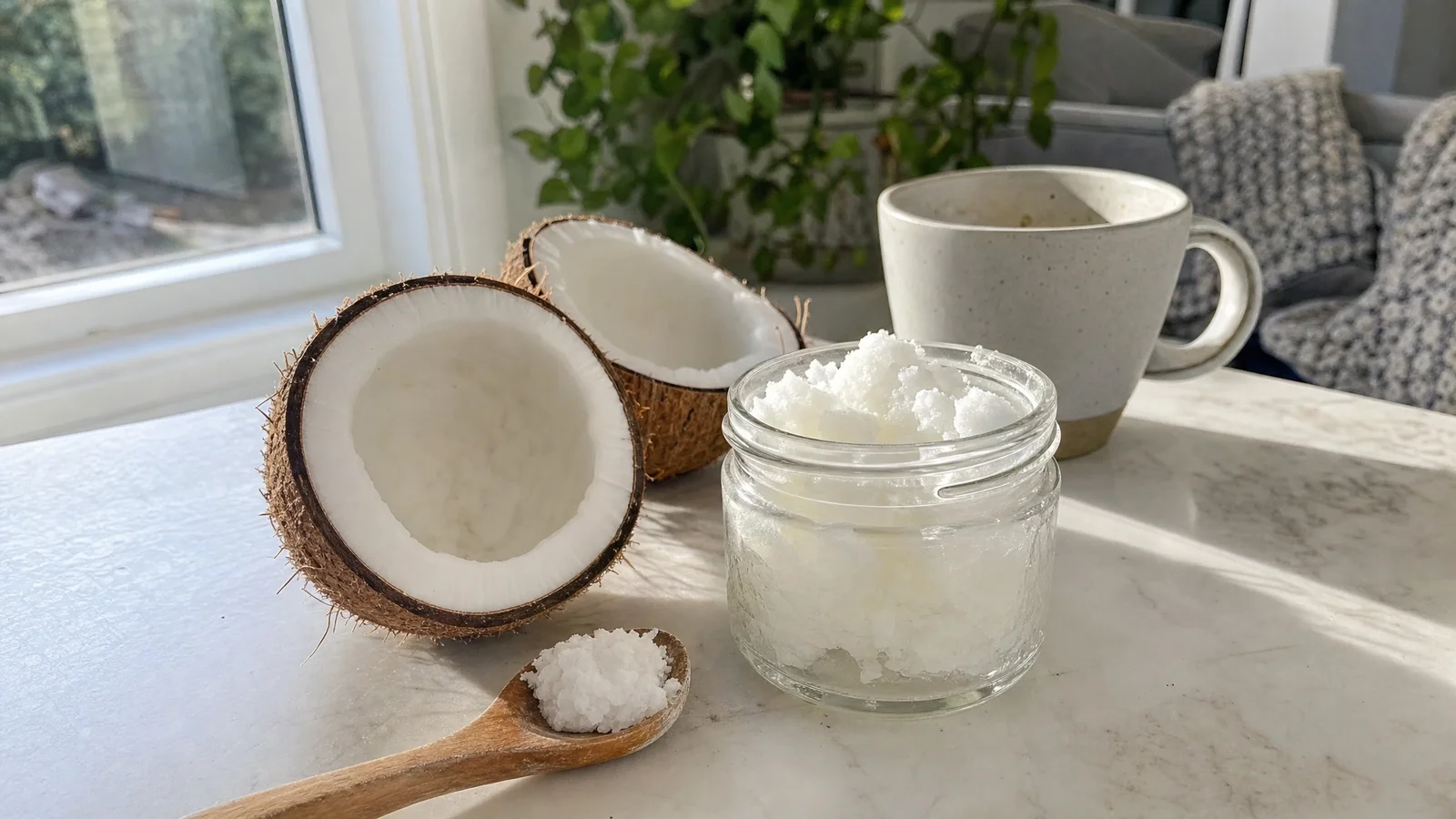
We do not label either of our oils cold-pressed. Our virgin unrefined listing has a rich, unmistakable coconut aroma, is firm in a cool room and melts in warm hands, and keeps 18 to 24 months when stored tightly closed in a cool, dark place. We publish no certificate for it, so a buyer who needs peroxide value, free fatty acids or extraction details should ask us in writing before ordering. The fractionated oil is a different product again, and its published certificate for one batch shows physical constants and not a freshness measure. You can see both on the virgin unrefined and fractionated pages.
If you remember one thing, remember the order of questions: virgin or refined first, extraction method second, batch numbers third, and the temperature word last.
Fractionated Coconut Oil
Fractionated Coconut Oil from our own shop, in sizes from 0.5 oz to bulk.
From $9.99
Shop Now →Sources & Further Reading
- Ghani NAA et al., 2018. Physicochemical properties, antioxidant capacities, and metal contents of virgin coconut oil produced by wet and dry processes. Food Sci Nutr 6(5):1298-1306. PMC6060898
- Seneviratne KN, Hapuarachchi CD, Ekanayake S, 2009. Comparison of the phenolic-dependent antioxidant properties of coconut oil extracted under cold and hot conditions. Food Chem 114(4):1444-1449. doi.org/10.1016/j.foodchem.2008.11.038
- Marina AM, Che Man YB, Nazimah SA, Amin I, 2009. Antioxidant capacity and phenolic acids of virgin coconut oil. Int J Food Sci Nutr 60(Suppl 2):114-123. doi.org/10.1080/09637480802549127
- Burnett CL et al., 2011. Final report on the safety assessment of Cocos nucifera (coconut) oil and related ingredients. Int J Toxicol 30(3 Suppl):5S-16S. PMID 21772024
- Lin TK, Zhong L, Santiago JL, 2018. Anti-inflammatory and skin barrier repair effects of topical application of some plant oils. Int J Mol Sci 19(1):70. PMC5796020