How to Buy Coconut Oil: Reading the Listing First
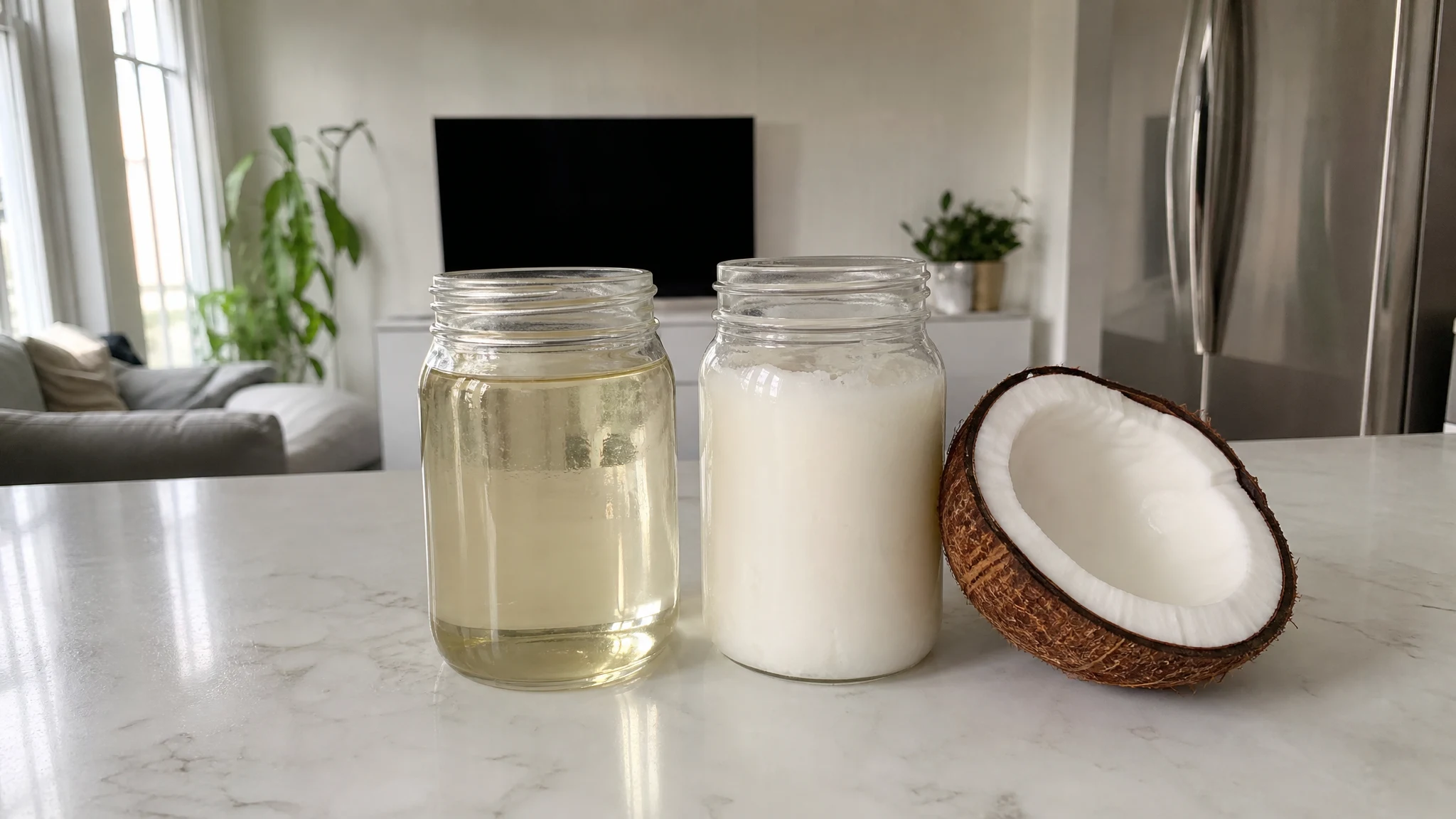
Two jars of coconut oil can look identical on a screen and behave nothing alike once they arrive. One smells like a beach holiday and sets firm on a cool shelf; the other pours like water and has barely any scent at all. Buying well comes down to reading the listing for a handful of clues, and we like to walk through them the way we would at the counter.

Fractionated Coconut Oil
Our own Fractionated Coconut Oil, in sizes from 0.5 oz to bulk.
From $9.99
Shop Now →Start with the job, then the type
Before any label, decide what the oil is for. Virgin unrefined oil carries the scent of coconut and turns solid in a cool room. A refined oil is processed to be mild. Fractionated oil stays liquid, which is why we reach for it as a light massage or blending base. A listing that only says "pure coconut oil" leaves out the one detail that settles whether it suits you.
US cosmetic rules ask for ingredients in descending order of predominance (21 CFR 701.3), which names the ingredient but not the type, so "virgin or refined?" is always a fair question for a seller. We sell fractionated coconut oil and a separate virgin unrefined listing, each named plainly. If you are torn, our guides to fractionated versus virgin and virgin versus refined will settle it, and liquid or solid covers the everyday jobs for each.
Let a number or a document back up the label words
"Natural," "pure," "cold-pressed" and "premium" sound like specifications, but the FDA's cosmetics labeling page says the agency keeps no list of approved or accepted claims for cosmetics, only that claims must be truthful and not misleading (FDA, current as of November 2022). So a descriptive word earns trust when a measurement or a document stands behind it. Our cold-pressed explainer takes one popular term apart if you would like to see how that works.

The same page notes that a product sold with disease claims, or claims to change the structure or function of the body, is treated as a drug. A cosmetic oil is at its best as a moisturizing base or carrier, and we keep it there: both of our oils are listed for external cosmetic use, with no medical claims. If a listing promises to fix a condition, that tells you something about the seller, and conditions belong with a dermatologist or pediatrician.
Know which ounce you are buying
Ounces come in two kinds. The FDA net-quantity rule asks for fluid measure on a liquid cosmetic and weight on a solid or semisolid, and it allows the two to be told apart by wording, such as "Net wt. 6 oz." versus "Net contents 6 fl. oz." (21 CFR 701.13). For a pourable oil the difference is small. At the density on our published certificate (0.948 for one fractionated batch), 16 fl oz weighs about 449 g, or 15.8 oz on a scale. A jar of virgin oil that sets solid is naturally sold by weight. If a listing says only "oz," ask which one it means before you compare sizes.
Match a virgin claim to the paperwork
Virgin coconut oil sells for far more than common vegetable oils, about ten times more in the 2023 study below, so it has drawn plenty of attention from authenticity researchers. De Luca and colleagues describe how that price gap encourages blending with cheaper oils such as sunflower, maize and peanut, and show that infrared spectroscopy can spot it (De Luca et al., 2023). Another group used NMR to tell virgin from refined coconut oil and to detect blends of the two (Bao et al., 2023). Both used instruments, not color or smell, and the practical lesson is simple: a virgin claim is most convincing when batch documents agree with it.
That is also why we encourage looking past the flag on the jar. Method and documentation say more about an oil than a country name does, and our piece on producing countries shows why.
Read the certificate for what it measures
A certificate of analysis is only as useful as its measurements. For virgin oil, the Asian and Pacific Coconut Community sets limits for properties such as moisture, peroxide value and free fatty acids. A 2018 study that made virgin oil four different ways found all four conforming, with lauric acid between 48.4% and 52.8% of the fatty acids (Ghani et al., 2018). Numbers like those are what a good certificate puts in front of you.
We publish a certificate for one fractionated batch. It records appearance, smell, relative density (0.948, against a standard of 0.938 to 0.950), refractive index (1.450, standard 1.445 to 1.455) and optical rotation (+0.00 degrees, standard -0.5 to +0.5). It reads as a record of that one batch, so we do not offer it as proof about every other batch, and it does not include a laboratory name, fatty-acid profile, peroxide value, free fatty acids, moisture, heavy metals or microbial results. A certificate for the virgin listing is not published on our site. If you need any of those figures, ask us in writing before you order. We would much rather answer a question than have you assume.
Ask who makes it and under which rules
The FDA's page on the Modernization of Cosmetics Regulation Act (current as of 29 October 2026) explains that manufacturers and processors register their facilities and renew every two years, and that a responsible person reports serious adverse events within 15 business days. It also says certain small businesses are exempt from good manufacturing practice, registration and product listing requirements, with exceptions that include products used on the eye mucous membrane, injected, or intended for internal use (FDA). Whether a supplier is covered or exempt is that supplier's answer to give, and "are you registered, or do you rely on the small-business exemption?" is a friendly, reasonable question for any seller. We bottle and ship every order from our US-based facility, and for registration details you are welcome to ask us directly in writing.
Last check: the oil and the job
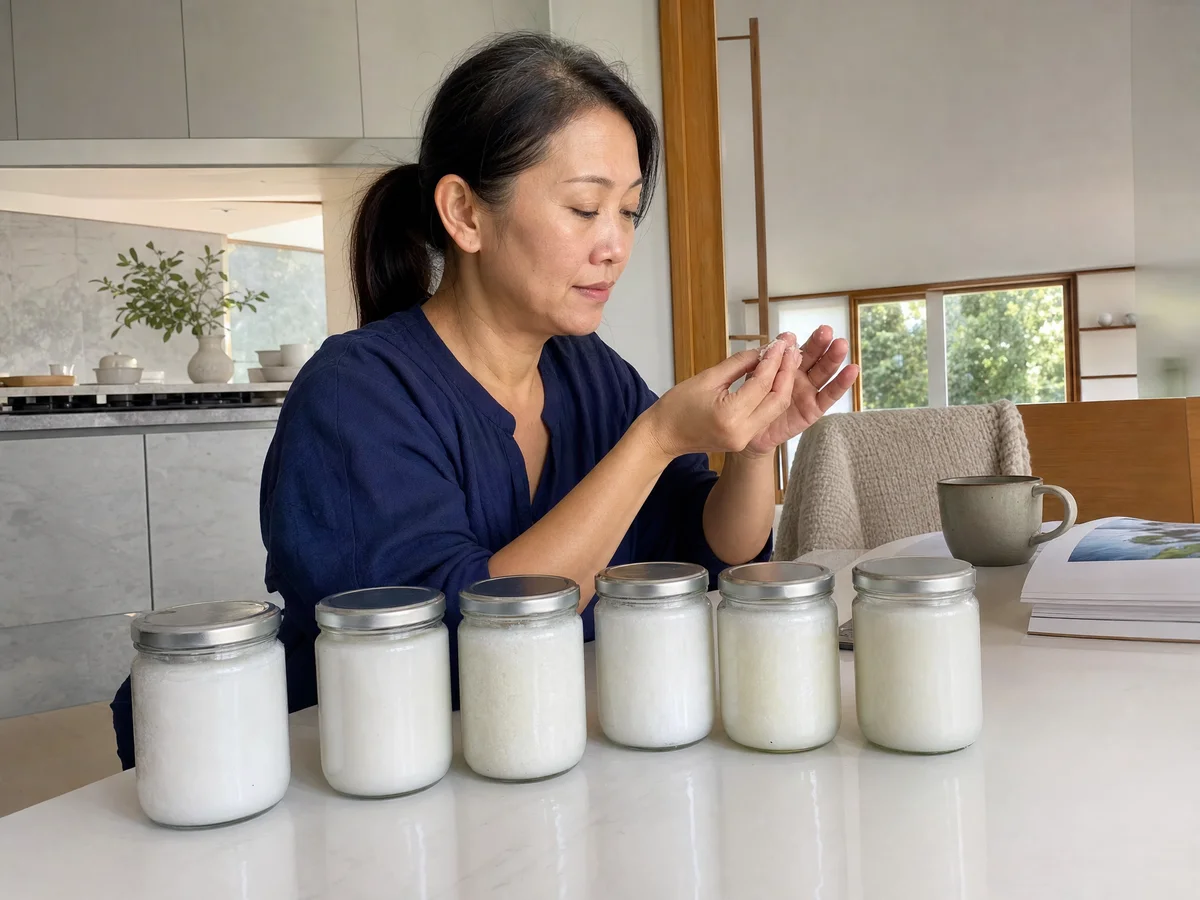
The final check is on your side of the counter. If you want the coconut scent, virgin is the one; if you want a pourable base for roll-ons or massage blends, fractionated is. Our plain-English fractionated guide helps with the second. Both of our oils are for external cosmetic use only, so choose an oil labeled for food if you are cooking, and ask a dentist, veterinarian or pharmacist about dental, pet or medical questions. For organic claims, our organic labels guide explains what the term means, and we do not claim organic status for either oil.
Work through these checks and you will read a listing better than most shoppers do. When you are ready to compare, our shop lists both oils in sizes from sample to bulk.
A listing rewards a slow read. Jot your questions down as you go, and ask them before the order is placed, not after the jar arrives.
Fractionated Coconut Oil
Fractionated Coconut Oil from our own shop, in sizes from 0.5 oz to bulk.
From $9.99
Shop Now →Sources & Further Reading
- US Code of Federal Regulations, 21 CFR 701.3. Designation of ingredients. law.cornell.edu/cfr/text/21/701.3
- US Code of Federal Regulations, 21 CFR 701.13. Net quantity of contents statement. law.cornell.edu/cfr/text/21/701.13
- US FDA, current as of 21 November 2022. Cosmetics labeling claims. fda.gov/cosmetics-labeling-claims
- US FDA, current as of 29 October 2026. Modernization of Cosmetics Regulation Act of 2022 (MoCRA). fda.gov MoCRA page
- De Luca M et al., 2023. Multivariate curve resolution methodology applied to the ATR-FTIR data for adulteration assessment of virgin coconut oil. Molecules. PMC10302750
- Bao R et al., 2023. A comparative evaluation of low-field and high-field NMR untargeted analysis: authentication of virgin coconut oil adulterated with refined coconut oil as a case study. Anal Chim Acta 1273:341537. pubmed/37423668
- Ghani NAA et al., 2018. Physicochemical properties, antioxidant capacities, and metal contents of virgin coconut oil produced by wet and dry processes. Food Sci Nutr 6(5):1298-1306. PMC6060898