Coconut Oil on Wood Furniture: Check the Finish First
Wood and oil go together so naturally that a jar of coconut oil can look like the obvious thing to reach for when a table looks tired. Before you do, spend a minute on one question: what is already on the wood? A varnished top and a bare one respond in opposite ways, and most advice never says which it means. We sell coconut oil for skin and hair rather than furniture, so think of this as a friendly walk through what to expect, guided by the conservation authority we could read in full.

Fractionated Coconut Oil
Our own Fractionated Coconut Oil, in sizes from 0.5 oz to bulk.
From $9.99
Shop Now →Find out what finish you have
Put a drop of water on a hidden spot. If it beads and sits, you most likely have a film finish such as varnish, lacquer, shellac or polyurethane. If it soaks in and darkens the wood, the surface is bare or oiled. That water drop is our own suggestion rather than a standard, and a valuable piece or an antique deserves a furniture conservator or restorer before anything goes on it.
The U.S. National Park Service's furniture leaflet shows why the finish matters. It says to put paste wax only on "stable, clear finishes, such as shellac, lacquer, and varnish," and not on bare wood, where wax would soak into the pores and be "nearly impossible to remove" (Sheetz, Conserve O Gram 7/2). That leaflet is about museum objects and wax and does not mention coconut oil, so applying its logic to an oil is our own reasoning.
What to expect on each surface
| Surface | Likely result | Our suggestion |
|---|---|---|
| Film finish in good shape | The film is already the protection. Oil sits on top and wipes off as a short-lived sheen. | Optional. A dust and a wipe do the job. |
| Film finish, worn or cracked | Oil can wick into the gaps and darken them. | Test a hidden spot first. |
| Bare or oil-finished wood | Oil soaks in and deepens the grain without hardening to a film. | Possible, though hard to reverse. |
| Antique or veneered piece | Hard to predict and hard to undo. | Ask a conservator first. |
Why coconut oil is not a finishing oil
Traditional wood-finishing oils such as linseed earn their name because they dry: their unsaturated bonds link up in air and set into a hard film. Coconut oil is built the other way around. One published composition puts it at about 92 percent saturated fatty acids, with oleic at 6 percent and linoleic at 2 percent (Lin et al., 2018). From that we would expect it to stay a soft, oily film on wood instead of curing, which means a surface that can feel slick, show fingerprints and gather dust. The same Park Service leaflet notes that too much wax leaves a sticky, dust-attracting surface, so thin coats of anything are the happy habit.
If you would like to try it
- Dust first. Oil holds on to whatever is sitting on the surface.
- Test a hidden area, such as under a drawer or the back of a leg, and wait a day.
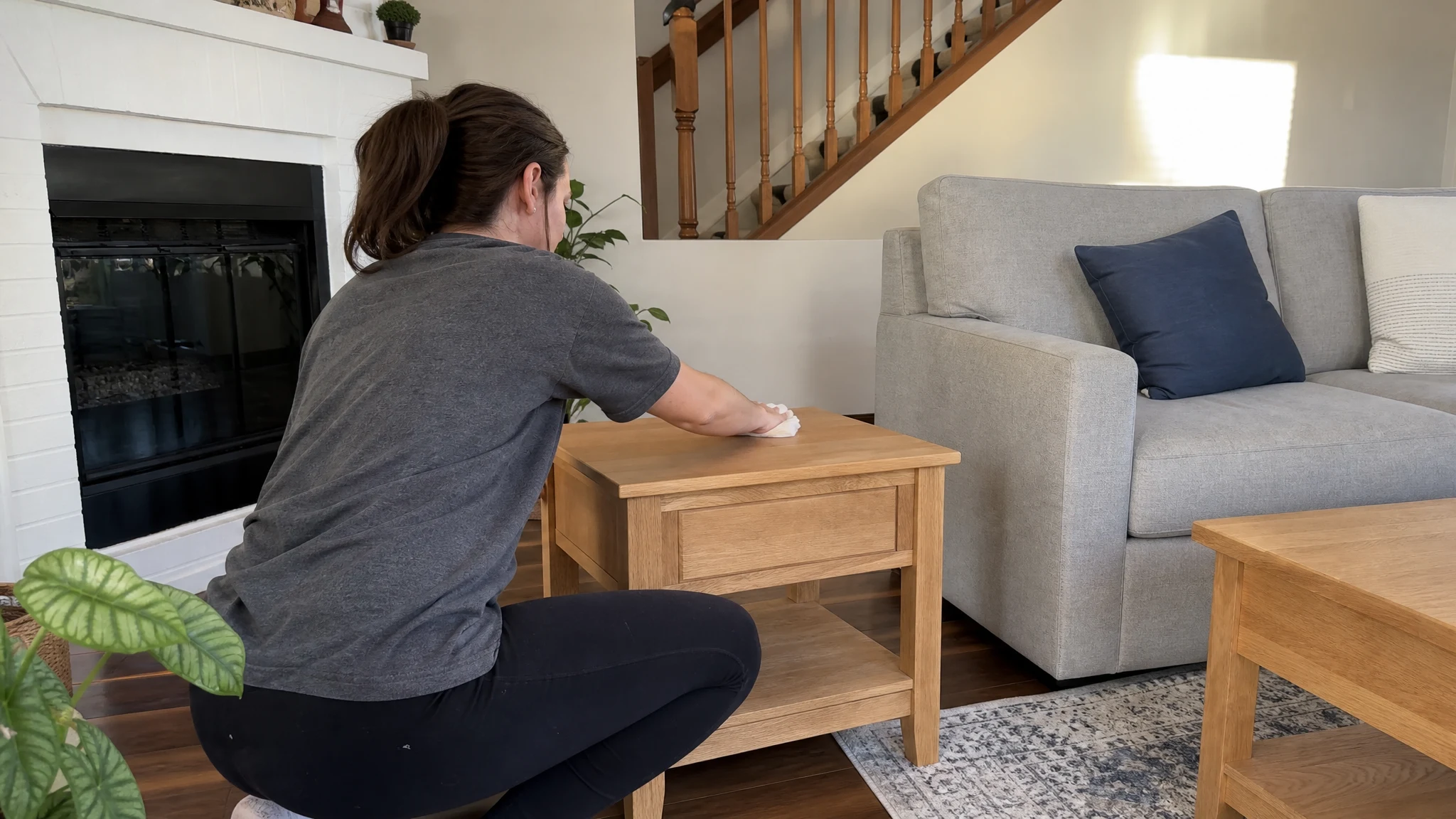
- Use a few drops on a lint-free cloth and wipe along the grain. If you can see wet oil, that is more than enough.
- Buff with a clean cloth until nothing transfers to your hand.
- Keep it away from food surfaces unless it is a board you mean to oil; our cutting board article covers that separate case.
Our virgin unrefined oil firms up below about 76 degrees Fahrenheit, so a cool room can leave a waxy smear, and it carries a coconut aroma. Our fractionated oil stays liquid and we describe it as virtually odorless. Neither is sold as a furniture polish.
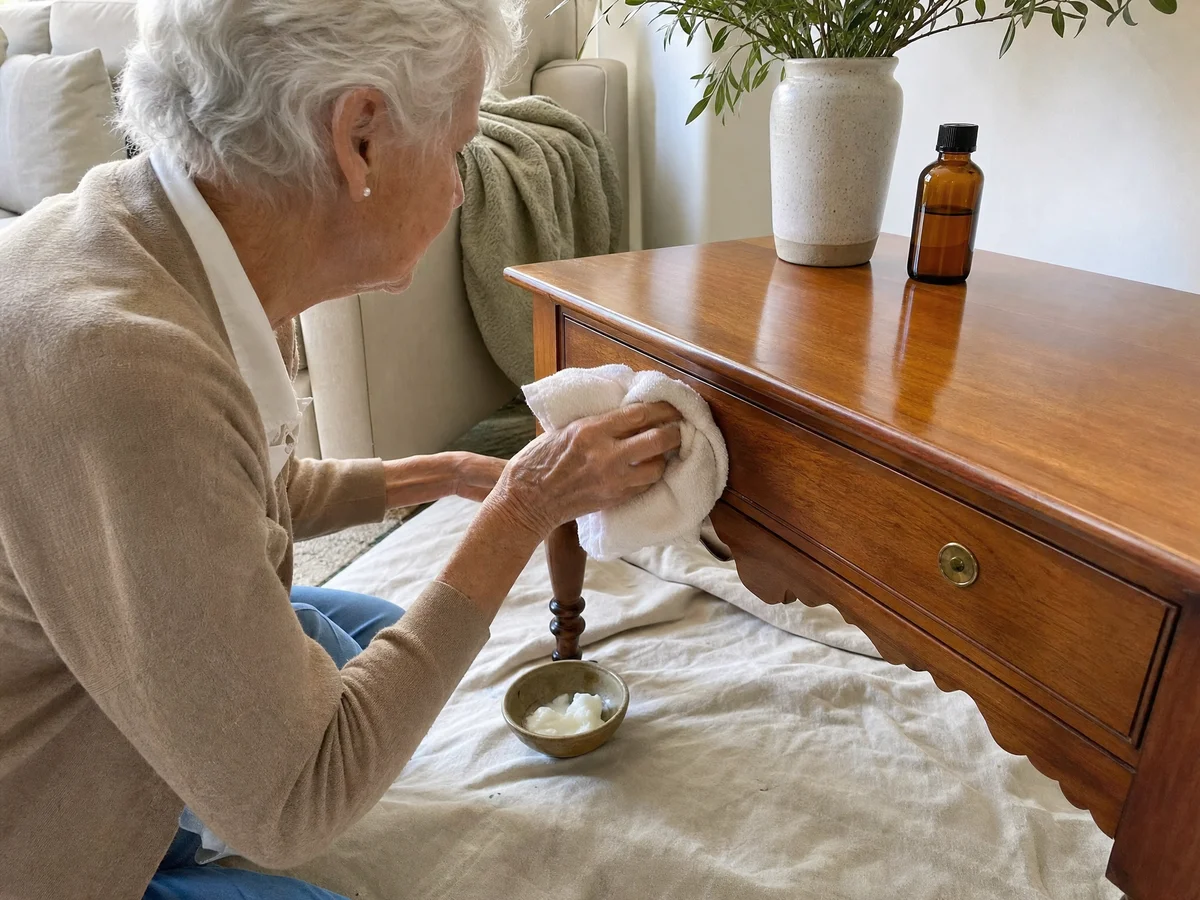
Good habits for any natural product
"Natural" and "gentle on a finish" are not the same thing. The Park Service's cleaning guidance says even safer, natural products can stain or damage museum collections (Conserve O Gram 2/21). If a piece is due for re-staining or re-varnishing, hold off on oil, because anything absorbed into bare wood is hard to draw out again; that is our reasoning, so check with your refinisher. Oil will darken a scratch for a while, but it does not repair one.
If you apply a little too much to a sound film finish, blot the excess, wipe with a cloth wrung out of warm water with a drop of dish detergent, and dry right away. The American Cleaning Institute's stain guide starts oil stains with detergent for the same reason it does in laundry: water alone does not dissolve oil. Bare wood is a different matter, since the oil sits in the pores.
Fats can also turn rancid. The Park Service's leather leaflet notes that oils and fats on leather can go rancid and leave a smell that cannot be reversed (Conserve O Gram 9/1). That is leather, not wood, and coconut oil is not named. Because coconut oil is mostly saturated, we would expect it to oxidize more slowly than a polyunsaturated oil, but we found no data on how a thin film ages on a table. If a piece starts to smell stale, wipe it with a detergent-damp cloth.
What conservators reach for
For a sound film finish, the Park Service recommends paste wax in two thin coats, and notes that most liquid and aerosol polishes contain silicones that could harm museum finishes. Rewaxing is only needed when the existing layer can no longer be buffed to a sheen. For everyday furniture, a dry or barely damp cloth does most of the work. If you are curious about other swaps around the house, our household uses for coconut oil sorts out which ones hold up, and the articles on leather and coconut oil stains cover what happens when oil lands somewhere unplanned.
Skin oil, hair oil and massage base are where our oils shine: fractionated coconut oil and a virgin unrefined listing, both for external cosmetic use. For the table, a paste wax from a hardware or furniture-supply shop is the better-supported choice.
Old furniture rewards patience. Start small, in a hidden spot, and let the wood tell you what it likes.
Fractionated Coconut Oil
Fractionated Coconut Oil from our own shop, in sizes from 0.5 oz to bulk.
From $9.99
Shop Now →Sources & Further Reading
- Sheetz R, U.S. National Park Service, updated 2025. Conserve O Gram 7/2: Waxing Furniture and Wooden Objects. nps.gov/articles/000/conserve-o-gram-07-2
- U.S. National Park Service. Conserve O Gram 2/21: Safer Cleaning Alternatives for the Museum & Visitor Center. nps.gov conserve-o-gram 2-21
- U.S. National Park Service, 2025. Conserve O Gram 9/1: Leather Dressings. nps.gov conserve-o-gram 9-1
- Lin TK, Zhong L, Santiago JL, 2018. Anti-inflammatory and skin barrier repair effects of topical application of some plant oils. Int J Mol Sci 19(1):70. PMC5796020
- American Cleaning Institute. Stain removal guide. cleaninginstitute.org