Coconut Milk vs Coconut Oil: Can You Swap Them?
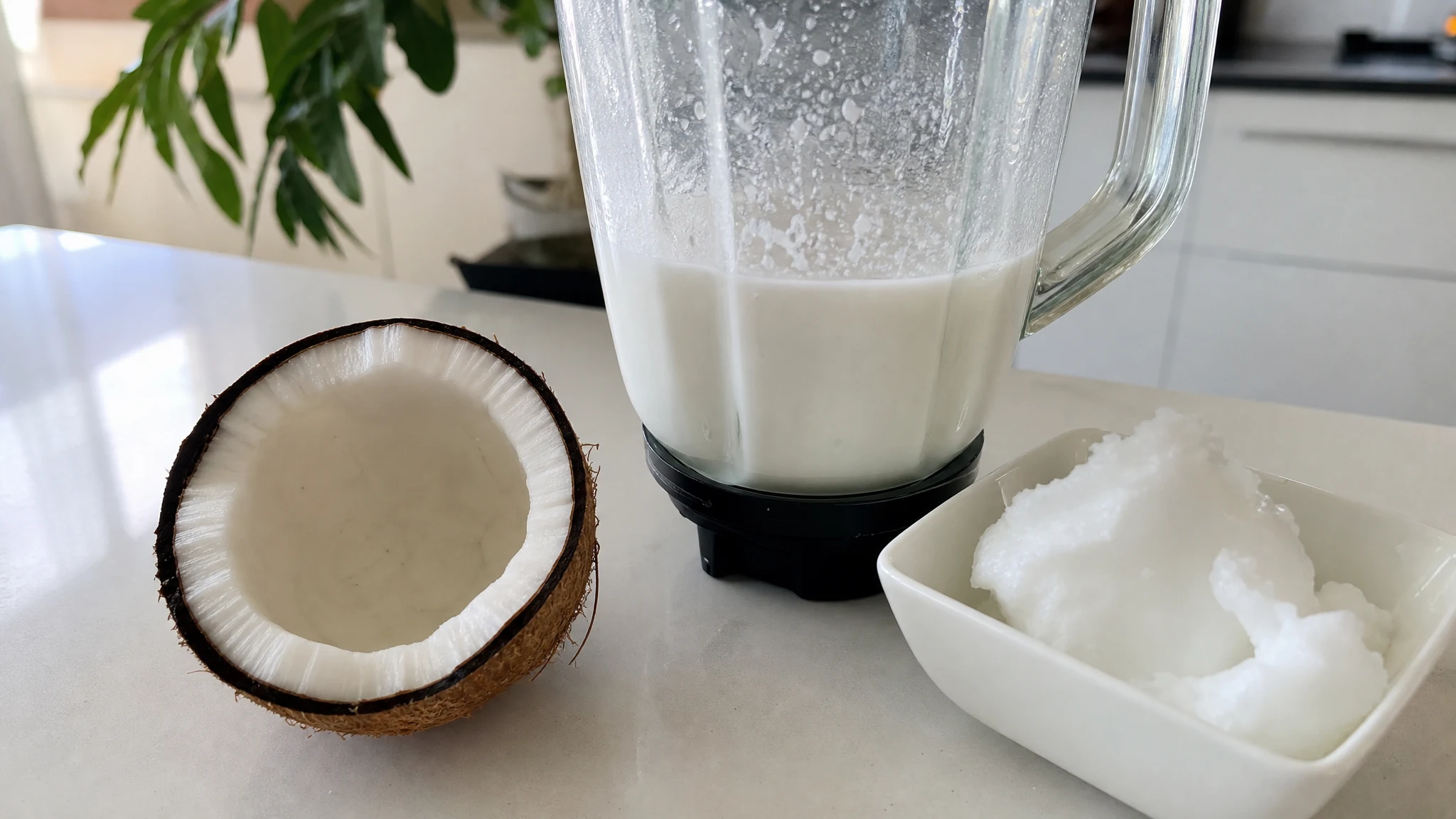
Coconut milk and coconut oil come from the same nut, so it is tempting to think a blender and a little patience can turn one into the other. In a loose sense they can, but the two are different things: milk is a creamy, water-based emulsion that carries the oil, and oil is the fat on its own. Once you see that one distinction, it is easy to tell when a swap in the kitchen works and when you should just open a can.
Fractionated Coconut Oil
Our own Fractionated Coconut Oil, in sizes from 0.5 oz to bulk.
From $9.99
Shop Now →What is actually in coconut milk
The Tetra Pak Coconut Handbook describes coconut milk as a white, opaque protein-oil-water emulsion: tiny droplets of oil spread through water and kept apart by the nut's own proteins and phospholipids. Its table for fresh coconut milk shows how much of the cup is not oil at all.
| Component | Fresh coconut milk |
|---|---|
| Moisture | 73.47 to 76.84% |
| Fat | 18.83 to 21.09% |
| Protein | 2.14 to 2.97% |
| Total sugars | 0.82 to 1.62% |
So fresh milk is about a fifth fat and three quarters water. Packaged products are sorted by fat too: the same chapter cites Codex Standard 240-2003, which sets minimums of 5% for light coconut milk, 10% for coconut milk, 20% for coconut cream and 29% for coconut cream concentrate. That is why a can marked "cream" whips up richer than one marked "milk": it simply carries more fat per spoonful.
Making a milk-like drink from oil
Take the Codex minimum for coconut milk, 10% fat, as the target. Ten grams of oil in 100 grams of finished liquid works out to 10 g of oil and 90 g of water, or about 26 g of oil for each US cup (roughly 237 g) of water. That is arithmetic from the standard, and it gives you a thin, milk-strength liquid.
Staying power is where real milk has the advantage. The Tetra Pak chapter points out that even real coconut milk is physically unstable: its protein is not enough to hold the fat droplets apart, so it separates into a fatty top and a watery bottom, which is why manufacturers homogenize it, usually with added emulsifiers and sometimes stabilizers. It adds that homogenizing works best with the coconut oil liquid, because it does little once the oil has gone solid in cold milk. Putting that together, oil blended into plain water has none of the protein and phospholipid that give real milk its hold, so it is likely to separate and form a fat layer if it chills. Blend it with warm water and use it straight away.
It will also lack the 2 to 3% protein and about 1% sugars that real milk brings, which matters more in a custard or a drink than in a curry. And for actual coconut flavor, the oil has to be a virgin one sold for food; the review by Ng and colleagues (Bioprocess and Biosystems Engineering, 2021) notes the characteristic coconut smell survives only in oil that has not been refined, bleached or deodorized. For a dairy-free creamy coffee, our look at coconut oil in coffee covers what blending does and does not do. Most of the time, a can of coconut milk is the better shortcut.
Going the other way: oil from milk
Getting oil out of milk is better documented, because it is how virgin coconut oil is made by the wet process. In Ghani and colleagues (Food Science and Nutrition, 2018), grated mature kernel was squeezed and filtered through cheesecloth into milk, and then one of two routes was followed. In the first, the milk was chilled below 4 C, spun briefly, and the cream layer was warmed in a 50 C water bath and centrifuged at 6,000 rpm for 45 minutes. In the second, the milk stood at room temperature for 72 hours, then was centrifuged at 6,000 rpm for 45 minutes and the oil drawn off.
The paper reports a yield of 20.44% for the chill-and-centrifuge route and 9.43% for fermentation, a gap of more than two to one. It does not state the basis for those percentages, so read them as a comparison between routes rather than something to expect from a can. The fermented oil also came out with higher free fatty acids (0.53% against 0.17%) and a slightly higher peroxide value (2.8 against 2.2 meq O2/kg), which are simple freshness indicators.
The centrifuge is the piece a home kitchen does not have: a fridge, a pot and time are easy, but a 6,000 rpm spin is not, and nothing in these sources shows a home substitute. The fermentation route also means leaving a milk product at room temperature for three days, a question for food-safety guidance such as your cooperative extension service. For more on home extraction, see making coconut oil at home from fresh coconuts, and how coconut oil is processed shows the industrial versions.
Swapping one for the other in a recipe
The helpful question is what the recipe uses the ingredient for: water, richness, or both. Milk supplies both; oil supplies richness only.
- Recipe wants milk, you have oil. You are replacing water, protein, sugar and fat with fat alone. Add water and expect a thinner, less creamy result, or buy the can.
- Recipe wants oil, you have milk. You are adding a lot of water, which splatters in a sauté and changes a dough. From the table, you would need around five times the weight of milk to match a given weight of fat, and you would bring roughly four times that weight in water and solids along.
- Recipe is a drink, a custard or a dessert. Use the ingredient it names; these are the dishes where the emulsion matters most.
The same fat-versus-water logic drives butter swaps, which we work through in coconut oil in baking.
Where our oils fit
We sell fractionated coconut oil and a virgin unrefined listing, both for external cosmetic use only, so neither belongs in a pot of homemade coconut milk. We describe the fractionated oil as virtually odorless, and it stays liquid at any temperature, a handy trait in a massage blend. For anything you eat, choose an oil labeled as food. For skin, hair and DIY bases, the fractionated oil page is the place to start, and virgin versus refined coconut oil explains how the two kinds differ.
If there is one thing to take to the stove, it is this: milk and oil are cousins, not twins, so treat a swap as a small experiment and adjust as you taste.
Fractionated Coconut Oil
Fractionated Coconut Oil from our own shop, in sizes from 0.5 oz to bulk.
From $9.99
Shop Now →Sources & Further Reading
- Tetra Pak, undated. Coconut Handbook, chemistry of coconut milk and cream (citing Codex Stan 240-2003). coconuthandbook.tetrapak.com
- Ghani NAA et al., 2018. Physicochemical properties, antioxidant capacities, and metal contents of virgin coconut oil produced by wet and dry processes. Food Sci Nutr 6(5):1298-1306. PMC6060898
- Ng et al., 2021. A comprehensive review on the techniques for coconut oil extraction and its application. Bioprocess Biosyst Eng. PMC8132276