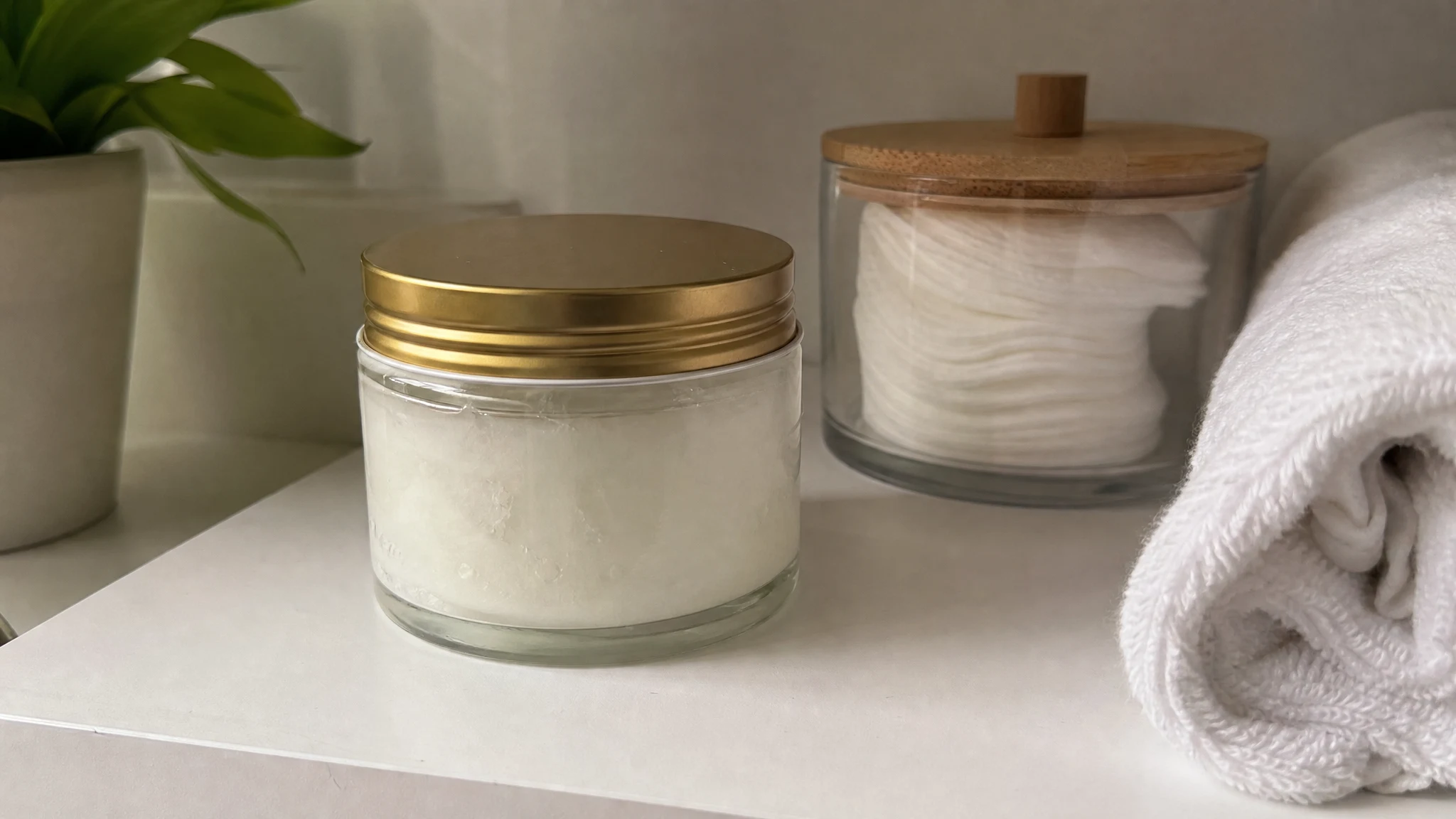
Coconut Oil vs Butter in Coffee: The Numbers
Hot coffee, a spoonful of fat, a quick whirl in the blender, and suddenly the mug is creamy with a pale foam on top. Butter and coconut oil are the two spoonfuls people argue about, and each has its fans. Which is better depends on what you want from the cup, and the numbers behind the choice are easy to look up once you know where to look.
Fractionated Coconut Oil
Our own Fractionated Coconut Oil, in sizes from 0.5 oz to bulk.
From $9.99
Shop Now →What one tablespoon puts in the cup
The USDA's FoodData Central lists coconut oil at 99.1 g fat and 82.5 g saturated fat per 100 g, with a tablespoon weighing 13.6 g. Salted butter comes in at 81.1 g fat, 51.4 g saturated fat and 16.2 g water per 100 g, with a tablespoon at 14.2 g. That water and those milk solids are why butter is the lighter of the two. Here is the per-tablespoon math (our arithmetic from those entries):
| Per tablespoon | Coconut oil | Salted butter |
|---|---|---|
| Weight | 13.6 g | 14.2 g |
| Energy | about 121 kcal | about 102 kcal |
| Fat | about 13.5 g | about 11.5 g |
| Saturated fat | about 11.2 g | about 7.3 g |
| Water | almost none | about 2.3 g |
| Protein | 0 g | about 0.1 g |
For scale, Harvard's Nutrition Source, summarizing the 2025-2030 Dietary Guidelines, puts the 10 percent of calories ceiling for saturated fat at roughly 22 g on a 2,000-calorie day. A tablespoon of coconut oil is about half of that allowance and a tablespoon of butter about a third, which is a good reason to begin with a small spoonful.
Where "coconut oil beats butter" comes from
The claim usually leans on two ideas. The first is simple and fair: coconut oil is dairy-free, so it suits anyone who avoids milk. The second is that coconut's medium-chain fats are somehow special. On the heart question the evidence does not bear that out. The American Heart Association's 2017 advisory notes that 82 percent of the fatty acids in coconut oil are saturated, and advises against using it because it raises LDL cholesterol and has no known offsetting favorable effects.
The pooled trials agree. Neelakantan, Seah and van Dam (Circulation, 2020) pooled 16 trials of at least two weeks and found coconut oil raised LDL cholesterol by 10.47 mg/dL and HDL by 4.00 mg/dL compared with non-tropical vegetable oils such as olive or safflower. For a butter comparison, Khaw and colleagues (BMJ Open, 2018) ran a four-week trial of 94 adults at 50 g a day, and butter raised LDL more than extra virgin coconut oil did. Our summary is that neither fat is the heart-friendly pick, so a cup of either sits in the enjoy-it-modestly category. Our saturated fat article goes deeper.
The MCT mix-up
Here is the detail that surprises most people: the original bulletproof recipe was built on MCT oil, not coconut oil. The USP monograph defines medium-chain triglycerides as mostly caprylic acid (C8, 50 to 80 percent) and capric acid (C10, 20 to 50 percent), with lauric acid (C12) capped at 3 percent. Coconut oil is a different blend, and lauric acid is its largest single fatty acid.
That matters if ketones are the point. Vandenberghe and colleagues (Current Developments in Nutrition, 2017) gave nine healthy adults 20 mL doses of different oils in skim milk, twice, four hours apart. Pure C8 produced the biggest ketone rise, while coconut oil's overall effect across the day was not significantly different from the control day. Nine people is a small study, so take it as direction rather than a dose guide. Our MCT oil versus coconut oil comparison unpacks the chemistry. In short, coconut oil makes a creamy, dairy-free cup, and for ketones MCT oil is the stronger tool.
What the one randomized coffee trial found
There is exactly one randomized trial of fat in coffee. Hoang and colleagues (Cureus, 2024) assigned 60 healthy adults aged 18 to 45 to plain coffee or coffee with butter plus MCT oil, building over 10 days to 2 tablespoons of each per day, split into three servings, for 12 weeks. Forty-one people finished. The authors reported no statistically significant differences between the groups, though raw averages drifted in different directions: LDL went from 106.5 to 114.1 mg/dL in the fat group and from 113.65 to 111.59 in the plain-coffee group. With so few completers, those gaps cannot be told apart from chance.
The reassuring reading is that no harm showed up in healthy young adults over three months. It says nothing about people who already have high LDL, and it used butter and MCT oil rather than coconut oil.
The coffee itself matters too
If this becomes a daily habit, one more detail is worth knowing. A meta-analysis of randomized trials by Cai and colleagues (European Journal of Clinical Nutrition, 2012) found that roughly 45 days of coffee raised total cholesterol by 8.1 mg/dL and LDL by 5.4 mg/dL, with a larger total-cholesterol rise in trials using unfiltered coffee. An easy choice follows: brew through a paper filter instead of a French press or boiled coffee, especially when there is fat in the mug.
Choosing your cup
If you avoid dairy and want a rich cup, coconut oil is a good fit. Start with a teaspoon rather than a tablespoon; the Hoang trial eased participants in over 10 days, a fine template for any big fat dose. If ketosis is the goal, carbohydrate intake does the heavy lifting, and Harvard's ketogenic diet review puts the usual ceiling under 50 g of carbohydrate a day, which a fatty coffee cannot offset on its own (our keto guide covers it). Counting calories? A tablespoon of coconut oil adds about 121 kcal and no protein. If you have high LDL, take a cholesterol medicine or have a digestive or liver condition, bring the question to your physician or a registered dietitian before adding 100 to 250 kcal of saturated fat to a daily habit, since that call needs your lab values.
For the mug, here is a method worked out from how fat and water behave: brew 240 mL through a paper filter, add a teaspoon (about 4.5 g) of food-grade coconut oil or butter, and blend for 20 to 30 seconds so the fat breaks into tiny droplets. Oil and water only stay mixed while agitated, so expect separation as it cools and drink it hot.
A quick note on our own shelves: our fractionated and virgin unrefined coconut oils are cosmetic carrier oils for external use only, so the jar for your coffee belongs in the food aisle. To see what ours are made for, start with our fractionated coconut oil explainer, or compare butter with another cooking fat in coconut oil versus ghee. For cosmetic projects that use more oil, see our bulk sizes and our guide to buying fractionated coconut oil in bulk.
Fractionated Coconut Oil
Fractionated Coconut Oil from our own shop, in sizes from 0.5 oz to bulk.
From $9.99
Shop Now →Sources & Further Reading
- USDA, 2019. FoodData Central, Oil, coconut (SR Legacy 171412). fdc.nal.usda.gov/171412
- USDA, 2019. FoodData Central, Butter, salted (SR Legacy 173410). fdc.nal.usda.gov/173410
- Harvard T.H. Chan School of Public Health, 2026. Dietary Guidelines for Americans 2025-2030: progress on added sugar, protein hype, saturated fat contradictions. nutritionsource.hsph.harvard.edu
- American Heart Association, 2017. Dietary fats and cardiovascular disease: top things to know (Sacks et al., Circulation 2017;136:e1-e23). heart.org
- Neelakantan N, Seah JYH, van Dam RM, 2020. The effect of coconut oil consumption on cardiovascular risk factors. Circulation 141(10):803-814. pubmed.ncbi.nlm.nih.gov/31928080
- Khaw KT et al., 2018. Randomised trial of coconut oil, olive oil or butter on blood lipids. BMJ Open 8(3):e020167. pubmed.ncbi.nlm.nih.gov/29511019
- United States Pharmacopeia, 2012. Medium-Chain Triglycerides monograph, USP 35. drugfuture.com/USP35
- Vandenberghe C et al., 2017. Tricaprylin alone increases plasma ketone response more than coconut oil or other medium-chain triglycerides. Curr Dev Nutr 1(4):e000257. PMC5998344
- Hoang TD et al., 2024. The effects of medium-chain triglyceride oil and butter on lipid profiles. Cureus 16(6):e62556. PMC11254513
- Cai L et al., 2012. The effect of coffee consumption on serum lipids: a meta-analysis of randomized controlled trials. Eur J Clin Nutr 66(8):872-877. pubmed.ncbi.nlm.nih.gov/22713771
- Harvard T.H. Chan School of Public Health, 2026. Diet review: ketogenic diet. nutritionsource.hsph.harvard.edu