How to Pack Coconut Oil for Travel Without Leaks
The best travel oil is the one that is still in its bottle when you unzip your bag. Coconut oil can be a lovely carry-along for dry cabin air and hotel-room skin, and two small decisions, bottle size and oil type, decide whether it behaves.
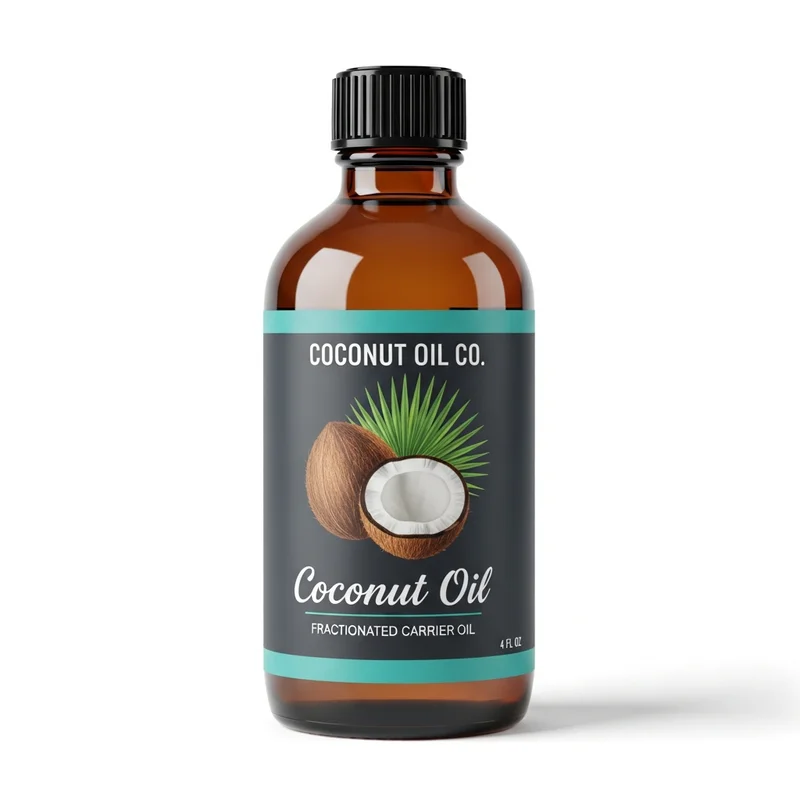
Fractionated Coconut Oil
Our own Fractionated Coconut Oil, in sizes from 0.5 oz to bulk.
From $9.99
Shop Now →Do the checkpoint math first
The TSA's liquids, aerosols and gels rule allows carry-on containers of 3.4 ounces (100 milliliters) or less, all gathered in one quart-size clear bag. The page names liquids, gels and creams rather than oil specifically, so treating a pourable oil as a liquid is our reading of the rule. It also covers US screening only, and other countries and airlines set their own limits.
Since one ounce is 29.57 ml, the sizes we sell work out to 14.8 ml for 0.5 oz, 29.6 ml for 1 oz, 59.1 ml for 2 oz and 118.3 ml for 4 oz. The first three slide under the limit, and the 4 oz bottle goes in checked luggage. Screeners judge a container by the size printed on it, so a half-empty big bottle still counts as a big bottle. For a carry-on, the 1 oz or 2 oz is our pick.
Choose the oil for the suitcase
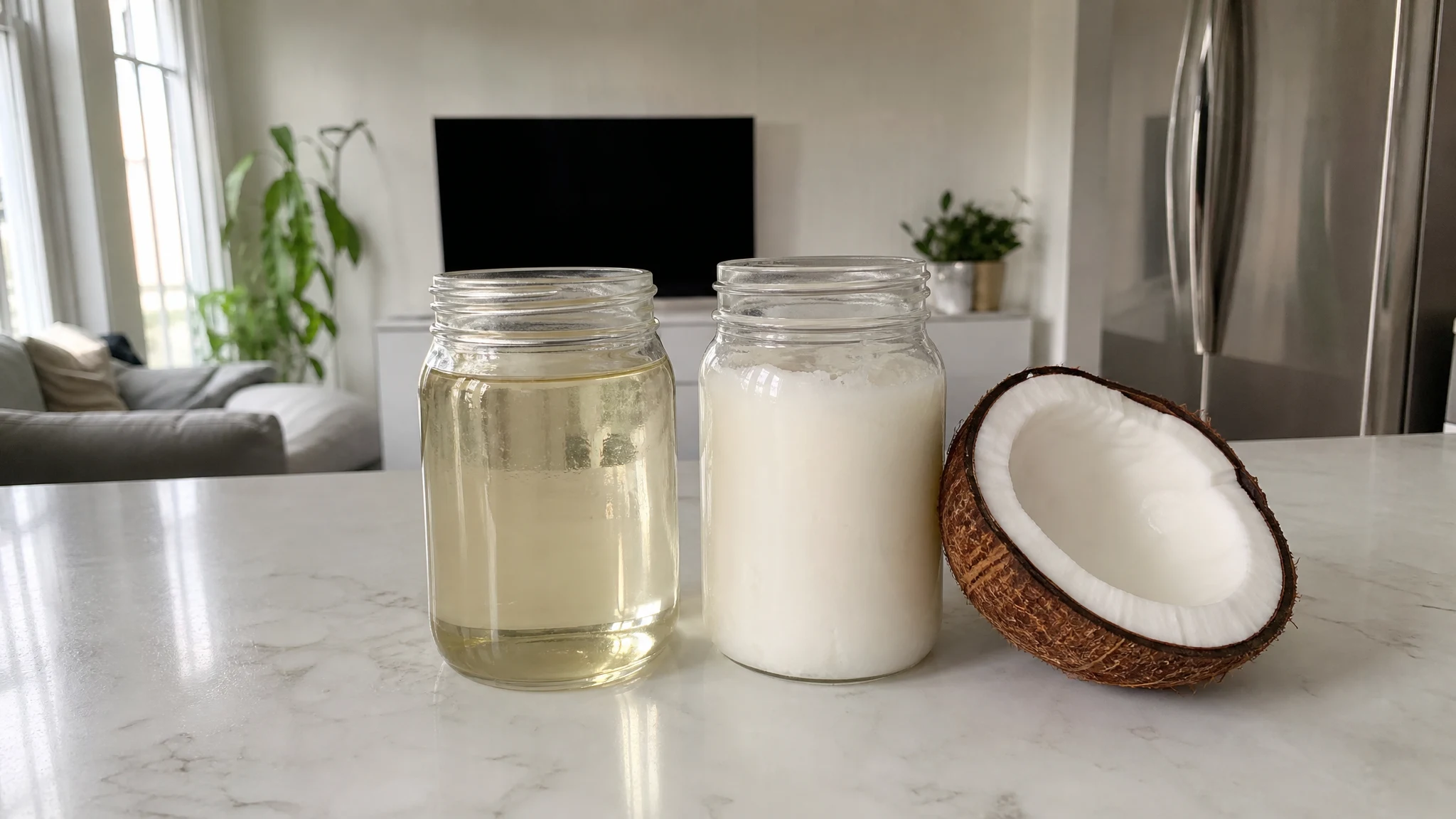
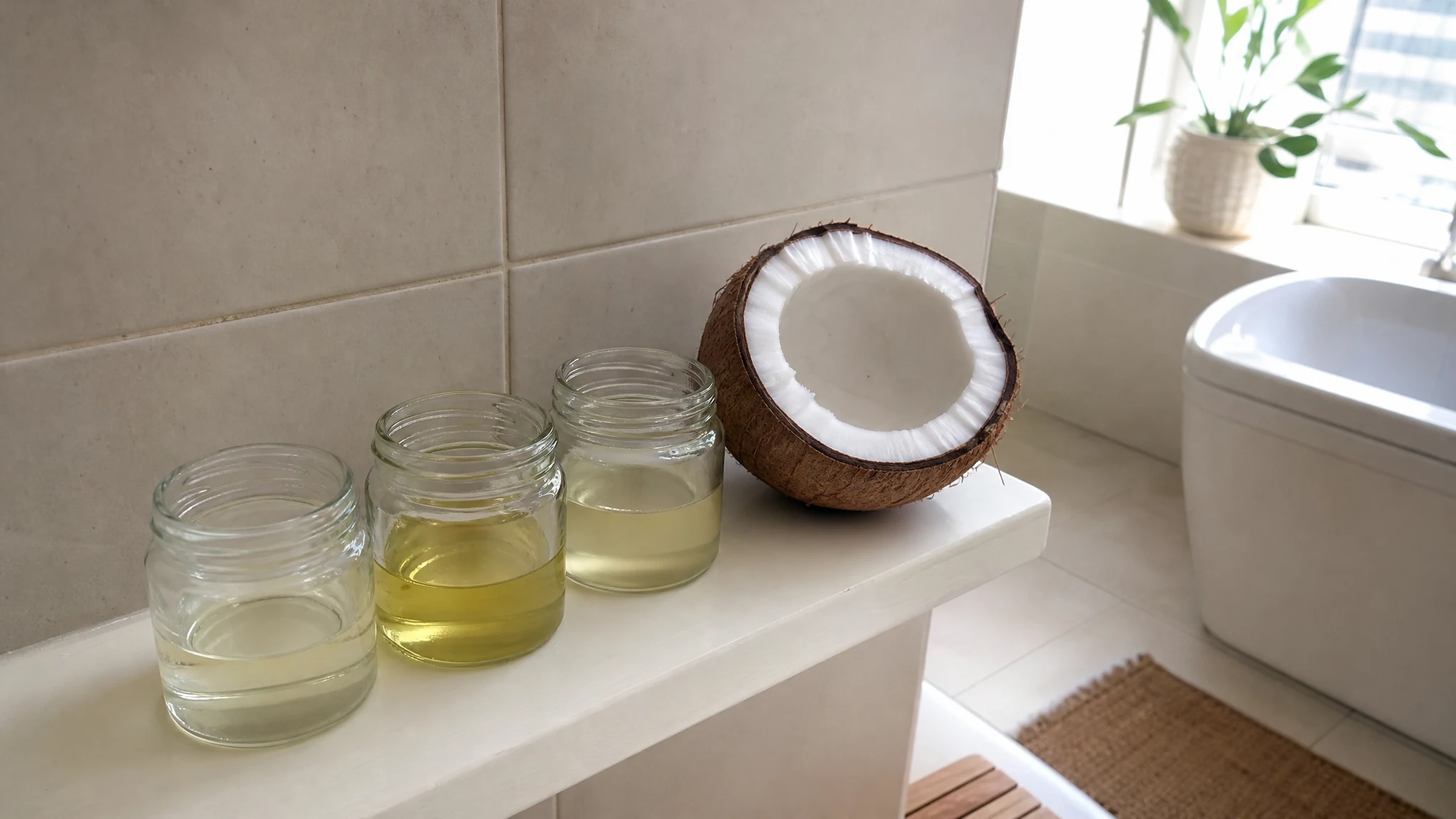
This is where our two oils part ways. Our fractionated oil stays liquid at any temperature, so it behaves the same in a cold cabin, a warm hotel room and a hot car. Our virgin unrefined oil is firm in a cool room and melts in warm hands, at about 76 degrees Fahrenheit (24 C) according to our origin page, which fits the roughly 24 C that Gopala Krishna and colleagues report for virgin coconut oil. From that, it follows that a jar of virgin oil riding in a warm car turns liquid, and liquid finds any loose lid.
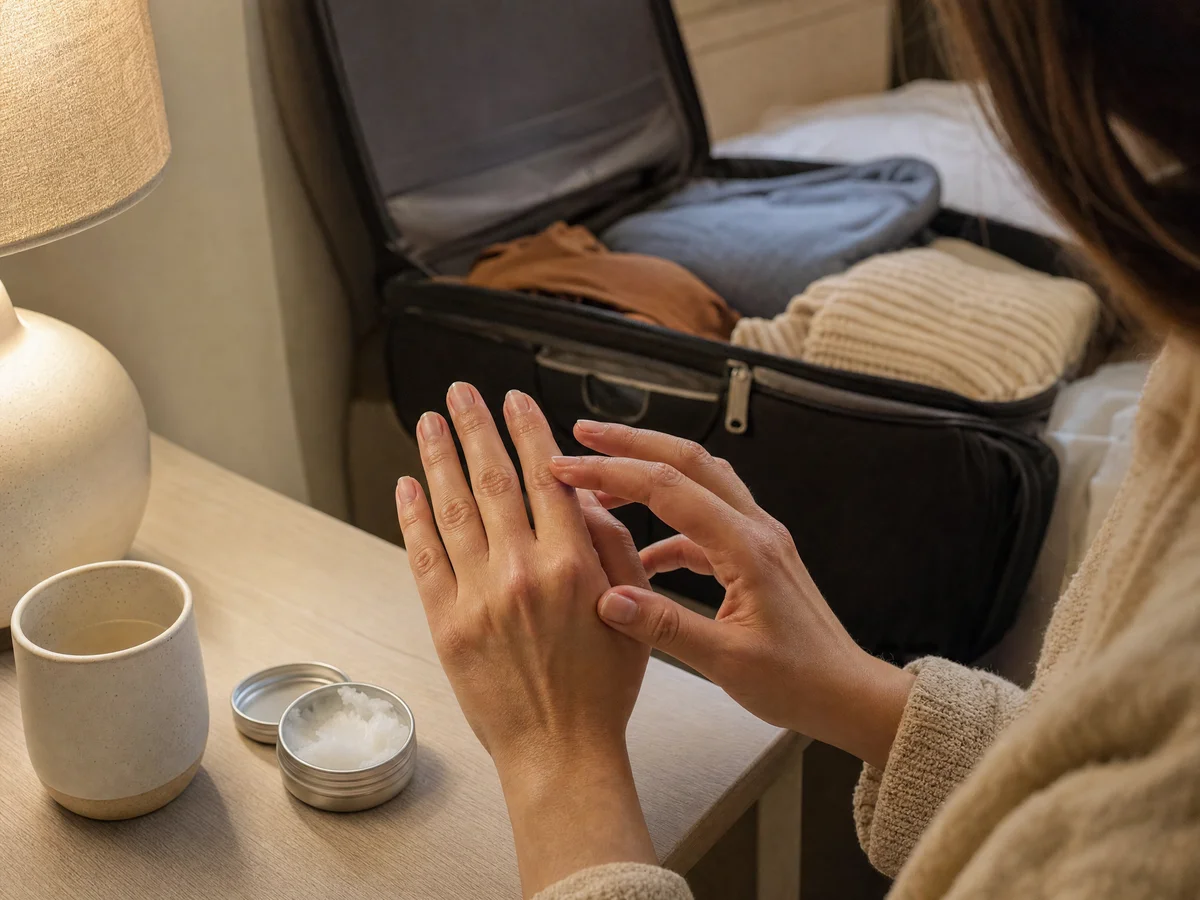
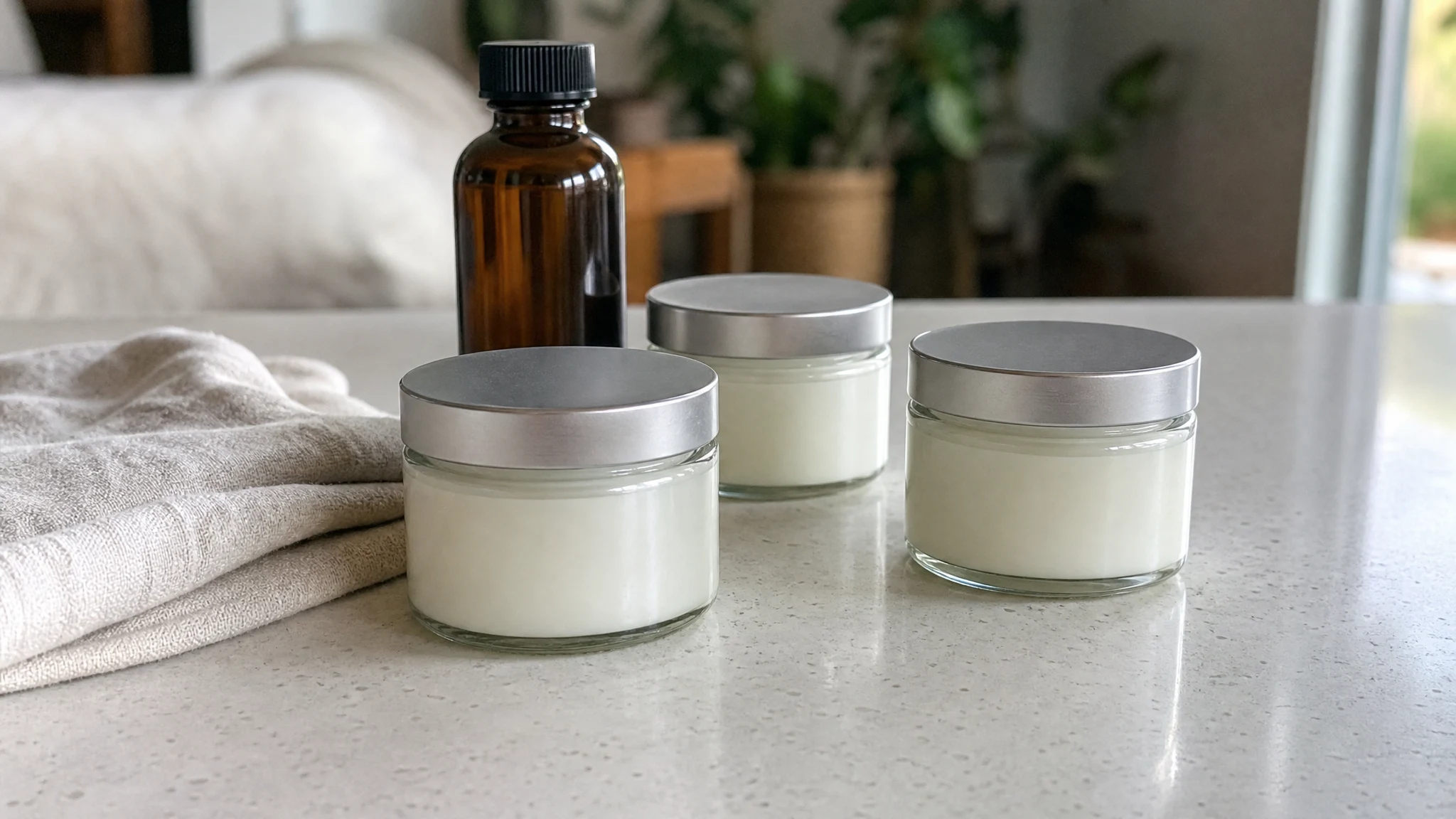
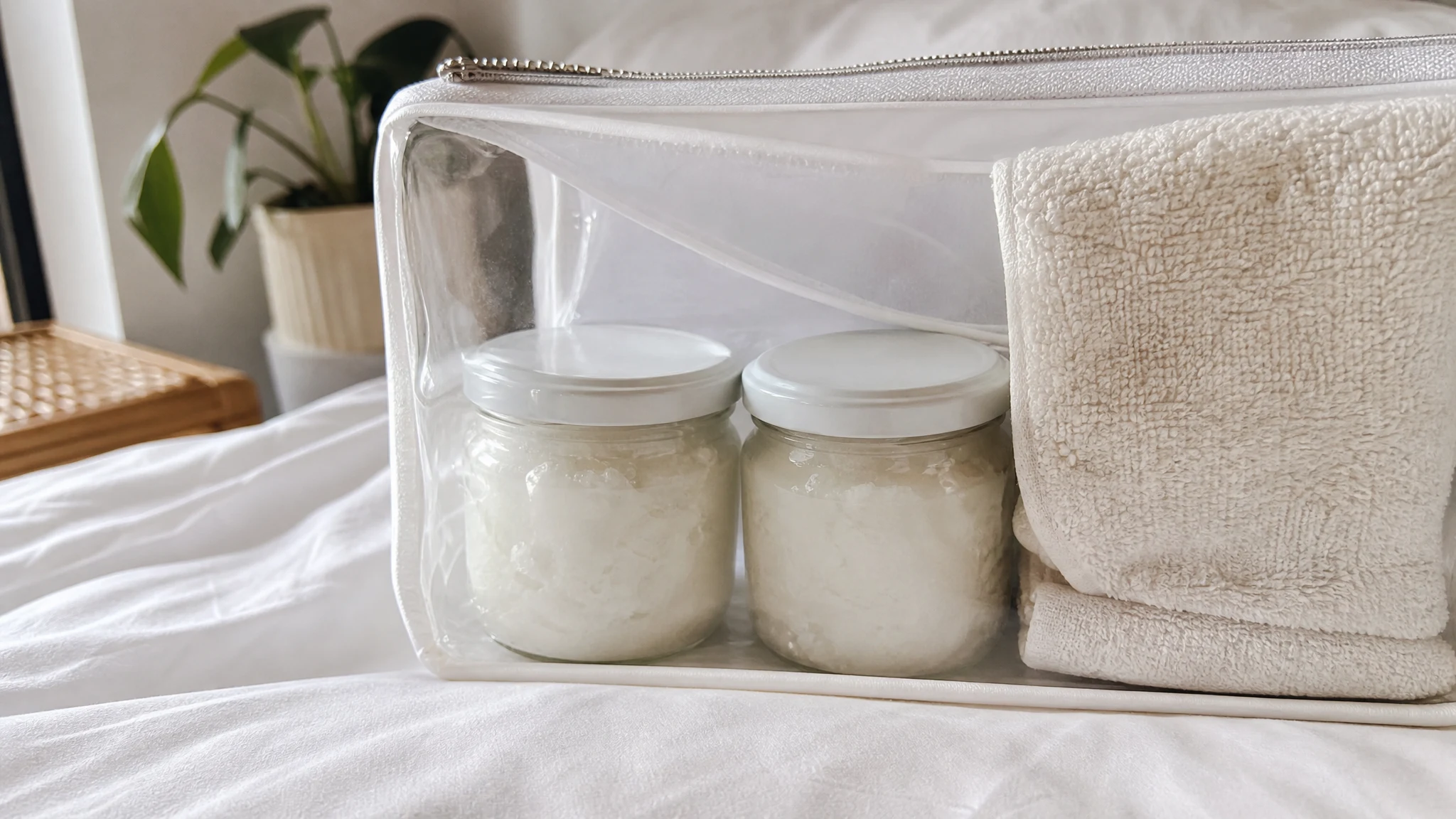
So we suggest a screw-top bottle of our fractionated oil for most trips. If you love the coconut scent and want virgin oil, a small tin or jar that closes tightly, tucked into the middle of your bag, travels well. A zip bag around either is cheap insurance, and in a carry-on the quart bag already does that job.
One packing habit pays off with either oil: decant. A trip rarely needs more than a week of oil, so pour a small amount into a 1 oz or 2 oz bottle you can carry and leave the large bottle at home. Press the cap down firmly, stand the bottle upright in a zip bag, and put the bag in the middle of your clothes, away from the outer wall of the suitcase where pressure and temperature swing the most. A leaked bottle is mostly a laundry problem, but a tidy bag keeps it from becoming a toiletry-bag problem too.
What it is good for on the road
The most natural use is body moisturizer for dry air. The American Academy of Dermatology advises moisturizing while skin is still damp after a bath or shower, and says ointments and creams hold in more moisture than lotions. That page does not name coconut oil, so we offer it as a convenient choice. In a 2004 trial of 34 people with mild to moderate dry skin, virgin coconut oil and mineral oil both improved skin hydration, with no significant difference between them. That trial used virgin oil, so applying it to fractionated oil is an inference.
A few drops of fractionated oil also make a handy carrier for a roll-on scent, one of the uses we list for it. Our dilution guide has the arithmetic, and any essential oil bottle counts toward the same quart bag. If you wear makeup, our piece on coconut oil as a makeup remover covers rinsing well and keeping it away from the eyes. And for something solid that fits a pocket, coconut oil lotion bars are made for bags.
Many travelers like a few drops smoothed over damp skin after a hotel shower. On the way home, wipe the neck of the bottle clean before you cap it, so a thin film does not creep down the threads.
Leave these at home
Coconut oil is not a sunscreen. A 2021 study of 14 virgin vegetable oils found the five most-promoted ones, coconut among them, far below the SPF values claimed earlier, and the rest with little or none. The AAD recommends water-resistant, broad-spectrum sunscreen of SPF 30 or higher, so pack that separately. Our SPF article goes into the detail.

Our oils are sold for external cosmetic use only, which keeps them in the toiletry bag and out of the kitchen or medicine kit. For cuts, rashes or bites on your trip, a pharmacist or clinician is the right call, and for skin that gets sore on long walks, our chafing article explains where an oil fits.
Try it at home first
A new oil deserves a trial run before the airport. We advise a patch test on a small area of skin first, with a 24-hour wait for our fractionated oil, and anyone with a tree nut or coconut allergy should check with a professional before use. The AAAAI notes that coconut oil can cause contact dermatitis in some people, and the middle of a trip is a poor moment to find out.
The short version: one bottle of 2 oz or less in a zip bag, cap checked, fractionated if you want it to stay liquid, smoothed over damp skin. For more on how heat and time treat the oils, see how to store coconut oil.
Fractionated Coconut Oil
Fractionated Coconut Oil from our own shop, in sizes from 0.5 oz to bulk.
From $9.99
Shop Now →Sources & Further Reading
- US Transportation Security Administration, undated. Liquids, aerosols and gels rule. tsa.gov/liquids-aerosols-and-gels-rule
- Gopala Krishna AG et al., 2010. Coconut oil: chemistry, production and its applications, a review. Indian Coconut Journal (CFTRI, Mysore). coconutboard.in/Gopalakrishna-CFTRI.pdf
- American Academy of Dermatology, updated 1/2/26. Dermatologists' tips to relieve dry skin. aad.org/dry-skin-tips
- Agero AL, Verallo-Rowell VM, 2004. Extra virgin coconut oil vs mineral oil as a moisturizer for xerosis. Dermatitis 15(3):109-116. pubmed.ncbi.nlm.nih.gov/15724344
- Acsova A et al., 2021. Photochem Photobiol Sci 20(1):139-151. doi.org/10.1007/s43630-020-00009-3
- American Academy of Dermatology. How to apply sunscreen. aad.org/how-to-apply-sunscreen
- AAAAI, reviewed 12/8/2023. Reaction to coconut (Ask the Expert). aaaai.org/reaction-to-coconut