Essential Oils in Coconut Oil: Dilution, Step by Step
Most dilution charts hand you a drop count and treat the percentage as an afterthought. We like to start from the other end: choose the percentage, turn it into a weight or a measured volume, and only then enjoy the fun part, which is the scent. Drops are perfectly fine in a one-ounce bottle and a little slippery in the small roller bottles most of us actually fill, so this walk-through builds one blend from start to finish. We use our fractionated coconut oil as the example because it stays liquid, with notes on where the virgin unrefined oil changes the steps.

Fractionated Coconut Oil
Our own Fractionated Coconut Oil, in sizes from 0.5 oz to bulk.
From $9.99
Shop Now →Start with where the blend will go
The Tisserand Institute dilution guide gives a handy map: 0.2 to 1% for sensitive skin, 0.5 to 1.2% for the face, 1 to 3% for body oils, 2 to 4% for bath and wash-off products, and 3 to 10% for rollerballs. Its rule of thumb is to start low and go up only if needed, and we agree wholeheartedly. For a first batch, sit at the bottom of the range for that area. A stronger smell is not a better blend, and concentration is the variable that most affects how skin responds.
Those ranges are general ceilings, and a few oils carry their own lower limit that applies everywhere on the body. The Institute's maximum-dermal page uses lemongrass at 0.7% as its example. If the oil you love has a lower number than the table, the lower number wins. The ranges do not cover children, so ask a pediatrician first, and if you are pregnant or nursing, ask an OB/GYN or midwife. Poison control explains the extra care around kids: poison.org says children "have thin skin and immature livers."
Do the arithmetic once
One fluid ounce is 29.57 ml. The certificate of analysis we publish measured one batch of our fractionated oil at a relative density of 0.948 at 20 C, so an ounce of that batch weighs about 28.0 grams. The table converts three common strengths into drops, assuming 20 drops to a milliliter. That drop size is our approximation, and every drop conversion is approximate.
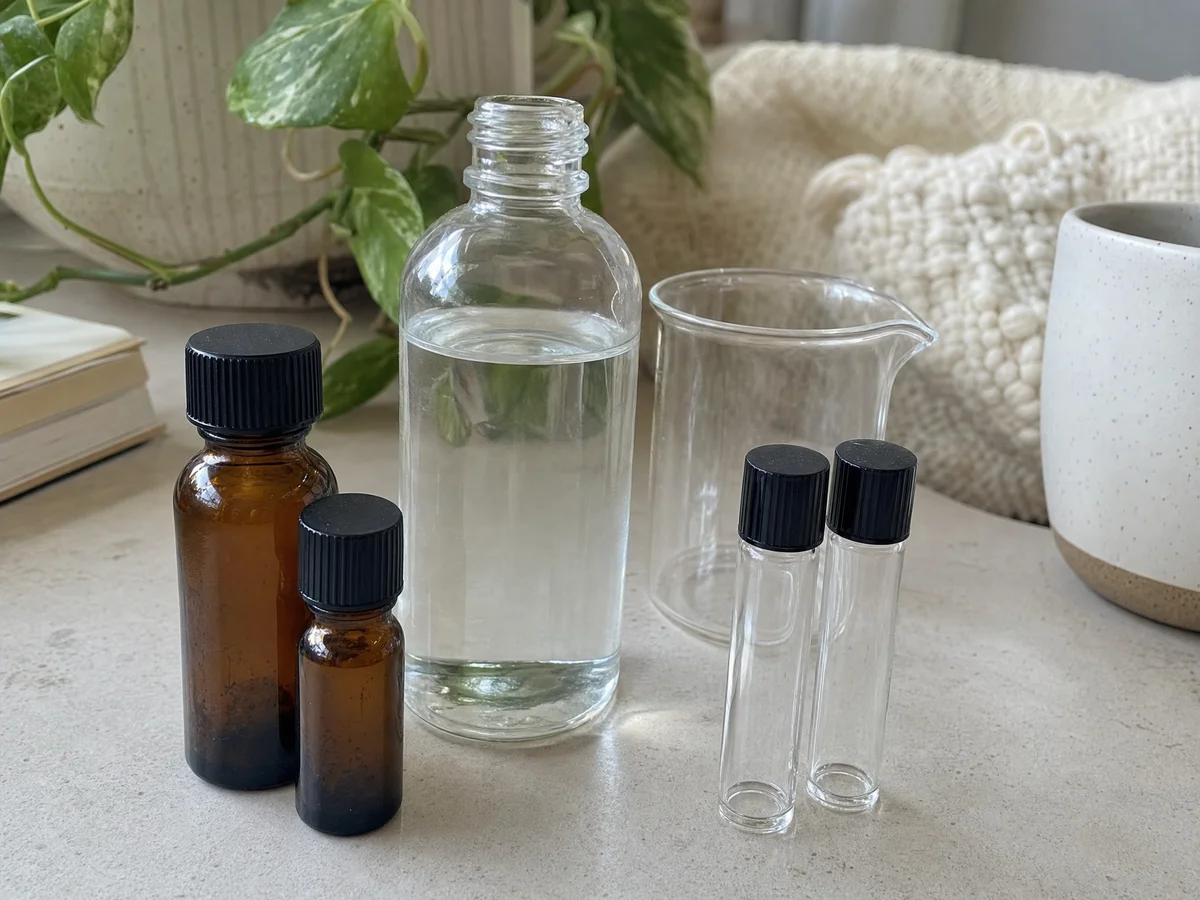
| Bottle (carrier volume) | 0.5% | 1% | 2% |
|---|---|---|---|
| 10 ml roller | 1 drop | 2 drops | 4 drops |
| 15 ml (half ounce) | 1.5 drops | 3 drops | 6 drops |
| 30 ml (about 1 oz) | 3 drops | 6 drops | 12 drops |
| 100 ml | 10 drops | 20 drops | 40 drops |
Look at the first row. At 0.5% in a 10 ml roller you add a single drop, and a drop from a different dropper can easily be half again as large or as small, which swings the final percentage by a factor of two. For anything under an ounce we like to weigh the essential oil on a scale that reads to 0.01 gram, or to pre-dilute: make a 10% stock in a milliliter or two of carrier and measure out the stock. That is our reasoning from the arithmetic rather than a published rule, and an aromatherapy trainer may have a method they prefer.
Mixing it up
With fractionated oil there is nothing fussy to do. Add the essential oil to the carrier and shake or stir; no warming needed. We describe the oil as virtually odorless, so the scent you smell in the bottle will be the essential oil doing the talking.
Our virgin unrefined oil solidifies below about 76 degrees Fahrenheit. If the jar is firm, set it closed in a bowl of warm water until it just turns liquid, let it cool a little, then add the essential oil, stir and pour. Letting it cool first is our own precaution rather than a sourced figure. In a cool room the blend will set again, which is lovely in a jar and awkward in a roller, so for a roller fractionated is the easy choice.
Neither oil mixes with water. The Tisserand Institute's bath safety page notes that oils float and cling, and names dispersants such as polysorbate 20 and Solubol for putting essential oils in a bath. A coconut oil blend poured into the tub makes a floating film, so these blends are best kept for skin, massage and hair.
Building a scent within your limit
Here is a small trick that is easy to enjoy: three essential oils in a 1% blend means roughly a third of a percent each, not 1% each. Count the total. Our fractionated oil page lists lavender, lemon, tea tree, peppermint, frankincense and rose as natural partners, and our virgin page lists sweet orange, lavender, ylang ylang, vanilla, patchouli and sandalwood. Those are aroma pairings, nothing more. For one finished example, our Islander blend uses the virgin oil.
Build around your strongest oil first. Add a drop, smell the carrier on a tissue after a minute, and stop sooner than you think you need to, because blends shift as they sit. If tea tree is the oil you are reaching for, the tea tree dilution post covers that pair. For choosing between our two oils for beauty projects, the DIY beauty comparison is a good companion.
Label it, date it, keep batches small
Write the percentage, the oils and the date on the bottle. The Tisserand Institute's oxidation page explains that oxidized essential oils are more likely to irritate skin, that most oils keep at least a year or two before oxidation takes hold, and that using them within 6 to 12 months makes it largely a non-issue. It gives no figure for carrier oils. We say about 2 years unopened for our fractionated oil and 18 to 24 months for the virgin when kept closed, cool and dark. A blend lasts as long as its shortest-lived ingredient, so a small batch you finish in a few months beats a big one that sits; the storage guide has the details.
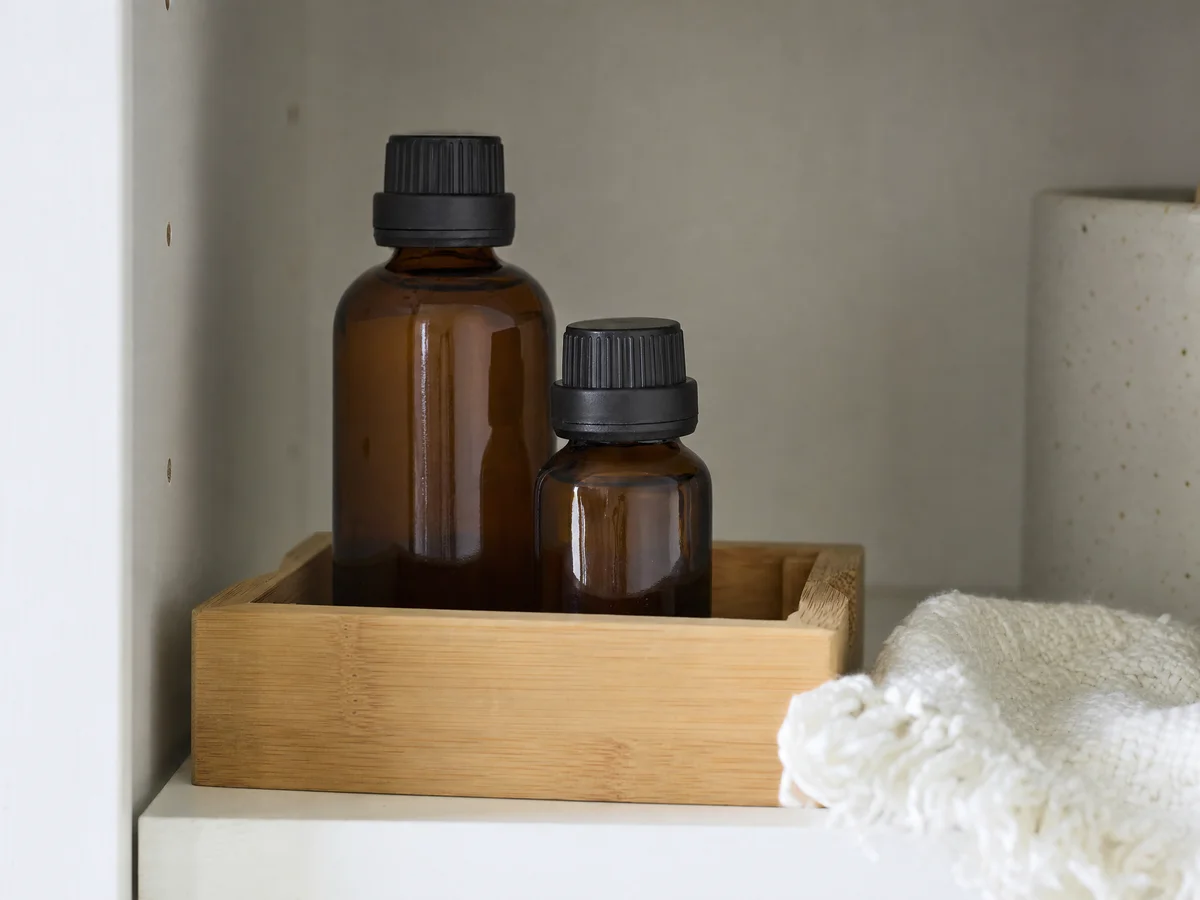
Then patch test. We ask for a small amount on a small area first (our fractionated page says to wait 24 hours) and for blends to stay away from your eyes. If you have a coconut or tree nut allergy, check with a professional first, and our allergy guide covers what the FDA changed in 2025.
What these blends are for
These blends are for skin. If a child swallows one, poison.org says to call Poison Help at 1-800-222-1222, and it advises keeping oils locked up and out of reach of children and pets. A blend for pain, sleep or any condition is a conversation with a clinician, and the FDA's cosmetic-or-drug page explains why a seller cannot promise it. The numbers above are arithmetic on the cited ranges.
When the blend needs to stay liquid in a roller or on a massage table, fractionated coconut oil is the base we point you to. For a firm, coconut-scented blend, the virgin unrefined oil is the one.
Pick the percentage, count the drops, and write the date on the bottle. After that, all that is left is the fun part: opening it and smelling what you have put together.
Fractionated Coconut Oil
Fractionated Coconut Oil from our own shop, in sizes from 0.5 oz to bulk.
From $9.99
Shop Now →Sources & Further Reading
- Tisserand Institute, undated. Dilution guide. tisserandinstitute.org/safety/dilution
- Tisserand Institute, undated. Safety: maximum dermal concentrations. tisserandinstitute.org/learn-more/safety-maximum-dermal
- Tisserand Institute, undated. Bath safety. tisserandinstitute.org/safety/bath-safety
- Tisserand Institute, undated. Oxidized essential oils. tisserandinstitute.org/learn-more/oxidized
- Poison Control (poison.org), undated. Essential oils. poison.org/articles/essential-oils
- US FDA, 2024. Is it a cosmetic, a drug, or both? fda.gov/cosmetics