Coconut Oil for DIY Beauty: Which Oil Suits Which Recipe?
Every DIY beauty recipe starts with a quiet question: where will the finished product live? A roll-on rides around in a purse, a body oil sits on a bathroom shelf that swings from January chill to July steam, and a balm has to keep its shape in a pocket. Coconut oil can anchor all three, but it arrives in two very different forms, and choosing between them is the single decision that shapes everything else.

Fractionated Coconut Oil
Our own Fractionated Coconut Oil, in sizes from 0.5 oz to bulk.
From $9.99
Shop Now →Same palm, two personalities
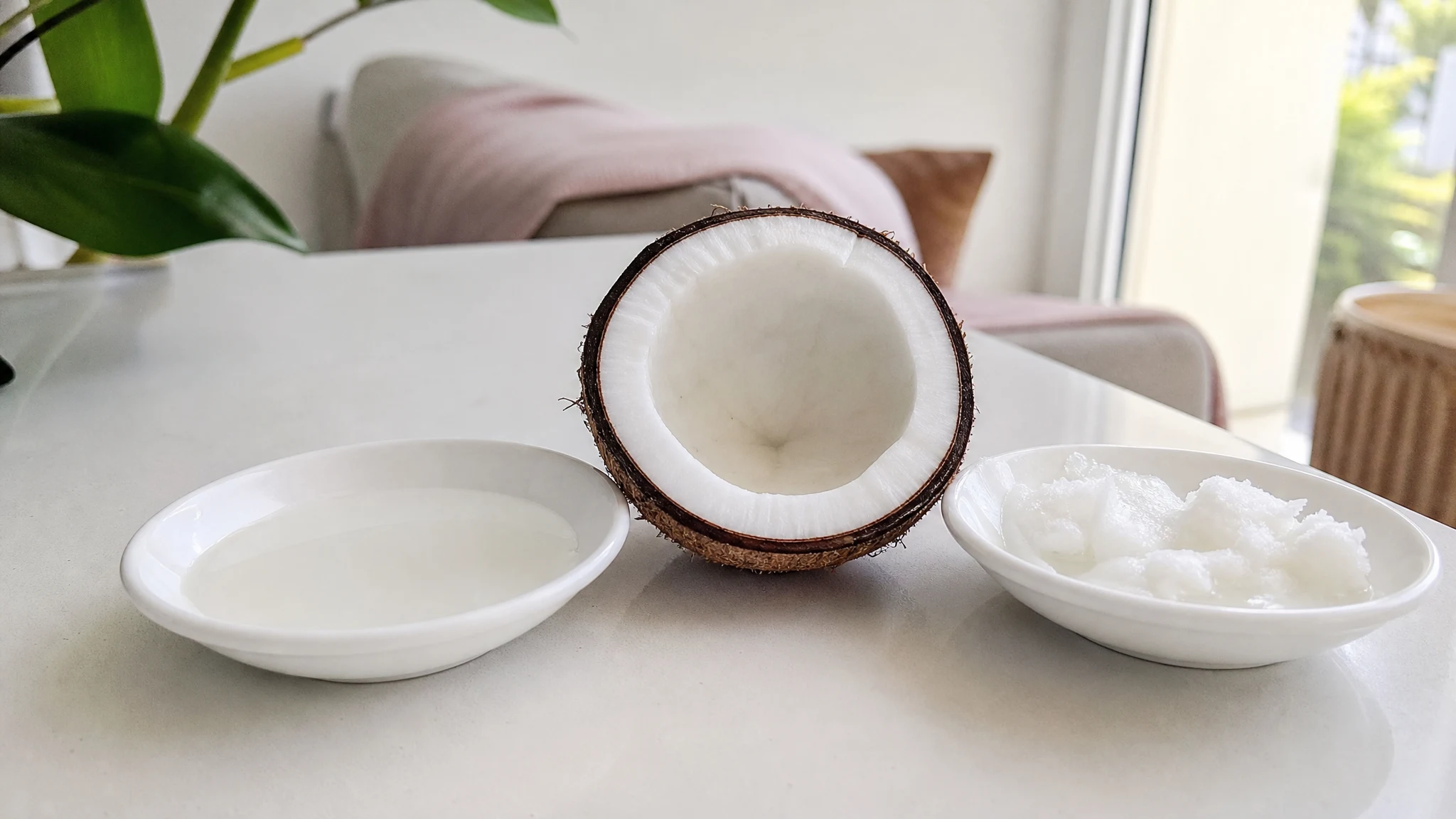
Ordinary coconut oil is built mostly from lauric acid. One review of plant oils used on skin lists roughly 49% lauric, 18% myristic, 8% palmitic, 8% caprylic and 7% capric. Fractionation sorts that mix by melting point: the oil is warmed, cooled, and the solid part is separated from the liquid, which leaves mostly caprylic and capric acids (Healthline gives a readable overview). That is a general description of the process, not a lab report on any one bottle.
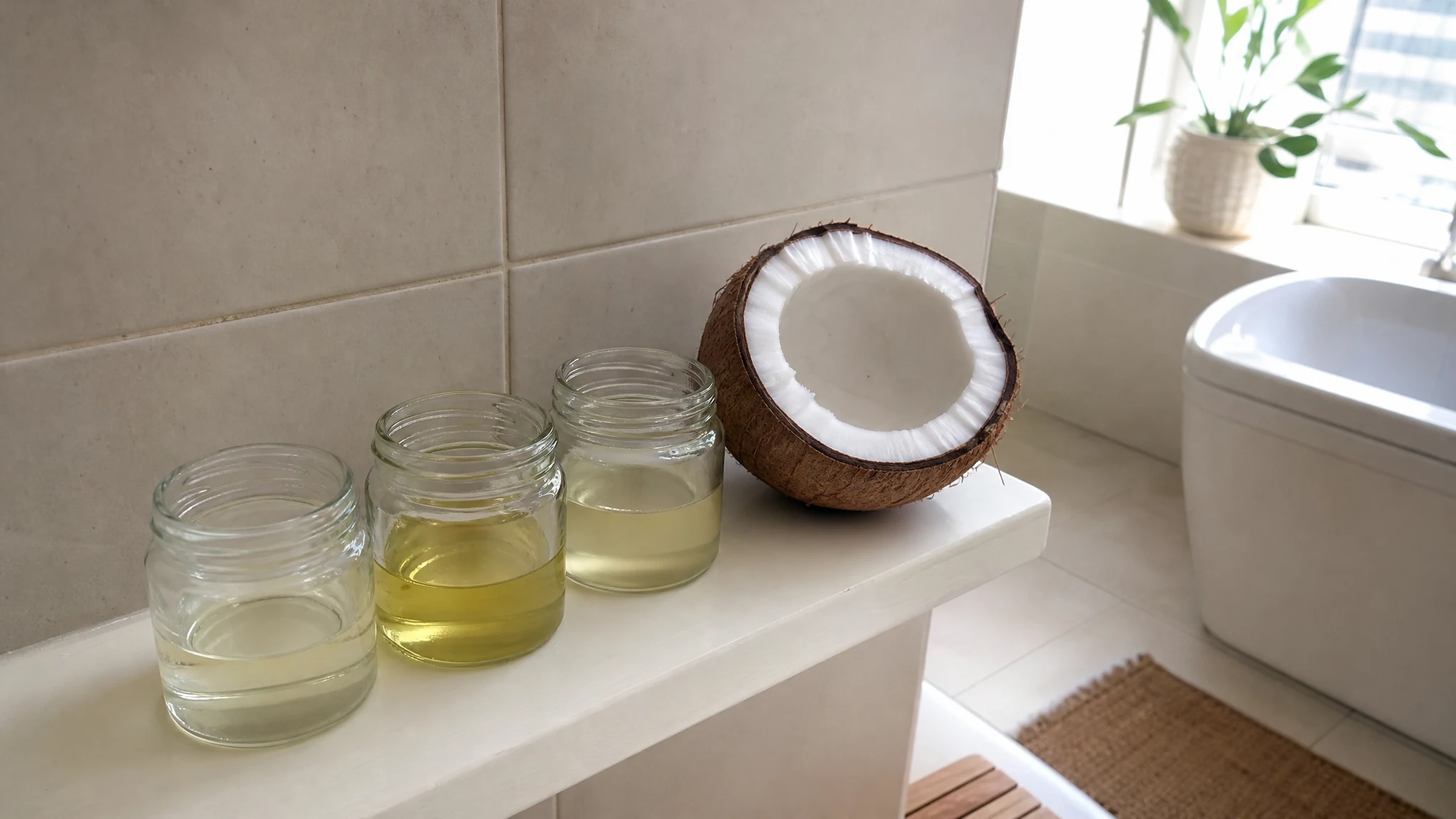
What you notice at the workbench is the result. Our fractionated coconut oil stays liquid at any temperature, and we describe it as colorless, virtually odorless, fast-absorbing and non-greasy. Our virgin unrefined coconut oil is its opposite number: it firms up below about 76 degrees Fahrenheit, melts in warm hands and carries a rich, creamy, unmistakably coconut aroma. Nearly every choice below follows from that contrast.
Matching the oil to the project
| What you are making | What it needs | Our pick |
|---|---|---|
| Roll-on or perfume-style blend | Stays liquid, adds no scent of its own | Fractionated |
| Massage or body oil | Pours and spreads the same all year | Fractionated |
| Hair or beard oil | Liquid with a light feel | Fractionated, or virgin if you love the coconut scent |
| Balm, solid bar, lip product | Sets firm without a hard wax doing all the work | Virgin unrefined plus a wax or butter |
| Anything meant to smell like coconut | The aroma has to survive | Virgin unrefined |
This table is reasoning from melting behavior, and the one rule it hides is worth saying out loud: a firm product built mostly on a low-melting oil can soften in a hot car or a steamy bathroom. Pour a small sample, leave it wherever the finished product will spend its time, and scale up once it behaves. We sell neat oils rather than finished balms, lotions, beeswax, butters, bottles or kits, so those ingredients come from elsewhere. For worked examples, try our lip balm recipe, the sugar scrub variations, the gift-making ideas, or coconut oil against shea butter if you are deciding between a butter and an oil.
Why oil-only recipes are the friendly place to start
A blend of oil and essential oil contains no water, which makes it the easiest kind of DIY product to get right. The moment a recipe adds water, aloe, hydrosol or a water-based extract, you have made something microbes can live in, and no oil, ours included, preserves that. The FDA's page on microbiological safety and cosmetics names an ineffective preservation system and contaminated water among the ways a cosmetic gets contaminated, and notes that warmth and damp speed growth. We suggest newcomers stay with oil, wax, butter and essential oil until they are ready to learn about preservation properly.
Scent goes in by the fraction of a milliliter
When a homemade oil blend bothers someone's skin, the culprit is usually the essential oil, not the carrier. The Tisserand Institute's dilution guidelines run from 0.2 to 1% for sensitive or impaired skin, 0.5 to 1.2% for the face, 1 to 3% for body oils and lotions, and 2 to 4% for bath products, with a reminder to start low. An ounce is 29.57 ml, so 1% is about 0.3 ml of essential oil and 3% about 0.9 ml; the facial range works out to roughly 0.15 to 0.35 ml per ounce. Those amounts are tiny, far smaller than many online recipes call for, and individual oils carry their own lower limits. Our drop-by-drop blending guide walks through it step by step.
What the skin studies cover
Much of the research on coconut oil and skin involves virgin oil. In a double-blind trial of 34 people with mild to moderate dry skin, extra virgin coconut oil and mineral oil were each applied to the legs twice a day for two weeks. Both raised skin hydration and surface lipids, and nobody had an adverse reaction. It was a small group over two weeks, and it used virgin oil, so applying it to fractionated oil is an inference.
Pores are a favorite DIY worry. Comedogenic ratings come from tests on raw ingredients, and a 2006 study in six people found that finished products containing comedogenic ingredients were not necessarily comedogenic. So a good number on a chart does not clear a whole recipe, and a poor one does not condemn it. We make no non-comedogenic claim for our oil, and our article on pores goes deeper. If you have acne-prone skin, eczema or another condition, a dermatologist is the right person to ask before putting a homemade product on your face.
Giving it away, or selling it
The FDA's fact sheet on homemade cosmetics confirms that making cosmetics at home is not against the law, and that you are responsible for their safety and proper labeling. Retail products need an ingredient list in descending order of predominance. Your wording counts too: the FDA explains that intended use decides whether a product is a cosmetic or a drug, so a roll-on stays a cosmetic when you describe it as one. Sunscreen, lubricants and anything made for babies sit outside what a DIY coconut oil recipe should attempt.
Questions worth asking any supplier, us included
Ask which oil it is by name, because fractionated, virgin and refined are different materials. Ask what paperwork exists. The certificate of analysis we publish covers one batch of our fractionated oil and lists appearance, smell, relative density (0.948 against a 0.938 to 0.950 standard), refractive index and optical rotation. It does not include a fatty acid profile, peroxide value, heavy metals or microbial data, and we publish no certificate for the virgin listing, so if you need figures like those, ask us in writing before you order. For shelf life, we say about 2 years unopened for the fractionated oil and typically 18 to 24 months for the virgin when it is kept tightly closed somewhere cool and dark. And smell a sample before you commit a scented recipe, because we describe the fractionated oil as virtually odorless while the virgin smells of coconut.
That is why we sell small sizes. Try a bottle of fractionated coconut oil or virgin unrefined, make one small batch and see how it behaves before you scale up. Both are sold neat for external cosmetic use, so patch test a small area first and keep them away from your eyes. When your projects grow, we also fill bulk and wholesale orders, and our buying checklist applies to any label you meet.
Start small, let one little batch show you how your oil behaves where it will live, and enjoy the making. Everything after that is just refinement.
Fractionated Coconut Oil
Fractionated Coconut Oil from our own shop, in sizes from 0.5 oz to bulk.
From $9.99
Shop Now →Sources & Further Reading
- Lin TK, Zhong L, Santiago JL, 2018. Anti-inflammatory and skin barrier repair effects of topical application of some plant oils. Int J Mol Sci 19(1):70. pmc.ncbi.nlm.nih.gov/PMC5796020
- Healthline, reviewed 2019. Fractionated coconut oil (secondary source). healthline.com/nutrition/fractionated-coconut-oil
- FDA, 2024. Microbiological Safety and Cosmetics. fda.gov/microbiological-safety-and-cosmetics
- FDA, 2025. Small Businesses & Homemade Cosmetics Fact Sheet. fda.gov/homemade-cosmetics
- FDA, 2025. Summary of Cosmetics Labeling Requirements. fda.gov/cosmetics-labeling-requirements
- FDA, 2024. Is it a cosmetic, a drug, or both? fda.gov/cosmetic-drug-or-both
- Tisserand Institute, undated. Essential oil dilution guidelines. tisserandinstitute.org/safety/dilution
- Agero AL, Verallo-Rowell VM, 2004. A randomized double-blind controlled trial comparing extra virgin coconut oil with mineral oil as a moisturizer for mild to moderate xerosis. Dermatitis 15(3):109-116. pubmed.ncbi.nlm.nih.gov/15724344
- Draelos ZD, DiNardo JC, 2006. A re-evaluation of the comedogenicity concept. J Am Acad Dermatol 54(3):507-512. pubmed.ncbi.nlm.nih.gov/16488305