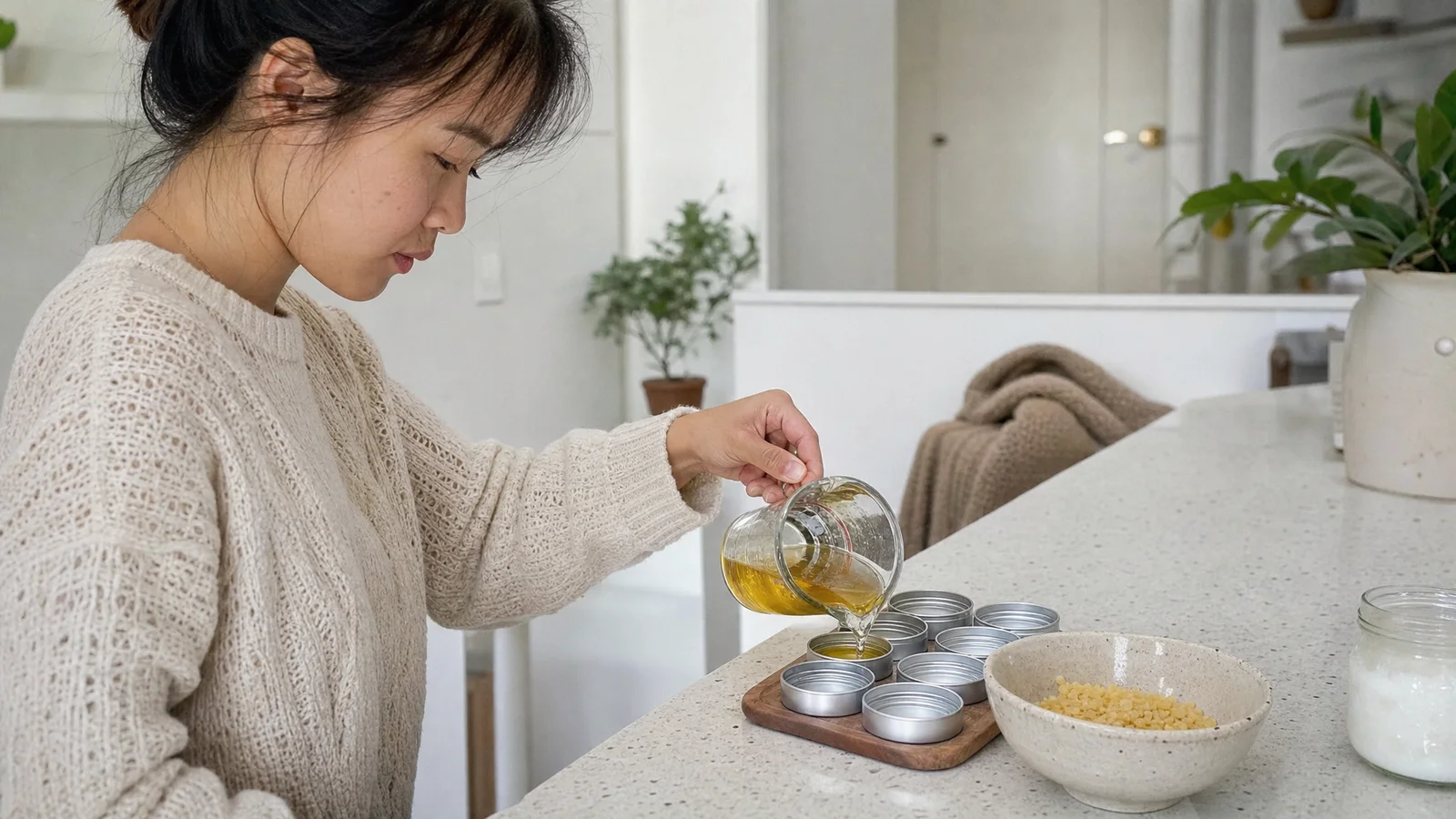
Homemade Coconut Oil Lip Balm: The Wax Ratio Guide
A lip balm is just a wax and an oil, and the entire recipe lives in the ratio between them. Most online versions hide that behind tablespoons of pellets, which is why two people following the same recipe can end up with a rock-hard stick and a puddle. Weigh instead of scoop and a simple coconut oil balm is easy to steer exactly where you want it.

Fractionated Coconut Oil
Our own Fractionated Coconut Oil, in sizes from 0.5 oz to bulk.
From $9.99
Shop Now →Start with the ratio
The best-known rule of thumb comes from Rhoda Peacher at Hobby Farms (2019): one part beeswax to three to five parts oil, with the note that solid ingredients like shea butter shift things and some experimenting is part of the fun. Her own lip balm used 1 oz of beeswax to 4 oz of herb-infused olive oil. It is a home rule and not a commercial specification, but it gives a workable window.
Turn the window into percentages and choosing gets easier. One part wax to three parts oil is 25% wax by weight, 1 to 4 is 20% and 1 to 5 is about 17%. For a 30 g batch:
| Wax : oil | Wax | Oil | What to expect |
|---|---|---|---|
| 1 : 3 | 7.5 g | 22.5 g | Firm, with some drag on the lip |
| 1 : 4 | 6 g | 24 g | The middle; a good place to start |
| 1 : 5 | 5 g | 25 g | Soft, nicer in a tin than a tube |
The last column is reasoning from the percentages. As for weighing, beeswax pellets do not pack like a liquid, so a spoonful of small pellets and a spoonful of large ones weigh different amounts. A kitchen scale that reads to 1 g takes that variable out.
Pick the oil for how the balm travels
Coconut oil behaves very differently depending on which one you start with.
- Virgin unrefined coconut oil. It is firm in a cool room and melts in warm hands, with the change at about 76 degrees Fahrenheit. A balm built on it firms up easily and smells pleasantly of coconut. It also softens in a coat pocket on a warm day, so it leans on the wax percentage to stay in its tube.
- Fractionated coconut oil. Ours stays liquid at any temperature, so the wax does all the structural work: the oil brings slip and the balm feels the same from a cold garage to a warm purse. We describe it as virtually odorless, so any scent in the finished balm is whatever you add.
Our recommendation: fractionated if the balm has to feel the same everywhere, virgin if you love the coconut scent and enjoy a seasonal texture. Both are for external cosmetic use, and we do not sell lip balms or wax, so those come from elsewhere.
The base recipe, by weight
This makes about 30 g and scales with the same ratio. It is a formulation worked out from the published guidance and the arithmetic above.
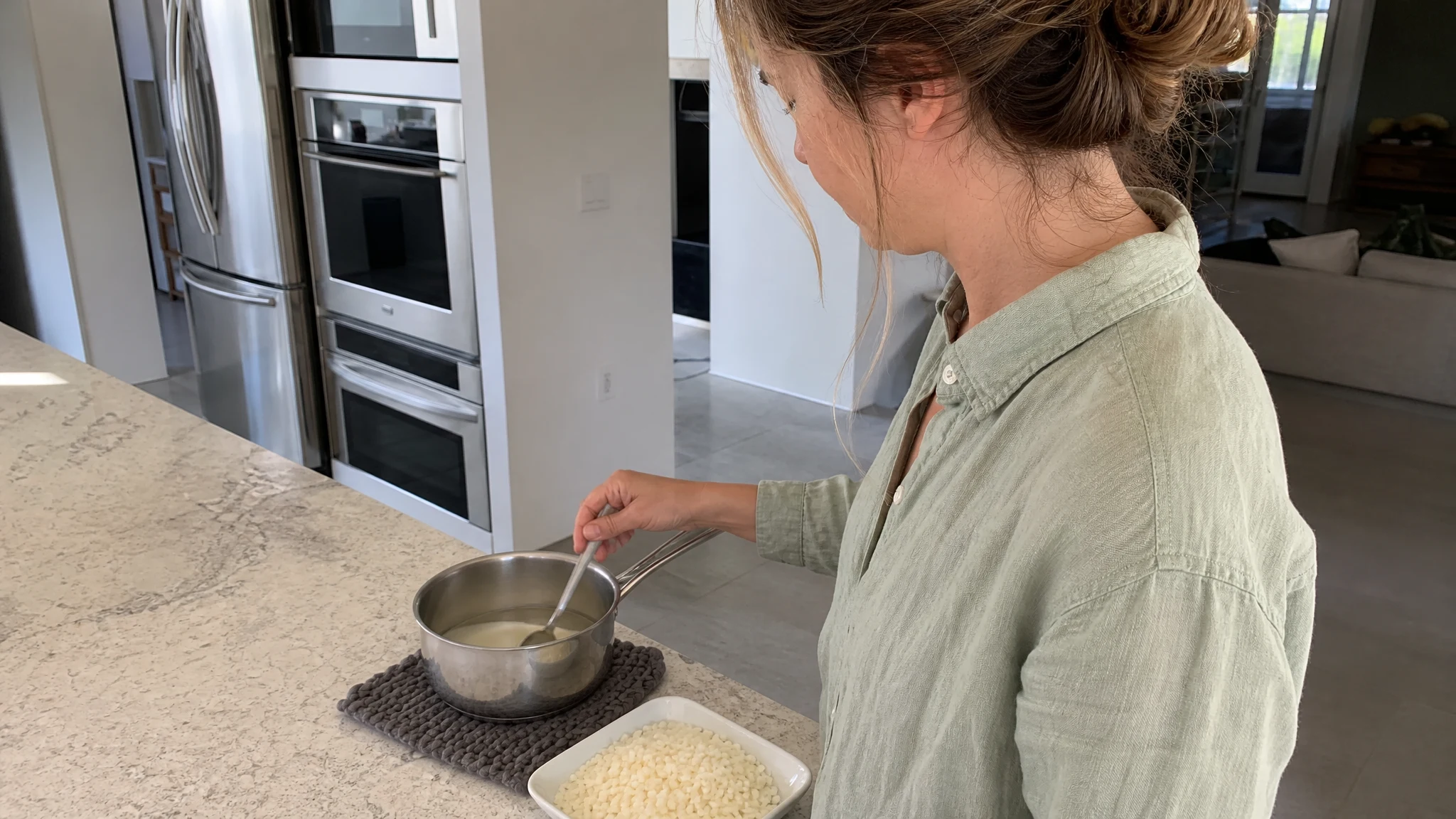
- Weigh 6 g of beeswax (or a plant wax, whose hardness differs, so treat the ratio as a starting point) into a heat-safe jar.
- Add 24 g of coconut oil. Virgin oil weighs the same solid or melted.
- Stand the jar in a pan of barely simmering water and stir until the wax is clear. Keep water out of the jar.
- Lift the jar out and put one small spoonful on a cold plate.
- Let the sample cool, judge it as described below, adjust the batch, then pour.
- Fill tubes or tins while liquid and leave them alone until fully set.
Keeping water out is the one rule worth underlining. The FDA's microbiological safety page says not to add water or saliva to cosmetics because water dilutes preservatives. An oil and wax balm has no water phase and no preservative, so dry jars, clean tools and no double-dipping a finger into a tin do the protecting.
The plate test
Peacher's own method is to spoon out a little, let it cool and check the firmness, reheating with more oil if it is too firm or adding wax if it is too soft. Press a fingertip into the cooled sample and drag it across the back of your hand. It should leave a thin film without crumbling. If it skids and smears, it wants more wax; if it drags, add oil. Then leave the sample in a warm room for an hour, since a balm that rides in a pocket has to cope with body temperature, which is above the point where virgin coconut oil melts.
Keep the first batch plain
Many recipes add flavor, honey or a drop of peppermint. The American Academy of Dermatology's page on chapped lips advises stopping lip products that contain irritants such as camphor, eucalyptus, flavorings, fragrance, lanolin, menthol and salicylic acid, and suggests products labeled fragrance free. From that it follows that the gentlest homemade balm for dry lips is the plain one: oil and wax and nothing else. Add-ins can come once you know how your lips like the base.
What a balm is for
A homemade balm is a moisturizer, and that is the job it does well. For time outdoors, the AAD advises a non-irritating lip balm with SPF 30 or higher, reapplied every two hours, and the FDA notes that products with sun-protection claims are cosmetic-drug products, so a balm you make cannot honestly claim it. The AAD also says an ointment such as white petroleum jelly holds in water longer than waxes or oils, so for very dry, cracked lips an oil and wax balm is the lighter option. It expects improvement within two to three weeks, and if lips do not improve, a board-certified dermatologist can look, because allergic reactions and other conditions can pass for plain dryness. Cutting back on licking, biting and picking helps too, and a balm reapplied every twenty minutes is often a clue to one of those habits.
Gifting and selling
A balm you give to a friend is a gift. A balm you sell is a cosmetic with labeling duties: the FDA's labeling summary says retail ingredients must be declared in descending order of predominance, alongside the firm name and address and a net quantity statement, and products without adequate safety substantiation must say so. Selling is a question for a cosmetic regulatory professional. For gifts, our gift-making piece covers the labeling worth doing, lotion bars are the firmer, larger relative of this balm, and sugar scrubs are a friendly next project.
Lips are the one place where a little product ends up swallowed, so if you or the recipient has a coconut allergy, check with an allergist before using a coconut-based balm. Otherwise, grab a scale and a jar, make a 30 g test batch and adjust from there.
Fractionated Coconut Oil
Fractionated Coconut Oil from our own shop, in sizes from 0.5 oz to bulk.
From $9.99
Shop Now →Sources & Further Reading
- Peacher R, Hobby Farms, 2019. Beeswax salve and lip balm guidance. hobbyfarms.com/?p=63105
- American Academy of Dermatology. Tips for dry, chapped lips. aad.org/chapped-lips
- US FDA, 2024. Microbiological Safety and Cosmetics. fda.gov/microbiological-safety-and-cosmetics
- US FDA, 2024. Is it a cosmetic, a drug, or both? fda.gov/cosmetic-drug-or-both
- US FDA, 2025. Summary of Cosmetics Labeling Requirements. fda.gov/cosmetics-labeling-requirements