Coconut Oil Makeup Remover: Who It Suits and How to Use It
Anyone who has watched foundation melt away under a few drops of oil knows why people love this trick: oil and oil-based makeup get along beautifully. Coconut oil makes a pleasant remover on calm, dry skin, and we think the real art lies in the second half of the routine, taking every trace of oil off again. Here is how we would go about it, who might prefer a different cleanser, and why the eyes are better left to a product made for them.

Fractionated Coconut Oil
Our own Fractionated Coconut Oil, in sizes from 0.5 oz to bulk.
From $9.99
Shop Now →Is oil right for your skin?
If you are prone to acne, a plain oil cleanser may not be your best friend. The American Academy of Dermatology's acne overview says to use only oil-free skin care, sunscreen and makeup, and that anything containing oil will likely clog your pores again. Its oily skin page (updated 9/3/24) advises against oil-based cleansers. Those pages speak about oil in general rather than coconut oil specifically, though a remover that is 100 percent oil falls within their wording. Our article on coconut oil and pores explains why no single rating can settle it for you.
Take a pause as well if you have eczema, a rash, or a coconut or tree nut allergy history. An allergist writing for AAAAI notes that coconut oil can cause contact dermatitis, and your face is a poor place to find out by surprise.
Why oil lifts makeup, and what the research covers
The reason oil takes off oil-based makeup is basic solubility: like dissolves like. That is chemistry rather than a measured result for coconut oil, and the nearby research is about skin, not removers. In a 2004 trial, 34 people with mild to moderate dry skin and negative patch tests applied extra virgin coconut oil or mineral oil to their legs twice daily for two weeks. Both improved hydration, and no adverse reactions were reported. It shows the oil can be well tolerated on leg skin by people who passed a patch test, and it says nothing about mascara.
On pores, Draelos and DiNardo (2006) tested finished products on six comedone-prone people and concluded that finished products using comedogenic ingredients are not necessarily comedogenic. That is a reason not to fret over a chart, though it is six people, on the back, and not a verdict on removers.
Fractionated or virgin for this job
Thinking about texture, our fractionated coconut oil is the easier of our two to work with here. It stays liquid at any temperature, and we describe it as fast-absorbing and virtually odorless, so there is no scooping and melting and no coconut scent on your pillow. Our virgin unrefined oil has the scent and the butter-like set; it is firm in a cool room, so you warm it in your palms first, and it is the closer relative of the oil in that skin trial. Healthline (October 2019) notes that fractionated oil is mainly caprylic and capric acid with most lauric acid removed, so the two are different materials.
A gentle method for dry, calm skin
- Patch test first. Inner forearm, then wait 24 hours, as our fractionated page advises. Redness, itching or swelling means skip it for your face.
- Start with clean hands. The FDA's eye cosmetic safety page (current as of 06/28/2022) points out that bacteria on hands can cause eye infections and says to wash them before applying eye cosmetics. The same habit makes sense when taking makeup off.
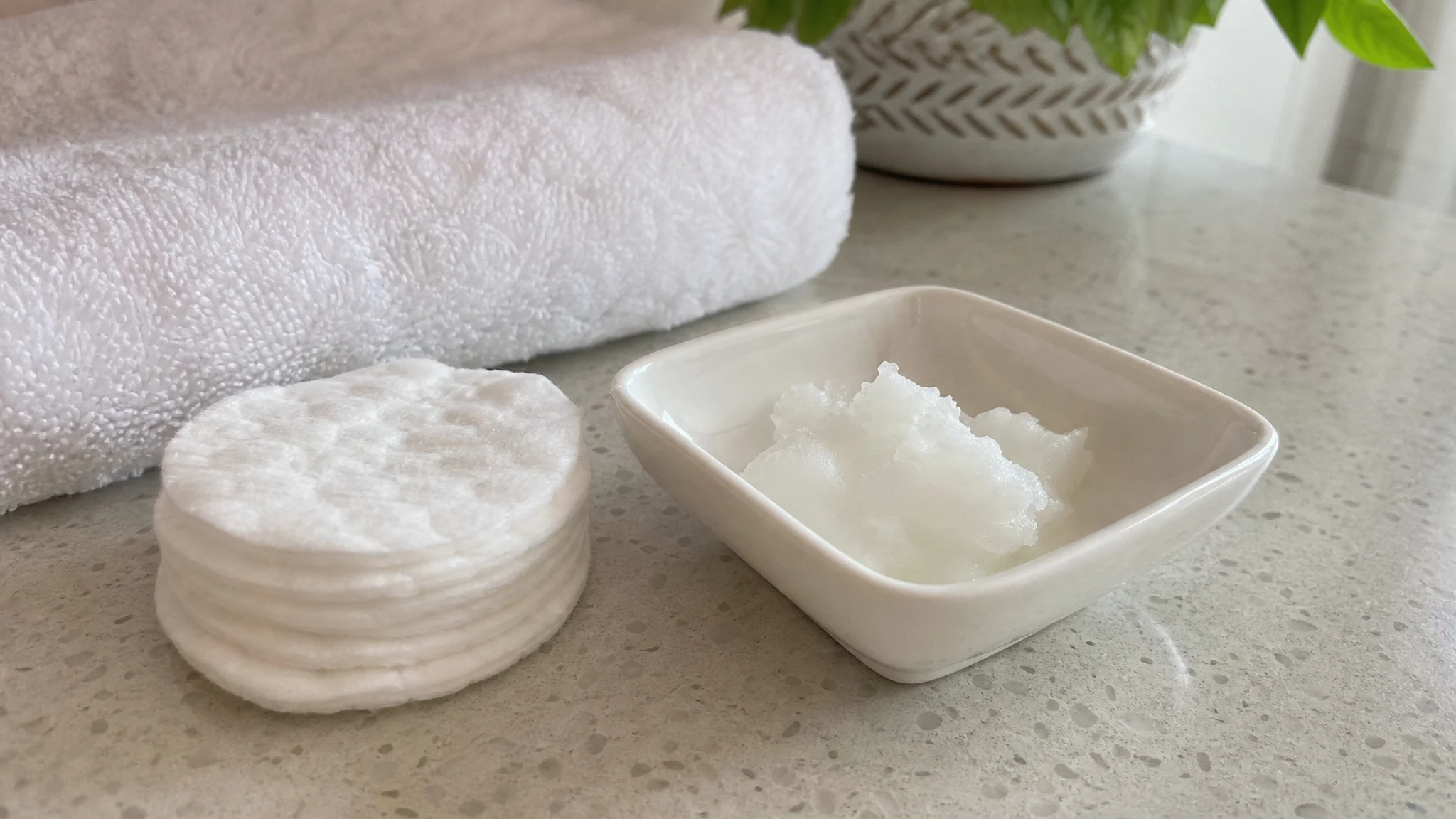
- Use a few drops on dry skin. Warm them between your fingers, then press and massage over foundation, blush or lipstick. Oil works on oil-based product, so water first would only get in the way.
- Lift it off with a damp, clean cloth or soft pad. Gentle strokes beat hard rubbing.
- Follow with a mild face wash. The AAD suggests a mild, gentle wash for oily skin, and this rinsing step keeps oil from sitting on your skin overnight. That is our reasoning from how an oil behaves.
Leave the eyes to an eye remover
Eye-area makeup, especially waterproof mascara, is the hardest to shift, which is why it tempts people to improvise. We say to keep both of our oils away from the eyes, so we do not suggest them on eyelids or the lash line. The FDA says not to use any cosmetic near the eyes unless it is intended for that use, and to take care not to scratch the eyeball or other sensitive areas when removing eye products. If an eye cosmetic causes irritation, it says to stop using it, and to see a doctor if irritation persists. A remover made for the eye area is the right tool, and anyone who wears contact lenses or has had eye irritation should ask an eye doctor what they want near their eyes.
Keep the bottle as clean as the face
The same FDA page advises against sharing cosmetics because another person's bacteria may be hazardous. From that, a few easy habits follow: pour a little oil into a clean palm or onto a pad instead of dipping fingers in the bottle, cap it after each use, and store it cool and dark as we recommend. Cloths that have wiped off makeup and oil belong in the wash after one use. Check dates as well: we say our fractionated oil keeps about two years unopened, and our virgin listing typically 18 to 24 months when kept tightly closed in a cool, dark place. An oil that smells off should stay off your face.
When to stop, and what to try instead
Stop at the first burning, rash, new bumps or swelling. Swelling of the lips or face, hives beyond the area you used, or trouble breathing need emergency care. If your skin breaks out, a dermatologist can name a remover they are comfortable with; for sensitive skin a pharmacist can help you find a fragrance-free one; and for heavy costume or stage makeup, a product made for it will serve you better than any single oil. Our look at coconut oil on the face goes wider, and the skin type guide helps you pick between our two oils.
On calm, dry skin, and rinsed off properly, oil is a lovely thing to try for face makeup. If your skin tends to break out, or you are working near the eyes, a different cleanser will suit you better.
Fractionated Coconut Oil
Fractionated Coconut Oil from our own shop, in sizes from 0.5 oz to bulk.
From $9.99
Shop Now →Sources & Further Reading
- American Academy of Dermatology, accessed 2026. Acne: overview. aad.org
- American Academy of Dermatology, updated 9/3/24. How to control oily skin. aad.org
- Agero AL, Verallo-Rowell VM, 2004. A randomized double-blind controlled trial comparing extra virgin coconut oil with mineral oil as a moisturizer for mild to moderate xerosis. Dermatitis 15(3):109-116. pubmed/15724344
- Draelos ZD, DiNardo JC, 2006. A re-evaluation of the comedogenicity concept. J Am Acad Dermatol 54(3):507-512. pubmed/16488305
- US FDA, current as of 06/28/2022. Eye cosmetic safety. fda.gov
- AAAAI Ask the Expert (P. Lieberman, MD). Reaction to coconut. aaaai.org
- Healthline, October 2019. Fractionated coconut oil. healthline.com