Jojoba vs Coconut Oil: Liquid Wax or Fat?
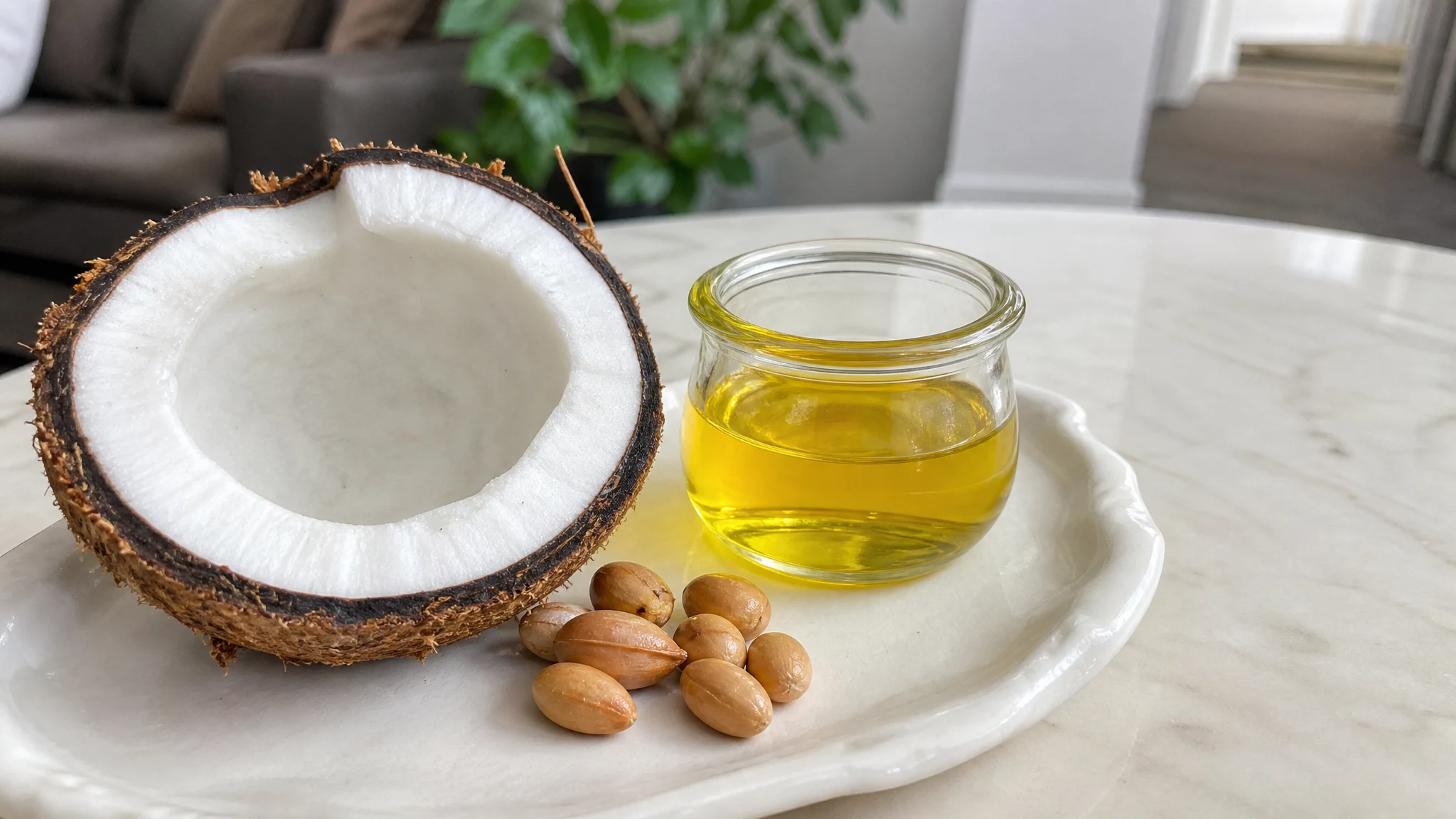
Here is a fun fact to hold onto when you stand in front of a shelf of carrier oils: jojoba is not really an oil. It is a liquid wax, pressed from the seeds of a desert shrub, and chemically it has more in common with a candle than with a salad dressing. Coconut oil is a true fat. Put the two side by side and you are comparing two different kinds of material that happen to both pour, and that is exactly why choosing between them gets easier once you know what each is for.

Fractionated Coconut Oil
Our own Fractionated Coconut Oil, in sizes from 0.5 oz to bulk.
From $9.99
Shop Now →One long molecule or three short ones
Analysis of an Egyptian jojoba sample found that about 55% of the oil was wax esters, and the two main types (C42 and C40) made up roughly 51% and 30% of that portion (El-Mallah and El-Shami, 2009). A wax ester is one long fatty acid joined to one long fatty alcohol. Coconut oil is built the way most fats are: three fatty acids hanging off a glycerol backbone, which makes it a triglyceride.
That small bit of structure explains a lot. It is why jojoba and coconut oil feel different between your fingers, and it is why you cannot borrow what you read about one and apply it to the other. A recipe written around jojoba is a jojoba recipe.
The fatty acids in coconut oil are what give it its personality. A review of plant oils for skin lists ordinary coconut oil at about 49% lauric acid, 18% myristic, 8% palmitic, 8% caprylic, 7% capric and only 6% oleic (Lin, Zhong and Santiago, 2018). Fractionating the oil separates those fats and keeps the medium-chain portion, mainly caprylic and capric acids, with most of the lauric acid left behind (Healthline, 2019). That is what we sell as our fractionated coconut oil: only the medium-chain triglycerides remain, and it stays liquid at any temperature. Those percentages describe coconut oil in general. The certificate of analysis we publish for one fractionated batch lists density, refractive index and optical rotation, so we leave composition numbers to the literature.
Hair: the study points at ordinary coconut oil
The best-known piece of hair research here is a 2003 lab study that compared coconut, sunflower and mineral oil on undamaged and damaged hair, applied before or after washing. Coconut oil was the only one of the three that clearly reduced protein loss, and the authors credited lauric acid's affinity for hair protein (Rele and Mohile, 2003). Jojoba was not in that lineup, so the fair reading is that it is unmeasured on that question, which is different from saying it falls short.
Because the explanation leans on lauric acid, the result describes ordinary coconut oil, which sits closer to our virgin unrefined than to the fractionated oil. If that study is what brought you here, the virgin oil is the closer match on paper: firm in a cool room, melting in warm hands, and unmistakably coconut. Carrying the result over to fractionated oil would be an inference. Our pre-wash guide shows how to use virgin oil before shampoo.
On skin, keep it simple
The same skin review describes jojoba as highly stable against oxidation and degradation, which is a pleasant quality in a carrier oil, though it is the review summarizing other work and not a figure we can give you. We would rather not build a buying decision on a line from a narrative review, so for skin we keep the comparison to what you can see and feel.
Scent, texture and blending
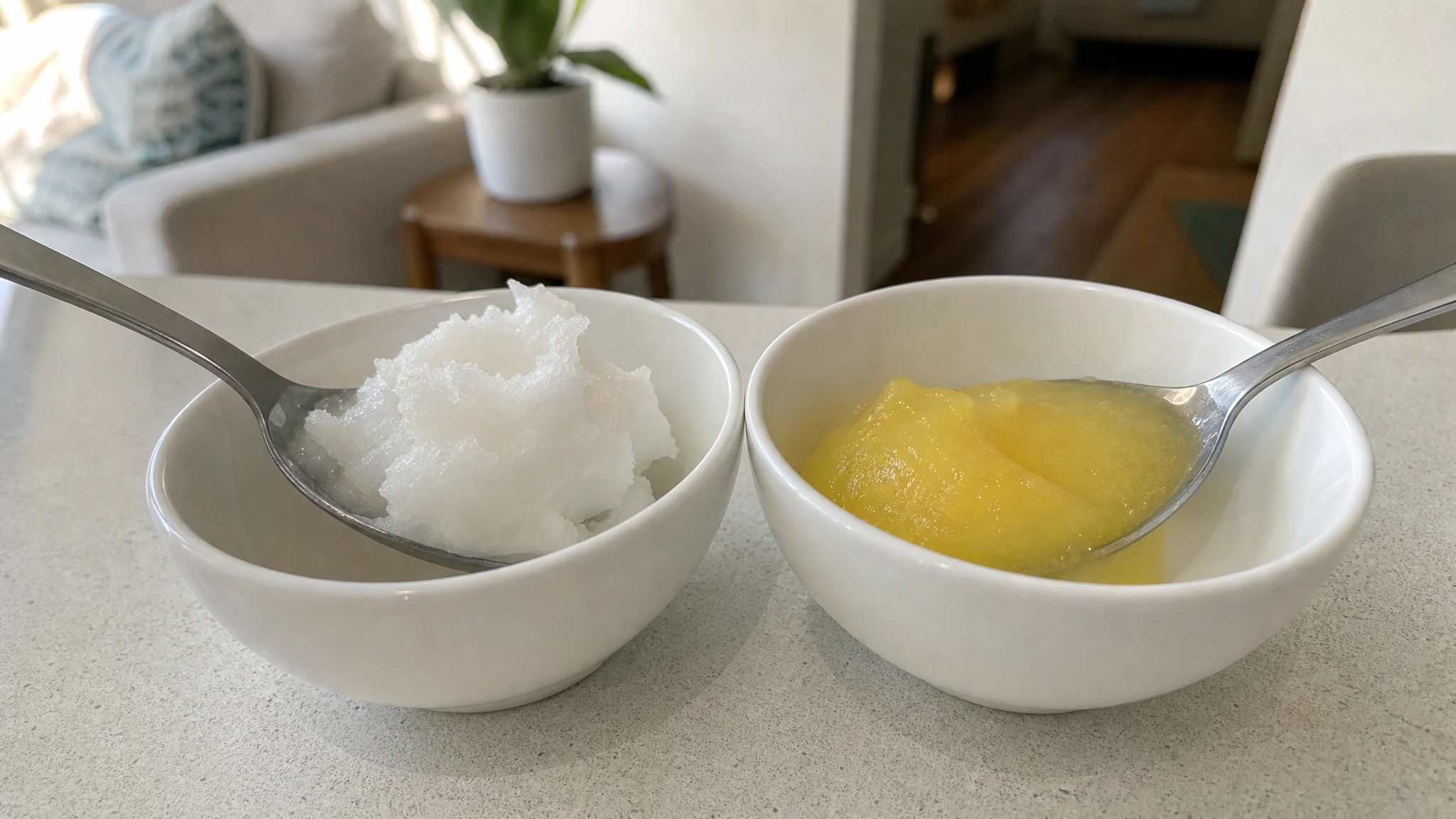
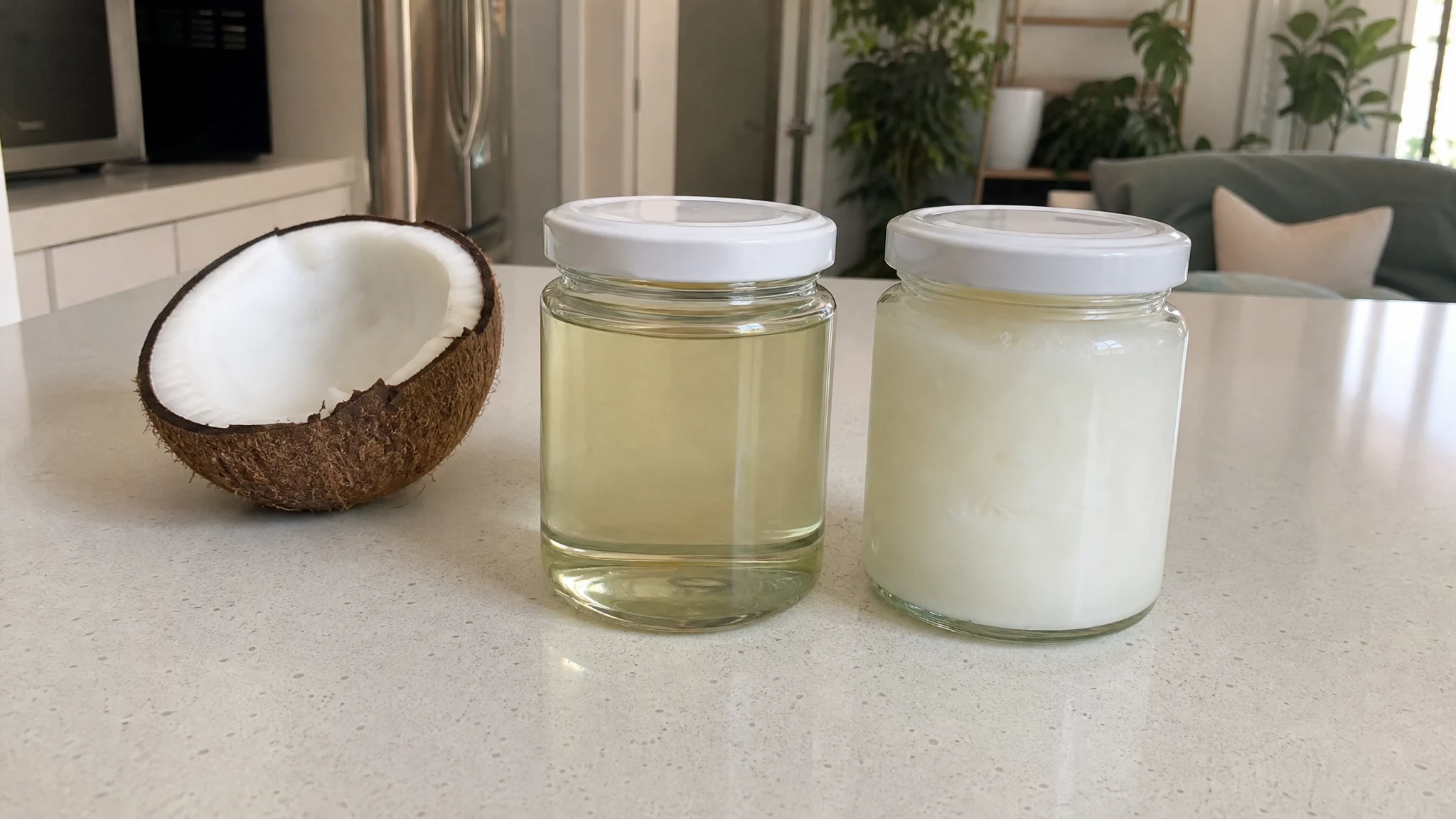
Here the gap is smaller than the chemistry suggests. Jojoba pours at room temperature, and our fractionated coconut oil pours at any temperature, so both behave like light liquids on a bottle shelf. What separates them is mostly aroma and how they act in a cool room.
- Aroma: our virgin unrefined oil has that rich, creamy coconut scent. We describe our fractionated oil as virtually odorless, which makes it a quiet backdrop when you want a lavender, lemon or peppermint blend to be the star.
- Cool rooms: virgin unrefined firms up below about seventy-six degrees Fahrenheit. Fractionated never does.
- Blending: we sell both coconut oils neat as a base for essential oil blends, and fractionated pairs nicely with lavender, lemon, tea tree, peppermint, frankincense and rose.
A habit worth keeping
When a recipe card names a specific oil, it is worth following the card the first time. Once you know how the original behaves in your hands, you can start to swap, and you will notice the differences straight away: the slip, the scent, the way it sits on the skin. Keep a note of what you changed so the next batch is easier to plan.
How we would choose
Treat them as two different tools. If a formula calls for jojoba, switching to fractionated coconut oil changes the chemistry, so it becomes a new formula. If you want a light, liquid, coconut-based carrier for massage or roll-on blends, that is exactly what fractionated coconut oil is for. If you want the coconut aroma and the oil that matches the hair study, reach for virgin unrefined. We do not sell jojoba, so for that one you will want its own supplier.
Both of our oils are cosmetic carriers for external use only. Patch test a small area first and keep them away from your eyes. If you have a coconut or tree nut allergy, check with a professional before use, and see a dermatologist for skin or scalp that is inflamed, weeping or not settling. Our allergy article goes into more detail.
Not sure which coconut oil you want? Our virgin versus refined breakdown lays out how the oils differ, and the argan comparison is a good next read if hair is your goal.
Fractionated Coconut Oil
Fractionated Coconut Oil from our own shop, in sizes from 0.5 oz to bulk.
From $9.99
Shop Now →Sources & Further Reading
- El-Mallah MH, El-Shami SM, 2009. Investigation of liquid wax components of Egyptian jojoba seeds. J Oleo Sci 58(11):543-8. pubmed.ncbi.nlm.nih.gov/19844068
- Lin TK, Zhong L, Santiago JL, 2018. Anti-inflammatory and skin barrier repair effects of topical application of some plant oils. Int J Mol Sci 19(1):70. pmc.ncbi.nlm.nih.gov/PMC5796020
- Rele AS, Mohile RB, 2003. Effect of mineral oil, sunflower oil, and coconut oil on prevention of hair damage. J Cosmet Sci 54(2):175-92. pubmed.ncbi.nlm.nih.gov/12715094
- Healthline, reviewed October 2019. What is fractionated coconut oil? healthline.com