Coconut Oil FAQ: Straight Answers to Common Questions
Coconut oil attracts questions the way a good bakery attracts a queue: can I eat it, will it break me out, what is the stuff in your bottle, how long does it last? We have gathered the ones worth asking and answered each with a source wherever there is one. Our two oils are for external cosmetic use, so on a few of these the most useful thing we can say is who to ask instead, and we say it gladly.
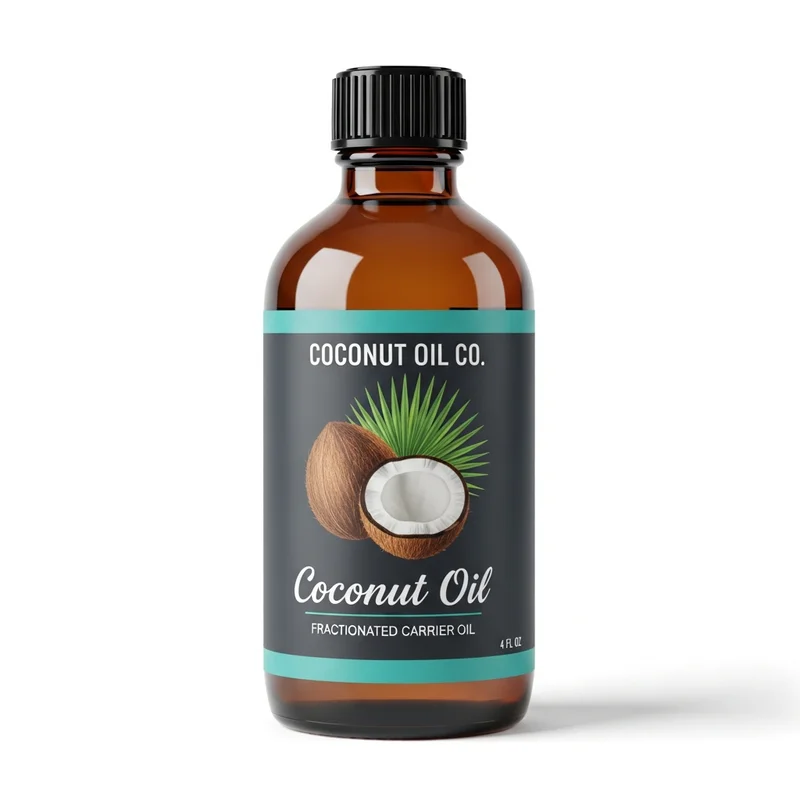
Fractionated Coconut Oil
Our own Fractionated Coconut Oil, in sizes from 0.5 oz to bulk.
From $9.99
Shop Now →If you are wondering about eating it
Is coconut oil good for you?
Think of it as a flavorful fat rather than a health food. A 2020 meta-analysis of 16 trials found that coconut oil raised LDL cholesterol by 10.47 mg/dL compared with non-tropical vegetable oils, and it did not significantly change body fat (Neelakantan et al., 2020). The USDA lists 82.475 g of saturated fat per 100 g (FoodData Central 171412). Our heart post weighs the whole argument, and a doctor or registered dietitian can fit it to your own numbers.
Will it help with weight loss?
The trials do not show it. One 12-week study followed 40 women on a reduced-calorie diet with daily walking, comparing 30 mL a day of coconut oil with soybean oil. BMI fell in both groups, and only the coconut group saw a significant drop in waist circumference (Assuncao et al., 2009). With a diet and exercise program running alongside, and the pooled review above finding no significant effect on body fat, we read it as a modest result. Our weight post goes through the studies one by one.
Is coconut oil the same as MCT oil?
No, and the gap is bigger than most labels suggest. The USP monograph for MCT oil puts caprylic acid (C8) at 50.0 to 80.0% and capric acid (C10) at 20.0 to 50.0% (USP 35). Whole coconut oil is about 49% lauric acid, 8% caprylic and 7% capric (Lin et al., 2018). The full comparison lives in MCT oil versus coconut oil.
Does coconut oil raise ketones?
Only modestly. In a crossover study of nine healthy adults, coconut oil did not change blood ketones significantly over the day (P = 0.11), and its peak came to about a quarter of the peak from pure C8 (Vandenberghe et al., 2017). More in our keto post.
Can I eat the oil you sell?
No. Both of our oils are for external cosmetic use, and we do not offer them as food. For the kitchen, choose a coconut oil sold as a food.
About our two oils
What separates fractionated from virgin?
Fractionation sorts the oil by how it melts. As Healthline describes it, most of the lauric acid is taken out, leaving mainly C8 and C10, and what remains stays liquid. We describe our fractionated oil as liquid at any temperature and virtually odorless. Our virgin unrefined oil has a rich, creamy coconut aroma and sets firm in a cool room (we put the change at about 76 degrees Fahrenheit). Want the smell of coconut? Choose virgin. Want a light, pourable base? Choose fractionated. The virgin, refined and fractionated comparison goes deeper.
What does your certificate of analysis show?
For one fractionated batch it lists a relative density at 20 C of 0.948 (standard 0.938 to 0.950), a refractive index of 1.450 (standard 1.445 to 1.455) and an optical rotation of +0.00 degrees. It does not include a fatty-acid profile, peroxide value, heavy metals or microbial results, and it names no laboratory. We publish no certificate for the virgin listing. If you need any of those details, ask us in writing before you order.
How long does it keep?
We say about 2 years unopened for the fractionated oil, and typically 18 to 24 months for the virgin when it is kept tightly closed in a cool, dark place. Those are our shelf-life figures rather than lab data.
How much is in a teaspoon?
A teaspoon is about 4.93 ml. Because the batch on our certificate measured a relative density of 0.948, a teaspoon of that batch weighs about 4.7 g, and a 1 oz bottle (29.57 ml) holds about 28 g. That is arithmetic from one batch, handy for recipes by weight.
Do you sell in bulk?
Yes, from 0.5 oz up to 400 lb, plus sample bottles and private label on the wholesale page. Our bulk buying guide walks through the sizes.
Skin, hair and everything else
Do I need a patch test?
Yes. Try a small area first (24 hours for the fractionated oil) and keep the oil away from your eyes. If you have a coconut or tree nut allergy, check with a professional before use. For context, the FDA's allergen labeling FAQ says it no longer considers coconut a major food allergen, which applies to food labeling and is not the same as saying nobody reacts (FDA allergen FAQ). An allergist can advise on your own case.
Does it clog pores?
Ratings disagree because they come from different methods, and we make no claim either way. Our pores post shows how the ratings are built.
Can it stand in for sunscreen?
No. The FDA's sunscreen guidance points to broad spectrum products with SPF 15 or higher (FDA), and our oils carry no SPF rating. Our sunscreen post has the lab numbers.
Does it repair hair?
One 2003 study found coconut oil reduced protein loss from hair, where mineral and sunflower oil did not (Rele and Mohile, 2003). It measured protein loss rather than repair, and it used whole coconut oil. Fractionated oil has a different make-up, so carrying the result over to it is an inference.
Is oil pulling worth trying?
The evidence is thin: four randomized trials with 182 participants over 7 to 14 days, with a high risk of bias (Woolley et al., 2020). Two case reports linked months of sesame oil pulling with lipoid pneumonia after some aspiration (Kuroyama et al., 2015). A dentist is the right person to ask, and we do not sell an oral-care product. More in our oil pulling post.
What about babies, pets or skin conditions?
We sell an external cosmetic oil and make no medical claims, so questions about eczema, lice, hemorrhoids, sunburn, infants or animals belong with a dermatologist, pediatrician, pharmacist or veterinarian.
The fractionated oil page lists the details of the oil most of these questions are about.
If your question is not here, our origin page sets out what we say about both oils.
Fractionated Coconut Oil
Fractionated Coconut Oil from our own shop, in sizes from 0.5 oz to bulk.
From $9.99
Shop Now →Sources & Further Reading
- Neelakantan N, Seah JYH, van Dam RM, 2020. The effect of coconut oil consumption on cardiovascular risk factors. Circulation. pubmed/31928080
- USDA FoodData Central, SR Legacy. Oil, coconut, FDC ID 171412. fdc.nal.usda.gov/171412
- Assuncao ML et al., 2009. Effects of dietary coconut oil on the biochemical and anthropometric profiles of women presenting abdominal obesity. Lipids. pubmed/19437058
- US Pharmacopeia, 2012. USP 35 Medium-Chain Triglycerides monograph. drugfuture.com USP35
- Lin TK, Zhong L, Santiago JL, 2018. Anti-inflammatory and skin barrier repair effects of topical application of some plant oils. Int J Mol Sci 19(1):70. PMC5796020
- Vandenberghe C et al., 2017. Tricaprylin alone increases plasma ketone response more than coconut oil or other medium-chain triglycerides. Curr Dev Nutr. PMC5998344
- Healthline, undated. Fractionated coconut oil. healthline.com
- US FDA. Food allergen labeling guidance FAQ. fda.gov allergen FAQ
- US FDA. Sunscreen. fda.gov/sunscreen
- Rele AS, Mohile RB, 2003. Effect of mineral oil, sunflower oil, and coconut oil on prevention of hair damage. J Cosmet Sci. pubmed/12715094
- Woolley J et al., 2020. Systematic review of oil pulling. Heliyon. pubmed/32923724
- Kuroyama M et al., 2015. Two cases of lipoid pneumonia linked to sesame oil pulling. BMC Pulm Med. PMC4628246