Does Coconut Oil Go Bad? How to Read Your Jar
Coconut oil has a reputation for lasting forever, and it is easy to see why: a jar can sit in the cupboard for a year and look exactly as it did the day you opened it. It does go off eventually, though, just slowly and quietly, which makes it a good oil to learn to read. The useful question is less "is it still good?" than "how long have I had it, and how fast am I using it?"

Fractionated Coconut Oil
Our own Fractionated Coconut Oil, in sizes from 0.5 oz to bulk.
From $9.99
Shop Now →Why it goes off slowly, and the two ways it can
Oils spoil by oxidation. Oxygen attacks the fat molecules, first forming peroxides and then smaller, smelly compounds. A 2025 review of vegetable oil oxidation points out that these later compounds are what give an oil its rancid, stale character, and that more saturated oils, with coconut named alongside palm and babassu, hold up better. In a six-week sunlight comparison it describes, coconut oil was the least affected of four oils (Gharby and colleagues, 2025).
Coconut oil is mostly saturated fat, with only small amounts of oleic and linoleic acid (about 6% and 2% in one review of plant oils for skin, Lin and colleagues, 2018). Unsaturated fats are the easiest for oxygen to attack, so there is simply less for it to work on. That is the quiet reason a jar of coconut oil outlasts a bottle of most other oils.
The second route is hydrolysis, where moisture, warmth and microbes break fats apart and release free fatty acids, changing the smell and flavour. The same review lists moisture, temperature, enzymes and micro-organisms as the factors behind it, and calls water a well-known catalyst for oxidation too. So a wet finger in the jar does more harm than a warm afternoon.
Counting months instead of guessing
Here is what we say about our own oils. Our fractionated coconut oil is about 2 years unopened. Our virgin unrefined oil is typically 18 to 24 months when kept tightly closed in a cool, dark place. The Certificate of Analysis we publish covers one fractionated batch, which carries a best-by date of 07/31/2028. Those are our shelf-life statements, and the clock on an opened jar depends on you.
A little arithmetic helps. A teaspoon is about 4.93 ml and 1 fl oz is 29.57 ml:
- A 0.5 oz bottle (14.8 ml) holds about 3 teaspoons.
- A 16 oz bottle (473 ml) holds about 96 teaspoons, so at a teaspoon a day it is finished in about three months.
- A 5 lb container is 2,268 g. Using the density of the batch on our published COA (0.948 g/ml), that is about 2.39 litres, or roughly 485 teaspoons. At a teaspoon a day it lasts about sixteen months, and at a tablespoon a day about five.
At that pace the sizes up to 16 oz are used up well inside the window, while a 5 lb container is better decanted. Fill a small working jar, keep the rest sealed and cool, and you open the big container only a few times a year. It also keeps the air in the container to a minimum, and the review links the oxygen in the headspace directly to shelf life. Our storage guide covers the jar, the shelf and the shower-steam question in more detail.
What a change actually looks like
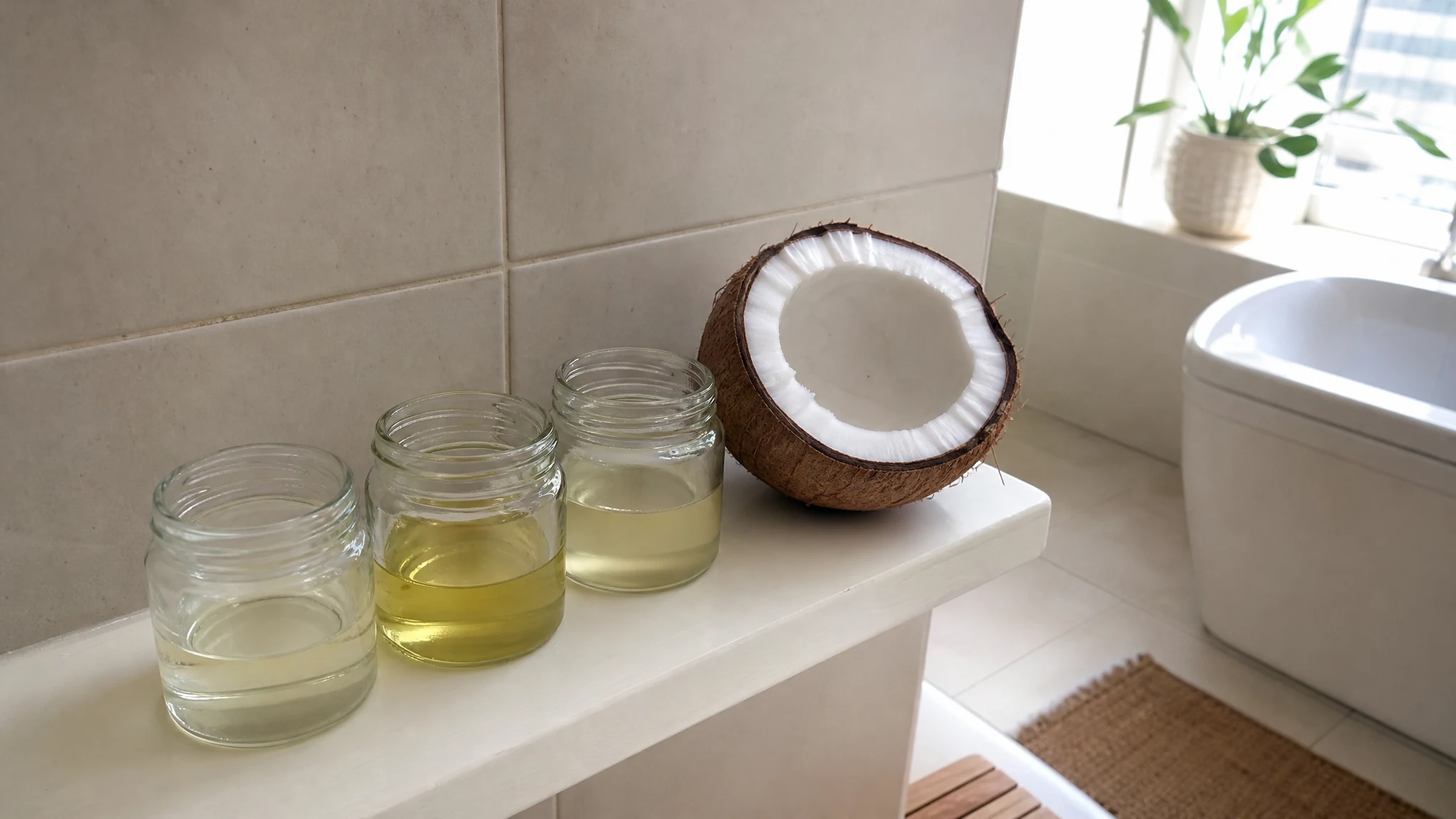
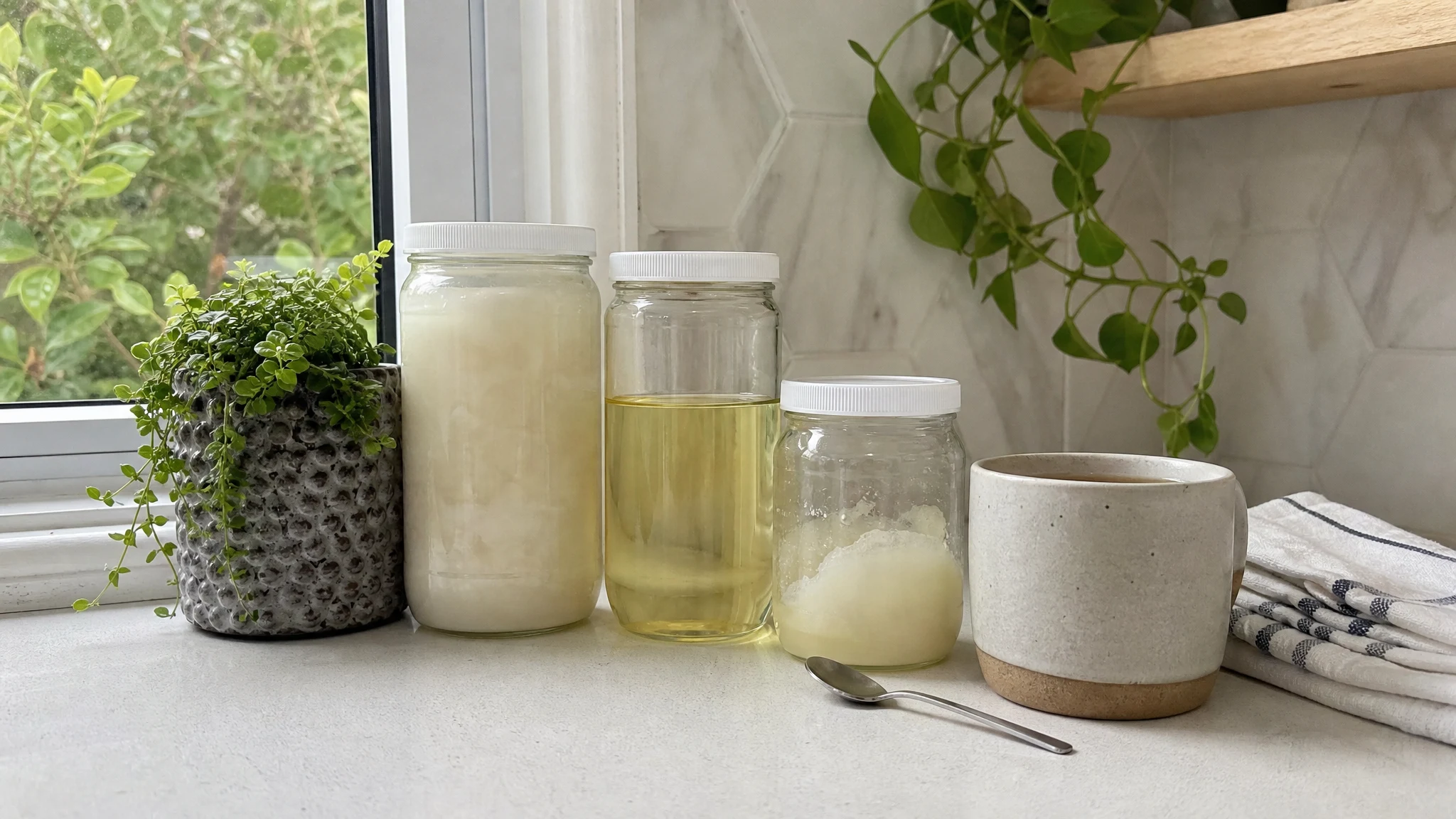
Because we describe our fractionated oil as virtually odorless, any smell that was not there before stands out. Virgin oil smells of coconut, so you are listening for a change in that note: sharper, flatter, stale. Cloudiness, specks or fuzzy growth mean the jar has met water and should go. A yellow tint in once-white solid oil is a reason to smell it carefully and not a verdict by itself, and a jar that is solid in winter and liquid in summer has not gone off, it is just coconut oil. Our guide to the types of coconut oil explains why the two behave so differently.
When a blend changes the clock
The oil on its own keeps well. Blends are where shelf life gets shorter, and the shortest-lived ingredient sets the pace. Fresh herbs, water, aloe or anything from the kitchen brings moisture into the jar, and an essential oil such as a citrus oil keeps its own schedule inside the blend. This is our reasoning and not a published rule: keep homemade blends in small batches, write the date on the container, and plan to use them within a few months. Oil-only blends such as the ones in our dilution guide are the simple end of that spectrum.
When to retire a jar
If a jar smells off, we would not put it on skin. There is no published threshold to say how off is too off, and a fresh jar settles the question. Bin the old oil rather than pouring it down the drain, where fat can set in the pipes. For anything in a bathroom, a quick sniff each time you open the jar is the best habit. The goal is not to throw things away early. It is to know your jar well enough that you notice the day it changes.
Fractionated Coconut Oil
Fractionated Coconut Oil from our own shop, in sizes from 0.5 oz to bulk.
From $9.99
Shop Now →Sources & Further Reading
- Vegetable oil oxidation: Mechanisms, impacts on quality, and approaches to enhance shelf life, Gharby S and colleagues, Food Chemistry: X 2025;28
- Anti-Inflammatory and Skin Barrier Repair Effects of Topical Application of Some Plant Oils, Lin TK, Zhong L, Santiago JL, International Journal of Molecular Sciences 2018;19(1):70