Coconut Oil With No Coconut Taste: What to Look For
Virgin coconut oil smells like a beach holiday, which is glorious in a curry and less welcome in a plain fried egg. So can you turn the volume down at home? The coconut aroma lives in the oil itself, and no kitchen trick we could find takes it out. A factory step called deodorization does, and the neutral coconut oil on a supermarket shelf has already been through it. The smart move is simply to pick the right bottle at the start.

Fractionated Coconut Oil
Our own Fractionated Coconut Oil, in sizes from 0.5 oz to bulk.
From $9.99
Shop Now →Where the aroma comes from
A review of coconut oil extraction notes that coconut oil keeps its typical coconut smell only if it has not been refined, bleached or deodorized (Ng et al., 2021). The scent comes with the oil from the kernel, and the documented ways of removing it are industrial refining steps. The Cosmetic Ingredient Review describes the standard route: crude oil pressed from dried coconut (copra), then refined, bleached and deodorized to remove free fatty acids, phospholipids, color and odor (CIR, 2008).
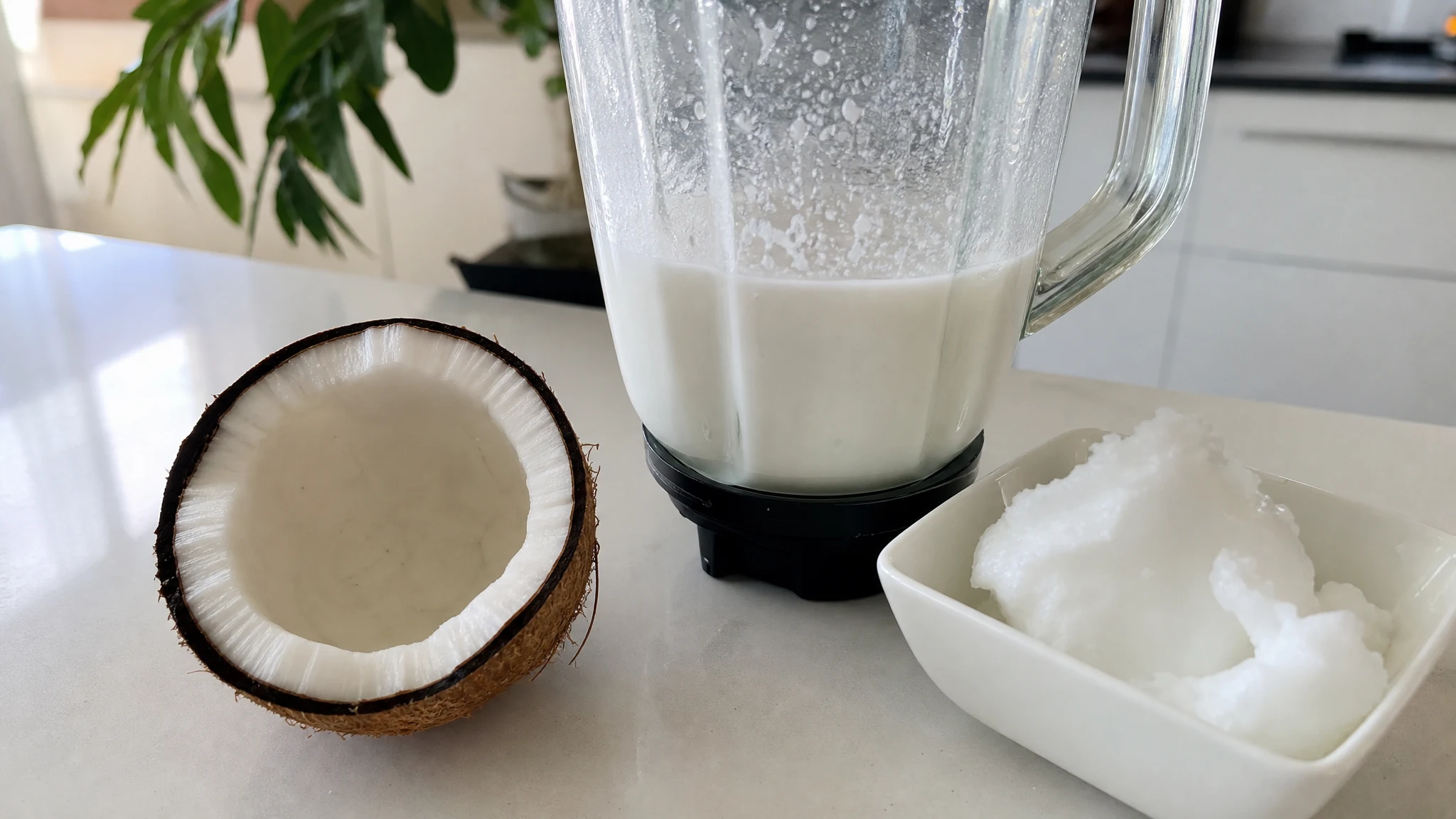
Virgin oil leaves those steps out on purpose. In a 2018 comparison of virgin routes, the wet process grated the kernel into coconut milk, then either chilled it below 4 C and centrifuged it at 6,000 rpm for 45 minutes, or let it ferment for 72 hours at room temperature before the same spin. Nothing in that route strips the aroma, which is exactly why virgin oil keeps it (Ghani et al., 2018). To see the process from the other end, making coconut oil from fresh coconuts walks through it.
What deodorization involves
Deodorization is a high-heat, high-vacuum steam step. Researchers who modelled it on coconut oil in a 2023 study used 230 C with steam stripping under 1 mbar vacuum for three hours (Bauwens et al., 2023). That is not a stovetop job, which is why we are not offering a home method.
Refining has two sides, and both are worth a sentence. In that 2023 study, deodorization completely removed spiked naphthalenes from crude coconut oil and cut benzo(a)pyrene by more than 98.8%, so the step clears out some unwanted compounds along with the aroma. On the other hand, a European Food Safety Authority opinion, summarized by EUFIC, notes that glycidyl esters form when vegetable oils are heated above 200 C, for instance during deodorization, and it set a tolerable daily intake of 0.8 micrograms per kilogram of body weight for 3-MCPD and its esters (EUFIC on EFSA, 2016). That summary covers vegetable oils in general and does not name coconut oil, so it says nothing about how much any particular bottle holds. The balanced reading is that refined oil is a mainstream food made with controls, and the process trades some compounds for others. If you are feeding infants, a pediatrician or registered dietitian is the person to ask.
How to get coconut oil without the coconut
- Buy refined, food-labelled coconut oil. This is the neutral option. Look for "refined" or "neutral" on the label and a statement that it is sold as food. It brings heat tolerance too: Ng et al. report a smoke point of about 170 C for unrefined oil and 232 C for refined.
- Match the oil to the dish. If a recipe really wants no coconut note, another neutral cooking oil may suit it better. Our cooking guides, such as coconut oil smoke points, show where coconut earns its place.
- Use less, or lean in. This is reasoning, not a tested method: a smaller share of coconut oil carries less aroma, and pairing it with lime, ginger, banana or curry spices makes whatever is left taste intentional.
Virgin is a range
Two virgin oils can differ in more than flavor. In the Ghani study, the chilled-and-centrifuged oil measured 0.17% free fatty acids and a peroxide value of 2.2 meq O2/kg, the fermented oil 0.53% and 2.8, and the two dry-process oils had peroxide values of 3.4 and 4.2. The authors compared these with the Asian and Pacific Coconut Community standard, which caps peroxide value at 3, and the dry-process oils landed just above it. One lab and one batch per method is not a ranking of methods, but it makes a practical point: "virgin" covers a spread, and the quality figures a seller shares tell you more than the word does. For the wider picture, see virgin versus refined and how coconut oil gets from palm to bottle.
Trust your nose at the shelf
If you can, pick the bottle up and read the front label slowly. Words like "refined" and "neutral" tell you the aroma has been taken out. "Virgin" and "unrefined" tell you it has been left in on purpose. Once you are home, open the jar and smell it before it goes near the pan. A faint, clean scent is one thing; a sharp or stale one is another, and your nose is a better judge than any label.
Where our oils fit
A clear, liquid, mild-smelling coconut oil can look like a neutral cooking oil, but ours are a different kind of product. We describe our fractionated coconut oil as virtually odorless, and our virgin unrefined oil has a rich, creamy coconut aroma. Both are sold for external cosmetic use only, and neither is labelled as food. The certificate of analysis we publish gives density, refractive index and optical rotation for one fractionated batch, not the peroxide or free fatty acid figures you would want for something you eat. For the stove, choose a bottle labelled as food. For a nearly scent-free oil for skin, hair or massage blends, our fractionated coconut oil is just the thing, and what fractionated coconut oil is explains how it differs from the oil in your pantry.
Neutral is something you pick at the shelf, long before the pan is hot. Match the bottle to the job and the aroma takes care of itself.
Fractionated Coconut Oil
Fractionated Coconut Oil from our own shop, in sizes from 0.5 oz to bulk.
From $9.99
Shop Now →Sources & Further Reading
- Ng et al., 2021. A comprehensive review on the techniques for coconut oil extraction and its application. Bioprocess Biosyst Eng 44(9):1807-1818. PMC8132276
- Cosmetic Ingredient Review, 2008. Final report on Cocos nucifera (coconut) oil and derivatives. cir-safety.org
- Ghani et al., 2018. Physicochemical properties, antioxidant capacities, and metal contents of virgin coconut oil produced by wet and dry processes. Food Sci Nutr 6(5):1298-1306. PMC6060898
- Bauwens et al., 2023. Investigation of the effect of refining on the presence of targeted mineral oil aromatic hydrocarbons in coconut oil. Food Addit Contam Part A 40:392-403. PMID 36608113
- EUFIC, 2016. Process contaminants in vegetable oils and foods (reporting EFSA, 3 May 2016). eufic.org