Whipped Coconut Body Butter: Recipe and Temperature Tips
Here is the secret to a cloud-soft whipped body butter: the oil that whips is not the one that stays liquid. Whipping needs a fat that is partly solid, so tiny crystals can hold the air you beat in. That makes our virgin unrefined coconut oil, firm in a cool room, the star of this recipe, and our fractionated coconut oil a very useful supporting player. Get that casting right and you have a fluffy butter that melts the moment it meets warm skin.

Fractionated Coconut Oil
Our own Fractionated Coconut Oil, in sizes from 0.5 oz to bulk.
From $9.99
Shop Now →Temperature is the whole trick
Our virgin unrefined coconut oil is firm in a cool room and melts in warm hands, changing state at around 76 F. Published measurements of virgin coconut oil agree that the melting point sits in the mid-70s F, about 25 C (Yang et al., 2026). That narrow window explains almost every whipping story. Beat fully melted oil and you get a puddle. Beat a rock-hard block and you get chunks. A butter forms in between, and the window moves with your kitchen, so a jar that whipped beautifully in January will be softer in July. Because of that, we suggest small batches, whipped when the oil is just beginning to thicken.
The three ingredients, by weight
Weigh everything, because solid fats pack differently into a measuring cup. This 120 g batch is worked out from the melting behavior above, so treat it as a starting point and adjust to your kitchen:
- 80 g virgin unrefined coconut oil is the whipping base. It gives the butter its light, creamy body and its coconut aroma.
- 25 g shea butter brings extra firmness, so the finished butter holds its peaks a little longer on a warm day. Shea is a firmer fat than coconut oil, which is the reason for including it.
- 15 g liquid oil keeps the butter from setting too hard. Fractionated coconut oil suits this role well because it stays liquid whatever the temperature. At the density measured for the one batch on our published Certificate of Analysis (0.948 g/ml), 15 g is about 15.8 ml, a little over three teaspoons.
The method, and what each step does
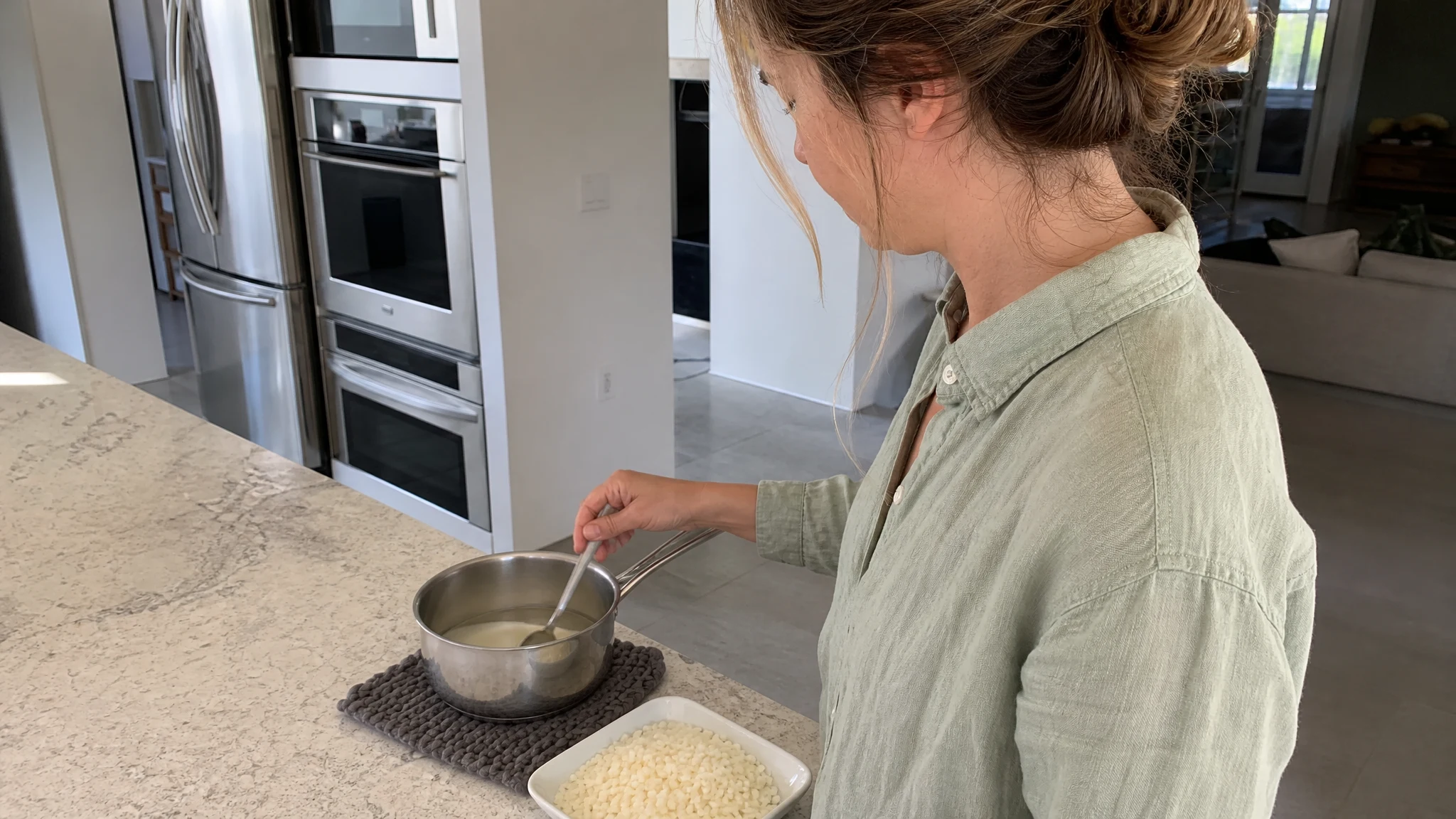
- Melt the coconut oil and shea together gently, just until clear.
- Stir in the liquid oil, then let the mixture cool at room temperature until it thickens and the edges begin to set. This is the step that matters. You want a soft, creamy solid, not a liquid.
- Whip with a mixer until it holds peaks. If it will not thicken, it is too warm, so chill it briefly. If it looks crumbly, it is too cold, so give it a few minutes on the counter.
- Spoon it into a clean, dry jar.
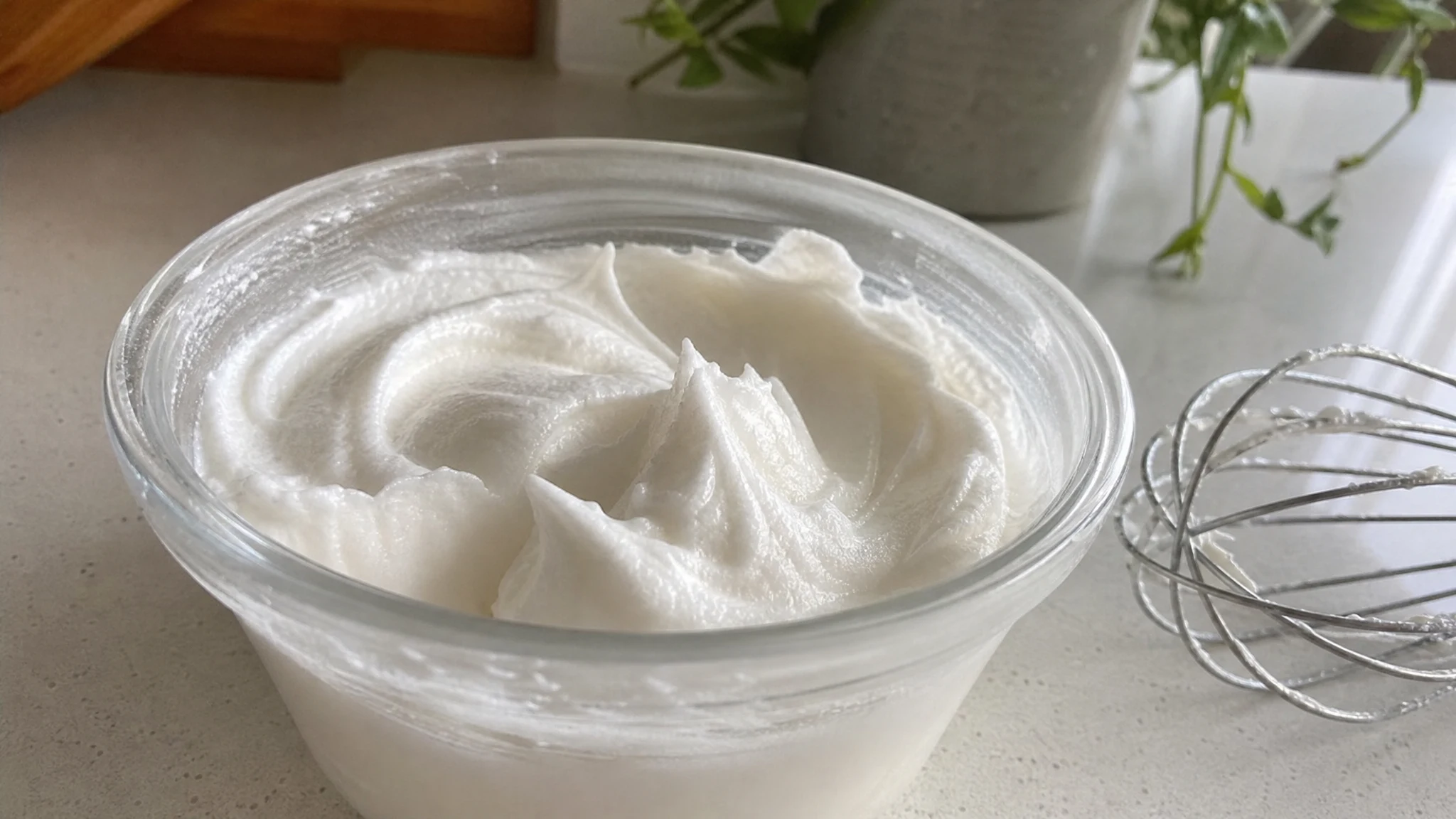
When the butter is ready it looks glossy and smooth and holds the shape of the beaters. A scoop should melt into a thin sheen on the back of your hand within seconds.
One note on texture: the firmer fats in shea can set on their own if a mixture cools very slowly, which would feel slightly grainy. If you notice that, melt everything again, cool it faster (the refrigerator works) and stir as it thickens.
Scaling, swapping and scenting
Double every weight for a 240 g batch, remembering that a bigger batch takes longer to cool. A shea-free version is possible in a cool kitchen, since virgin coconut oil near its melting point is itself a soft solid, but with no firmer fat to hold it up it will slump faster in warm weather. Leaving out the liquid oil makes the butter set firmer on the shelf.
If you would like to scent it, the Tisserand Institute lists 1 to 3% for body products, which on a 120 g batch means 1% is about 1.2 g of essential oil. We do not sell essential oils, so you would pick those separately. Plain virgin coconut oil already smells lovely on its own.
Keeping it fresh
This butter contains no water, which is part of why it does not need a preservative. What it does need is a dry life: a dry spoon each time, no wet fingers, and no spot in the shower steam. Keep the jar closed and cool. We give 18 to 24 months for our virgin oil kept tightly closed in a cool, dark place, but a homemade blend has no such figure of its own, so make amounts you will use within a few months and let the jar go if the smell changes. Our storage guide explains what to look for.
A few good things to know before gifting
A whipped butter is mostly a texture choice. For skin, one small trial compared virgin coconut oil with mineral oil on the legs of 34 people with dry skin for two weeks, and both improved hydration, with the authors calling coconut oil "as effective and safe as mineral oil" (Agero and Verallo-Rowell, 2004). That was plain oil, not a whipped butter with shea, so take it as encouraging background rather than a promise.
- Allergies. We suggest checking with a professional first if you have a coconut or tree nut allergy, and patching a small area for 24 hours. The FDA's allergen FAQ says coconut is no longer considered a major food allergen, though that concerns packaged-food labels and does not speak to skin.
- Eczema, psoriasis or broken skin. A dermatologist is the right guide. The American Academy of Dermatology's dry skin tips favor fragrance-free ointments and creams over lotions.
- Intimate use. The WHO, UNFPA and FHI 360 advisory note lists palm or coconut oil among household products not to use with latex condoms, so this is a body butter and nothing else.
- Fabric and flame. The NHS notes that clothing and bedding that have touched an emollient can easily catch fire, so keep it away from flames. Our stain guide helps with the laundry.
Once the jar is filled, the whipped shaving balm uses the same method for a different job, a sugar scrub makes a lovely companion, and virgin versus refined explains the choice of base.
Fractionated Coconut Oil
Fractionated Coconut Oil from our own shop, in sizes from 0.5 oz to bulk.
From $9.99
Shop Now →Sources & Further Reading
- Yang H et al., 2026. Synergistic effects of ultrasound and stirring on crystallization behavior of coconut oil. pmc.ncbi.nlm.nih.gov/PMC13277645
- Agero AL, Verallo-Rowell VM, 2004. A randomized double-blind controlled trial comparing extra virgin coconut oil with mineral oil as a moisturizer for mild to moderate xerosis. Dermatitis 15(3):109-16. pubmed/15724344
- U.S. FDA, 2026. Food allergen labeling guidance FAQ. fda.gov/food-allergen-FAQ
- American Academy of Dermatology, 2026. Dermatologists' top tips for relieving dry skin. aad.org
- WHO, UNFPA, FHI 360, 2012. Use and procurement of additional lubricants for male and female condoms. e-lactancia.org/Lubricants-WHO2012
- NHS, 2023. Emollients. nhs.uk/emollients
- Tisserand Institute, undated. Essential oil dilution. tisserandinstitute.org